Red earth and Malvazija around Brtonigla, grey hills and Muscat around Momjan. Two small villages near Buje that explain, in one day, why Istrian wine tastes the way it does.
The north-west corner of Istria, the area around Buje often called Bujština, is wine country. The land rolls gently from the coast at Umag and Novigrad up into higher hills towards the Slovenian border, and almost every slope has vines on it. Two villages in particular have become names that wine lovers recognise: Brtonigla, on the low plateau near the sea, and Momjan, on a ridge in the hills to the north. They are only a short drive apart, but they stand on very different ground, and you can taste the difference.
Why is north-west Istria so good for wine?
Istria is often described as having two main kinds of soil. Near the coast there is the famous red earth, terra rossa, on limestone: warm, well drained and iron-rich. Further inland and higher up there are grey and whitish soils on marl and flysch, which hold water differently and tend to give wines with more tension and freshness. North-west Istria has both, close together, along with sea breezes, sunny slopes and cooler nights in the hills. That combination is one reason so many respected Istrian winemakers work here.
If you want a primer on the grapes before you go, read our guide to Istrian wine grapes. In short: Malvazija istarska is the local white grape and the backbone of the region, Teran is the traditional red, and Muškat momjanski is the aromatic Muscat that takes its name from Momjan itself.
Brtonigla: Malvazija on red earth
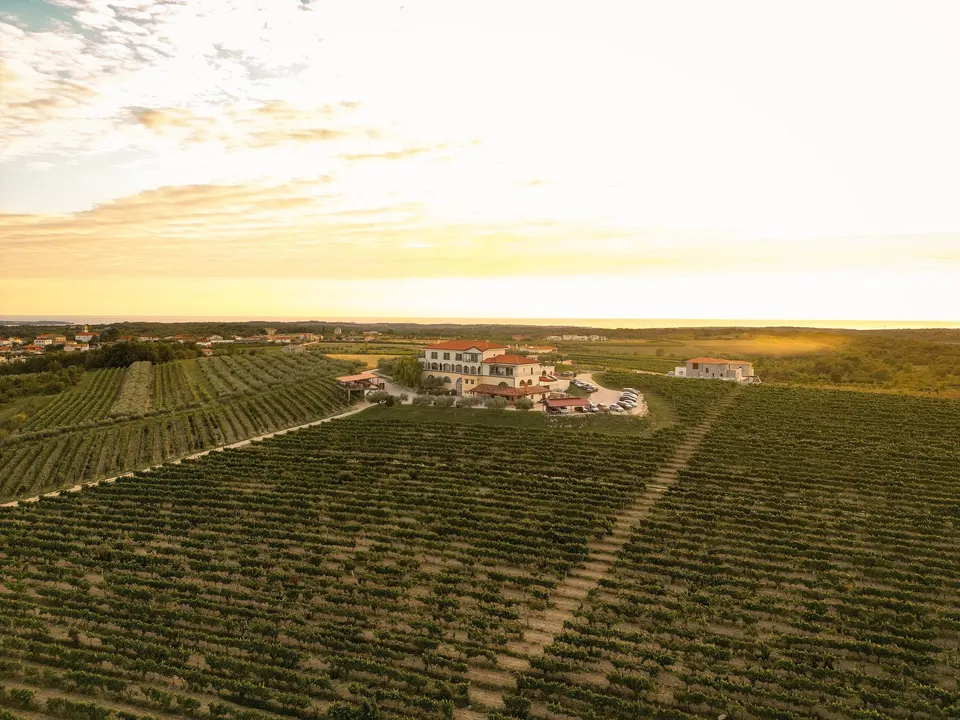
Brtonigla, Verteneglio in Italian, sits on a low rise a few kilometres inland from the coast between Umag and Novigrad. It is a small, unpretentious village of stone houses around a parish church, surrounded by vineyards and olive groves on red soil. The coast is close enough that on clear days you can see the sea from the edge of the village, and the breeze from the Adriatic helps keep the vines healthy in summer.
Brtonigla is best known for Malvazija. The white wines grown on this warm, red soil tend to be ripe and round, with notes of fruit, almond and herbs, and they go wonderfully with seafood and with the simple, olive-oil-based cooking of the coast. Several family wineries around the village and in the nearby hamlet of Nova Vas welcome visitors, usually by appointment.
The Mramornica cave
Just outside Brtonigla, near Nova Vas, is Mramornica, a show cave with stalactites, stalagmites and pale calcite formations that gave it its name, which means 'marble cave'. It is a good stop on a hot afternoon or a rainy day, and children usually love it. Opening depends on the season, so check locally before you go. For more caves across the peninsula, see our guide to Baredine and the caves of Istria.
Momjan: Muscat in the hills
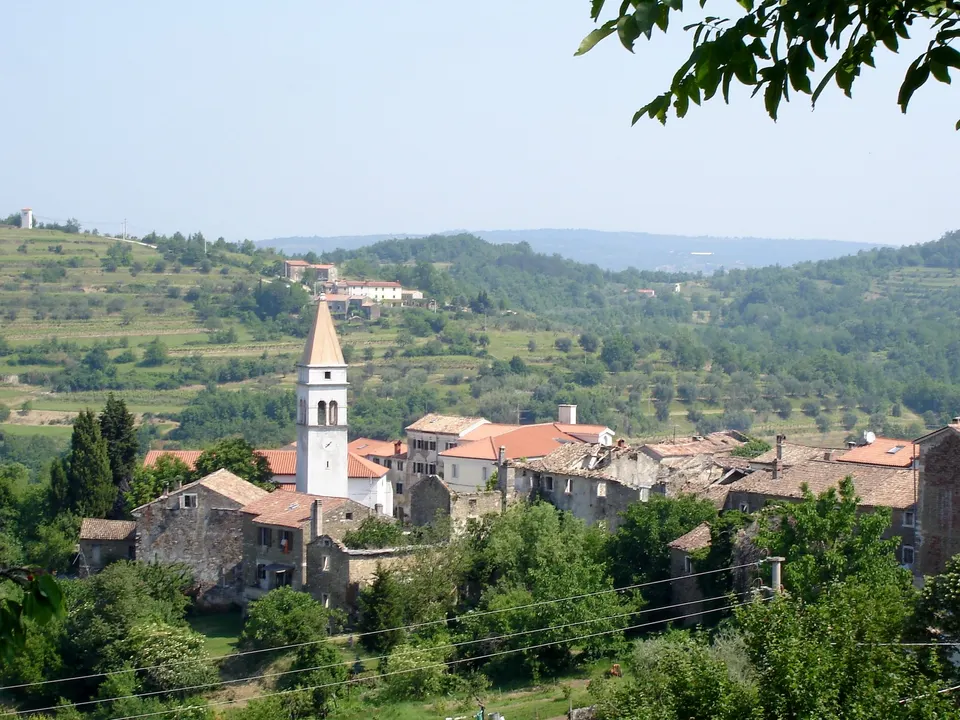
Momjan, Momiano in Italian, lies north-east of Buje, on a ridge high above a green valley close to the Slovenian border. The village is a cluster of stone houses and narrow lanes around its parish church, whose bell tower rises above the rooftops and can be seen from the vineyards all around. The landscape here is different from the coast: steeper hills, terraced slopes, woods in the valleys and the pale, grey soils typical of inland Istria.
Momjan is synonymous with Muškat momjanski, the Momjan Muscat. It is an aromatic white grape that can make dry wines, but it is especially loved in its sweet and semi-sweet forms, which are fragrant, golden and wonderful with desserts, cheese or on their own at the end of a meal. Many winemakers around Momjan also make excellent Malvazija and Teran, and a visit here is a chance to taste how the same grapes change in the hills.
The same grapes, a few kilometres apart, on very different ground.
The castle ruins
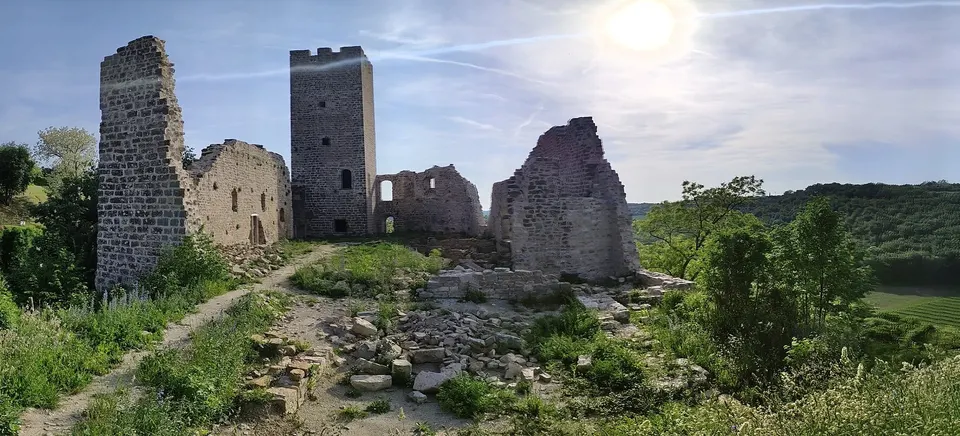
A short walk from the village, on a rock above the valley, stand the ruins of Momjan castle. Walls, towers and fragments of rooms remain, half-wrapped in vegetation, with wide views over the hills and vineyards. It is an atmospheric place at sunset and a reminder that this border area was once guarded closely by the families and powers that held it.
How to plan a wine day in Brtonigla and Momjan
The two villages make a natural pair. Start in the morning around Brtonigla, tasting Malvazija from the red soil, and perhaps visit the cave. Have lunch in a local konoba; our guide to the Istrian konoba explains what to expect. In the afternoon drive up through Buje to Momjan, taste the Muscat, walk out to the castle ruins and stay for the evening light over the hills.
- Book ahead. Most family wineries welcome visitors, but often by appointment. Call or write a day or two in advance.
- Designate a driver. The roads are narrow and winding, and tastings add up. Consider a local driver or a guided wine tour.
- Ask about the soil. Winemakers love explaining the difference between red earth and grey marl. It is the key to the region.
- Buy at the cellar. Many small producers sell bottles directly, including wines you will rarely find elsewhere.
- Pair it with food. Malvazija with fish and seafood, Teran with prosciutto and meat, sweet Muscat with desserts and cheese.
When to go
Late spring and early summer are lovely, with green vineyards and long evenings. September brings the harvest and a special energy to the villages. In November, St Martin's Day is celebrated across Istria as the moment when the new wine is blessed and tasted, and the wine villages are at their most convivial. Winter is quiet, but the cellars and konobas are cosy and the views from Momjan can be very clear.
Good to know
- Getting there. Brtonigla is a short drive from Novigrad and Umag; Momjan is reached via Buje. A car is the practical choice.
- Combine it. Add Umag and Savudrija for a swim, or the hill town of Grožnjan for art and views.
- Opening times. Wineries, the cave and village restaurants keep seasonal hours; check before you go.
- Border. Momjan is close to the Slovenian border; if you plan to cross, carry your documents.
Brtonigla and Momjan are not about grand monuments. They are about land, people and patience: vines planted on the right slope, cellars passed from one generation to the next, and wine poured by the person who made it. Many visitors leave with a few bottles in the boot and a new idea of what an Istrian house could feel like, with a table under a pergola and a glass of Malvazija at sunset.