Most of Istria is best seen from behind the wheel. How the motorway works, what to expect on country roads, and how to park near old towns without stress.
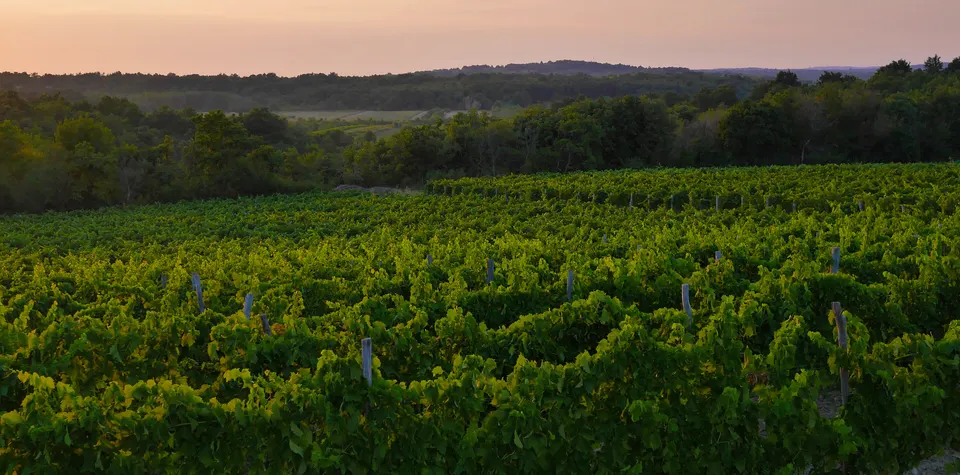
Istria is a peninsula of small distances. Most of its towns are less than an hour apart, and the interior is a patchwork of hill towns, vineyards and oak woods linked by quiet country roads. Buses connect the coast well, but the interior is hard to reach without a car, which is why most visitors drive, either in their own car or in one hired at an airport.
Driving here is generally relaxed. Roads are in good condition, signs are clear and often bilingual, in Croatian and Italian, and outside the summer peak there is little traffic. This guide covers what stays the same from year to year. Rules, toll prices and payment systems do change, so check the details with the Croatian Automobile Club (HAK) or your hire company before you set off.
What is the Istrian Y?
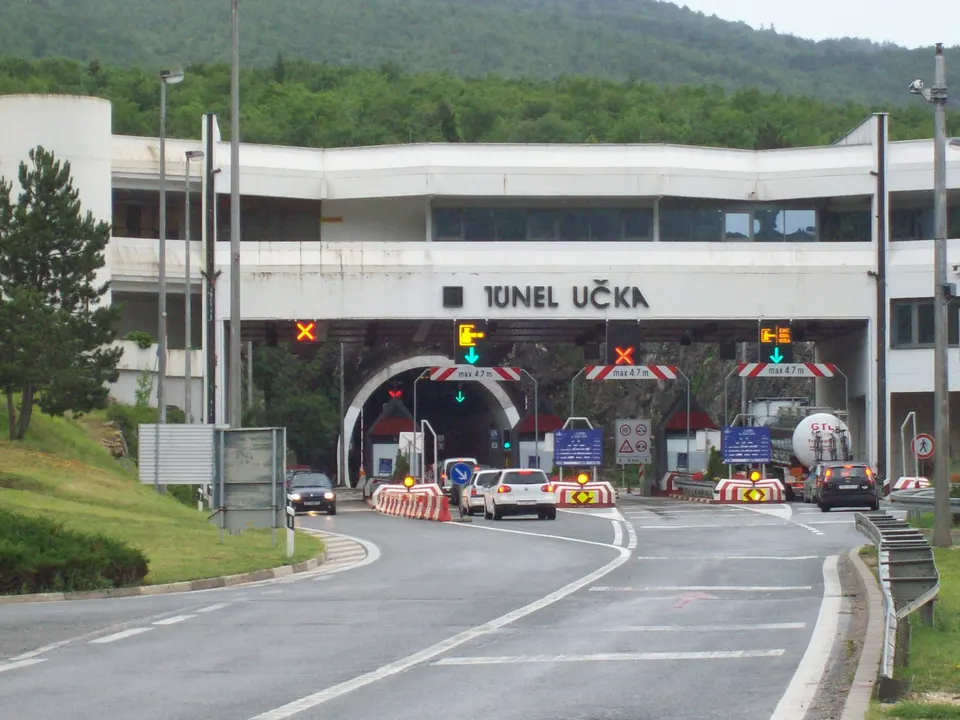
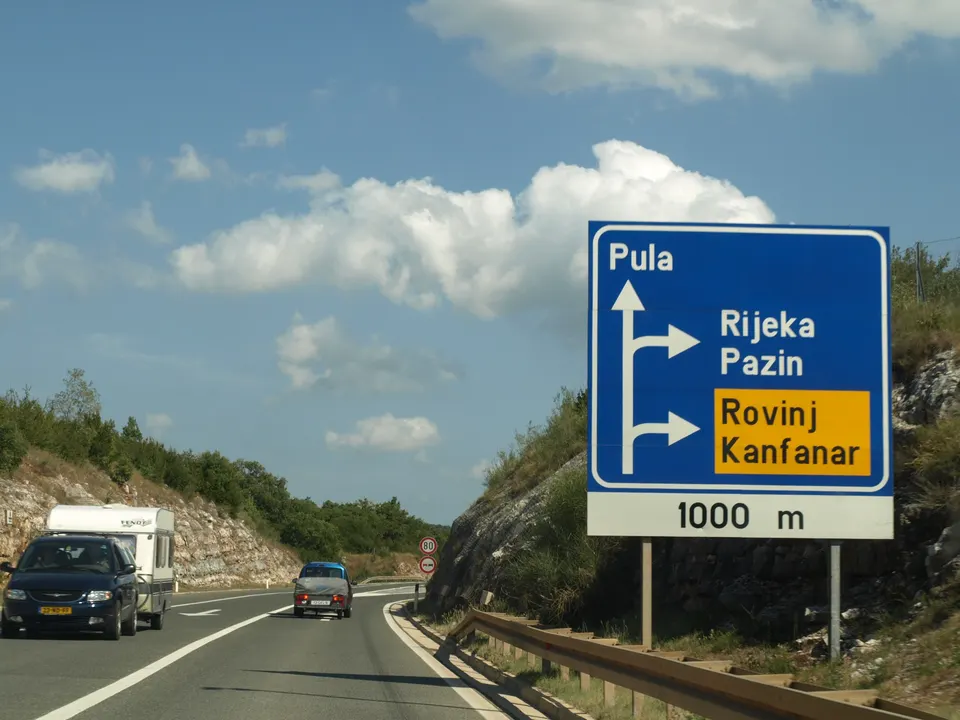
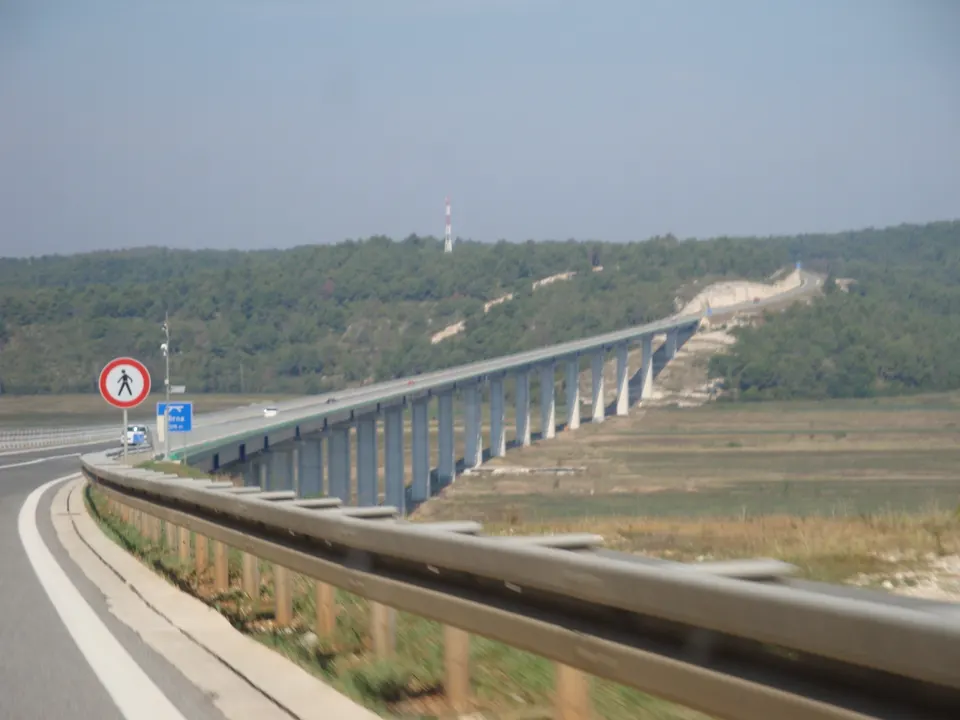
The backbone of the road network is a motorway shaped like the letter Y, which is exactly what locals call it: the Istrian Y, or Istarski ipsilon. One arm runs down the western side of the peninsula, from near Umag in the north to Pula in the south, with exits for Novigrad, Poreč, Rovinj and Vodnjan. The other arm leaves the western branch at the Kanfanar junction, in the middle of Istria, and runs east past Pazin to the Učka tunnel and on towards Rijeka.
On the western arm, the motorway crosses the Mirna valley on a long bridge and passes close to Lim Bay, where a viaduct carries it over the valley above the head of the inlet. If you are arriving from Slovenia or Italy, you will usually join it near Umag or Buje. If you are coming from Zagreb or Rijeka, you will enter Istria through the Učka tunnel. Our guide to getting to Istria covers the routes from Munich, Vienna, Ljubljana and Trieste.
How do tolls work in Istria?
Croatian motorways, including the Istrian Y, charge tolls by distance, and the Učka tunnel has a toll of its own. There are no vignettes in Croatia, unlike in neighbouring Slovenia and Austria, so if you drive through those countries you will need their vignettes as well. Croatia is introducing electronic, barrier-free tolling, and the way you pay is changing; check the current system and accepted payment methods before you travel, especially if you are driving a hire car.
You do not have to use the motorway at all. The old main roads still run alongside it, through villages and past farm shops, and they are often the more beautiful choice when you are not in a hurry.
Driving to the hill towns
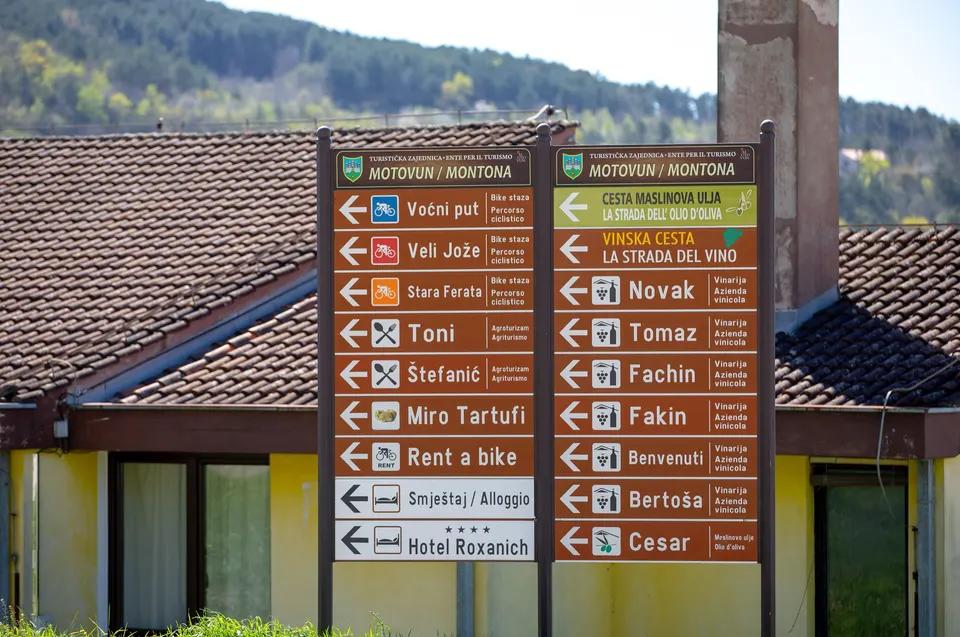
This is where Istria becomes a pleasure to drive, and where you need to slow down. The roads to Motovun, Grožnjan, Oprtalj, Hum and the other hill towns of Istria are narrow and winding, with blind bends, stone walls close to the tarmac and few places to overtake. You will share them with tractors, cyclists and the occasional delivery van that knows every curve by heart.
- Take your time. Distances look short on the map, but the bends make journeys slower than you expect. Plan for that rather than fight it.
- Watch for cyclists. Inland Istria is popular with road and gravel riders, especially in spring and autumn. Give them room on climbs and around corners.
- Use pull-ins. On single-track stretches, the driver closest to a wider spot usually waits.
- Do not drive into old towns. Most hill towns are closed to traffic inside the walls. Park below and walk up the last part.
- Mind the evening. Country roads are rarely lit, and wild animals, including deer and wild boar, cross them after dark.
Where to park in Rovinj, Poreč and the hill towns
Parking is the part of driving in Istria that causes the most stress, mainly in July and August. The old towns of Rovinj, Poreč and Novigrad are largely pedestrian, and car parks near their edges fill up early. In the hill towns, parking is usually a car park or a roadside area below the walls, sometimes with a steep walk up.
- Read the signs. Parking in towns is often divided into zones, with different rules and time limits. The signs and the ticket machines explain how each zone works.
- Know how to pay. Depending on the town, you can pay at a machine, at a kiosk, through an app or by text message from a Croatian mobile number. Carry some coins in case a machine does not take cards.
- Arrive early or late. In summer, the coastal car parks are easiest before mid-morning and after the beach crowds leave in the evening.
- Ask your host. If you are staying in an old town, ask in advance where guests park. Many places have an arrangement or a favourite car park nearby.
- Respect private land. A field or a driveway beside a hill-town road is almost always someone's property.
The distances look short on the map. The bends are what make the journey, and that is the point.
Fuel, charging and hire cars
Petrol stations are easy to find along the motorway and in the larger towns, but in the interior they are further apart, so fill up before a day in the hills. Charging points for electric cars are spreading across Istria, mostly in towns, at hotels and near the motorway; plan longer inland routes with a charging app.
If you hire a car in Italy or Slovenia, tell the company you will be driving to Croatia and check whether the insurance covers it. If you hire in Croatia, check how tolls are handled and whether the car is equipped for the current toll system. A small car is a real advantage on hill-town roads and in tight car parks.
Good to know before you drive
- Documents. Carry your driving licence, the vehicle documents and your passport or ID card. Croatia joined the Schengen area in 2023, so there are no routine border checks with Slovenia, but checks can still happen.
- Equipment and seasonal rules. Croatian rules require certain equipment in the car and set seasonal requirements, for example on daytime headlights and winter equipment. The details change; check them with HAK or your hire company.
- Speed limits. Limits are signposted and enforced, and they change often on country roads, through villages and near schools. Follow the signs rather than your instinct.
- Alcohol. The safest rule is simple: if you are going to a wine tasting, someone else drives. See our guide to the wines of Istria for the tasting itself.
- Summer Saturdays. Many holiday rentals change over on Saturdays, and the motorway, border crossings and the Učka tunnel are at their busiest. Travel midweek if you can.
- Emergencies. The European emergency number 112 works in Croatia. HAK runs a roadside assistance service; save its contact details before you set off.
- Traffic news. HAK publishes current road conditions, roadworks and closures, which is worth checking before a long drive.
A first drive worth doing
If you want one route that shows why driving in Istria is worthwhile, leave the coast behind, follow the road up the Mirna valley towards Motovun, then climb on to Oprtalj and Grožnjan. In an hour or two you will pass river meadows, oak forest, vineyards and three walled towns, each with a view of the last. Our three-day itinerary builds a longer trip around routes like this one.