A former island crowned by a Venetian bell tower, a working fishing harbour and a pine forest by the sea. How to see Rovinj well, at any time of year.
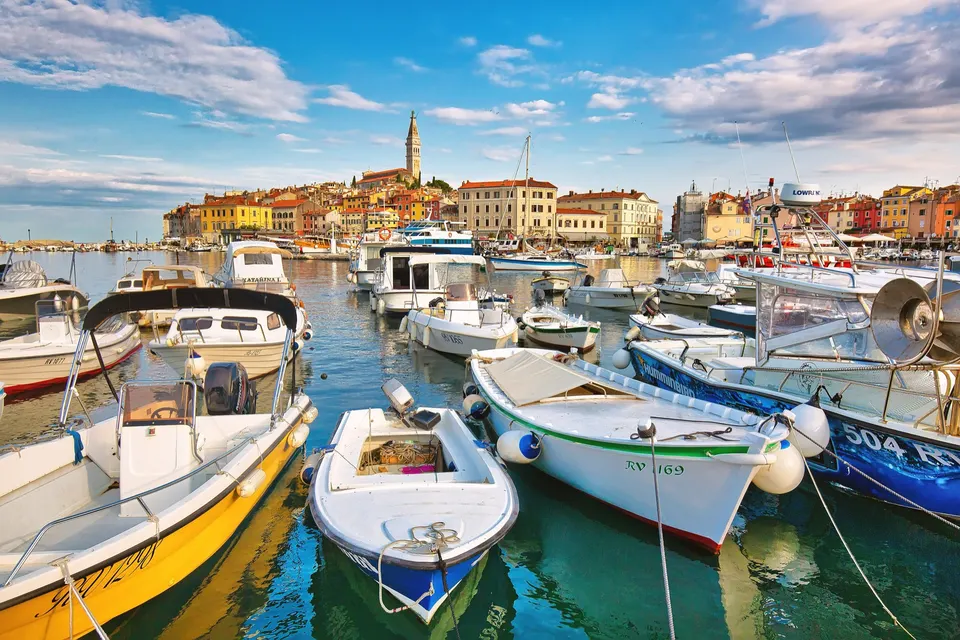
Few towns on the Adriatic are as instantly recognisable as Rovinj. The old town sits on a rounded hill above the sea, its houses stacked shoulder to shoulder down to the water, and at the very top the tall bell tower of St Euphemia stands like a pin holding the whole picture together. It is the most photographed town in Istria, and for once the photographs do not exaggerate.
Rovinj is also bilingual. Its Italian name, Rovigno, appears on street signs alongside the Croatian, and the town still has an active Italian community. That double identity, Venetian in its architecture and Croatian in its daily life, is part of what makes it feel so different from the resorts further along the coast.
Why is Rovinj's old town shaped like that?
Because it was once an island. A narrow channel separated the town from the mainland until it was filled in during the eighteenth century, and the old town still behaves like an island: compact, walled by the sea on three sides, with streets that climb in rings towards the summit. For centuries it was part of the Venetian Republic, and the lion of St Mark still appears on gates and facades.
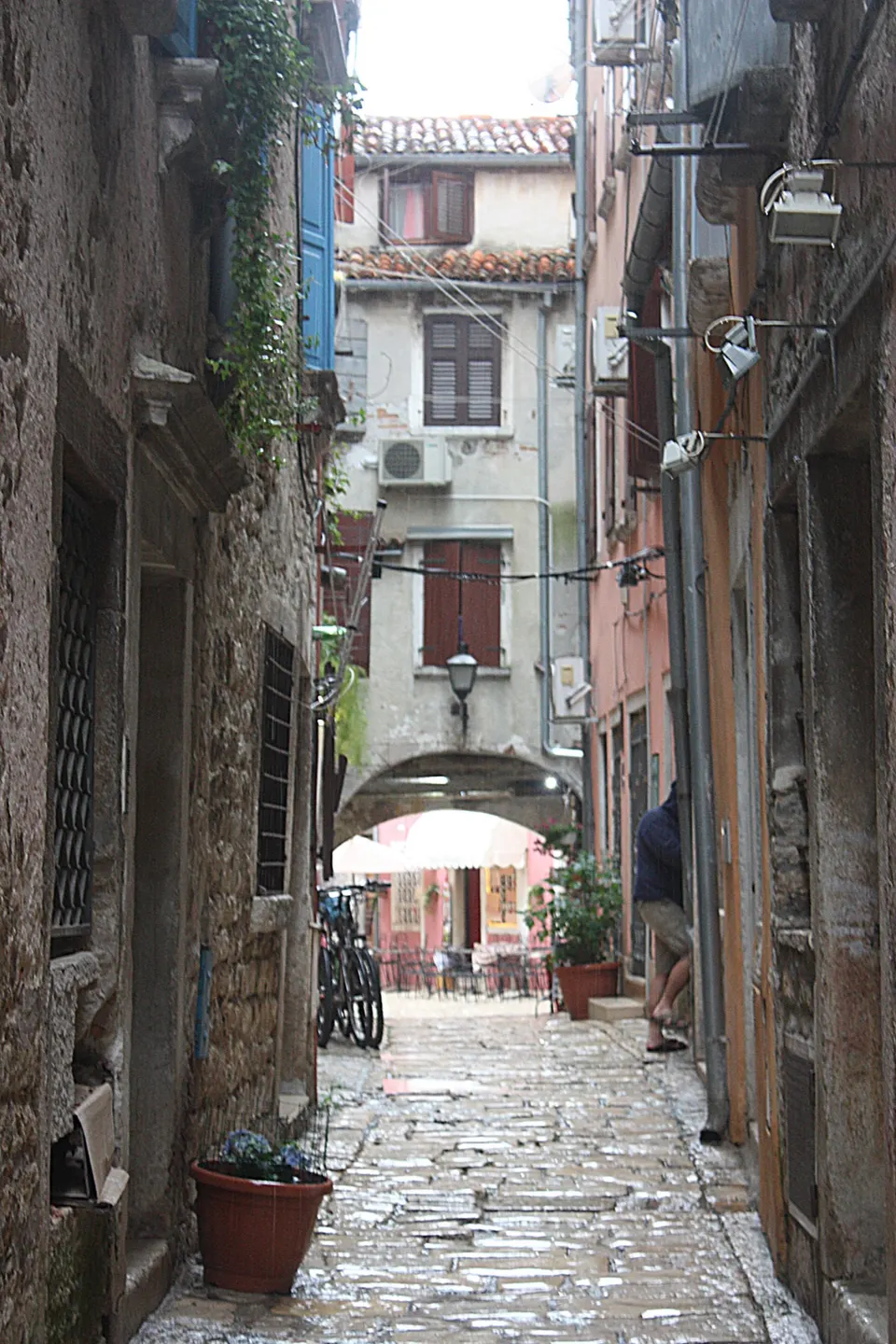
The best way in is through the Balbi Arch, a baroque gateway built on the site of an older town gate, which leads from the main square into the lanes. From there, simply walk uphill. The streets are paved with smooth, polished stone, so wear shoes with some grip, especially after rain.
The Church of St Euphemia
At the top of the hill stands the Church of St Euphemia, a large baroque church completed in the first half of the eighteenth century. Its bell tower, modelled on the campanile of St Mark's in Venice, is the tallest in Istria and is topped by a copper statue of the saint that turns with the wind, acting as a giant weathervane. Locals say they can read the weather from the way she faces.
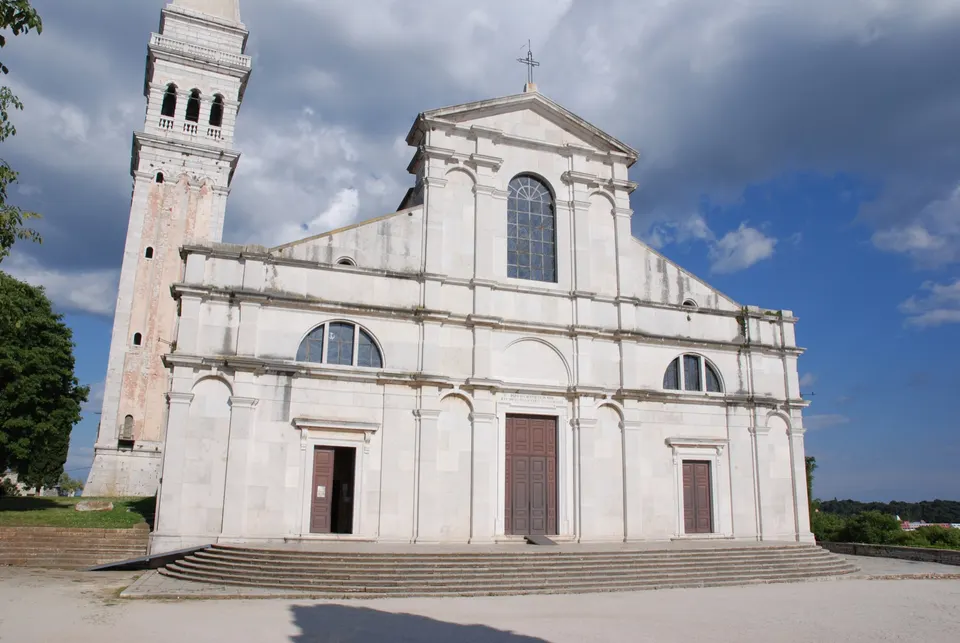
Inside, a stone sarcophagus holds the relics of St Euphemia, an early Christian martyr. According to local legend, the sarcophagus arrived by sea, washed up on the shore below the hill, and only a small boy with two calves could pull it up to the church. Whatever you believe, the story explains the devotion the town still feels for her. Outside, the churchyard opens onto a terrace with wide views over the sea and the islands, one of the best free viewpoints on the coast.
The old town still behaves like an island: compact, ringed by the sea, its streets climbing towards the summit.
Grisia, the lanes and the harbour
Grisia, the steep street that leads up towards the church, is lined with small galleries and studios and is the town's artistic spine. But the real pleasure of Rovinj is getting slightly lost. Take the side lanes, look for the narrow openings between houses where the sea suddenly appears, and notice the tall, thin houses with their external chimneys, a sign of how tightly the old town was packed.
Down at the waterfront, the harbour is still a working one. Fishing boats tie up beside excursion boats, and early in the morning you can watch the catch being unloaded. The traditional wooden boat of Rovinj is the batana, a flat-bottomed fishing boat; the town's Ecomuseum Batana, which keeps this boatbuilding and fishing culture alive, has been recognised by UNESCO as an example of good practice in safeguarding intangible heritage. If you hear a group singing in close, unaccompanied harmony in a tavern, that is likely to be bitinada, the old local singing style.
What to see beyond the old town
- Golden Cape (Zlatni rt). A forest park south of the town, planted in the late nineteenth century, with shaded paths, rocky coves and clear water. Ideal for a walk or a swim. More in our guide to Rovinj beaches and the Golden Cape.
- The islands. The Rovinj archipelago is made up of around twenty islands and islets. The closest, St Catherine and Red Island, are reached by regular boats from the harbour in season.
- Lim Bay. A long, fjord-like inlet just north of Rovinj, known for its oysters and mussels and for boat trips between steep, wooded sides. See our guide to Lim Bay.
- The market. The morning market near the Valdibora side of the harbour sells seasonal fruit, vegetables, olive oil, cheese and, in its fish hall, the night's catch.
When is the best time to visit Rovinj?
July and August are lively, warm and busy, with the old town crowded in the evenings. If you can choose, come in late May, June or September. The sea is warm enough to swim, the light is softer and the lanes are easier to enjoy. Autumn and spring are quiet and beautiful for walking, and winter shows the town at its most local, although many restaurants and shops close for part of the season.
How to get to Rovinj
- By air. The nearest airport is Pula, in the south of the peninsula, under an hour's drive away. Trieste, Rijeka and Ljubljana are other options for travellers coming by road.
- By car. The old town is closed to traffic. Use the public car parks on the edge of the centre and walk in.
- By bus. Rovinj has a bus station close to the centre, with connections to Pula, Poreč and the rest of Istria.
- By sea. In summer, seasonal passenger boats link Rovinj with Venice. Check the current timetable before planning around them.
Good to know
- The old town is steep and paved with slippery stone. Comfortable shoes matter more than you think.
- Sunset is the town's main event. Find a spot on the rocks below the church or along the western waterfront early.
- Dress modestly to enter the church, and avoid visiting during Mass.
- Combine Rovinj with nearby inland towns such as Bale or Svetvinčenat for a quieter afternoon, or with a day in Pula.
Rovinj rewards slow days. Walk the lanes in the morning, swim in the Golden Cape at noon, and come back to the harbour as the light turns gold on the facades. Many people who first come for a weekend end up returning every year, and some end up staying. If that is where you are heading, a house near Rovinj deserves the same care as the town itself.