For five centuries the Republic of Venice ruled the Istrian coast. Its lions, loggias, bell towers and Gothic windows still define Rovinj, Poreč, Novigrad and Pula.
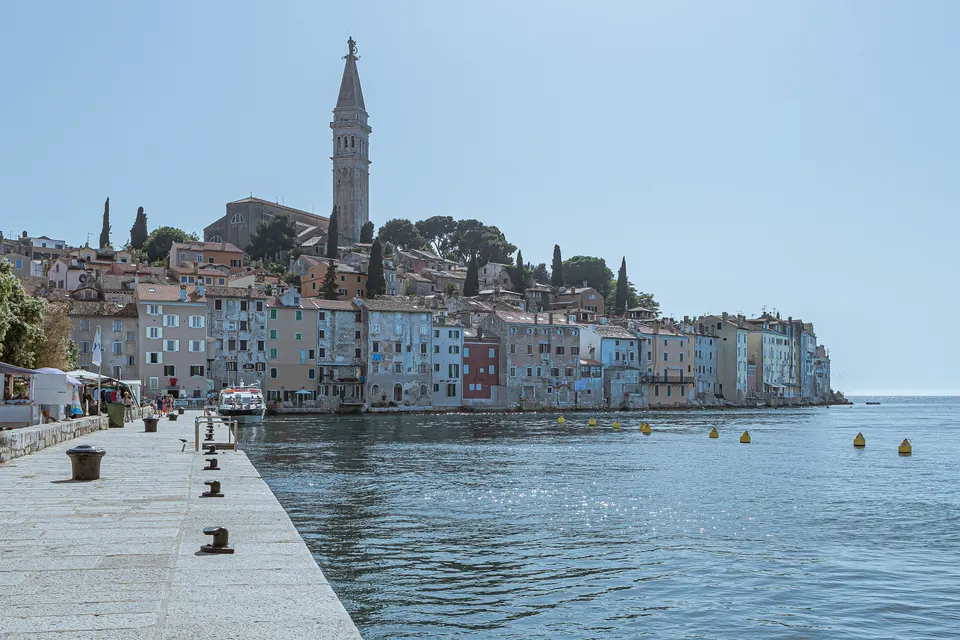
Stand on the waterfront in Rovinj and look up at the bell tower of St Euphemia, and you could almost be in Venice. That is no accident. From the thirteenth century until 1797, most of the Istrian coast belonged to the Republic of Venice, and the Serenissima left its mark on almost every town: in the shape of the streets, the style of the houses, the stone lions over the gates and even the dialect people still speak. Once you learn to read these signs, a walk through any coastal town becomes a lesson in history.
When did Venice rule Istria?
Venice had trading interests on the Istrian coast from early on, but formal rule came town by town in the second half of the thirteenth century, when Poreč, Novigrad, Rovinj and others submitted to the Republic one after another. Pula followed in the fourteenth century. The interior was a different story: the County of Pazin and much of central Istria belonged to the Habsburgs, and for centuries a border ran across the peninsula. That is why the coast feels Venetian and parts of the interior feel quite different.
Venetian rule ended in 1797, when Napoleon brought down the Republic. Istria then passed through Austrian, French and again Austrian hands, but the Venetian imprint on its towns was already set in stone.
The lion of St Mark
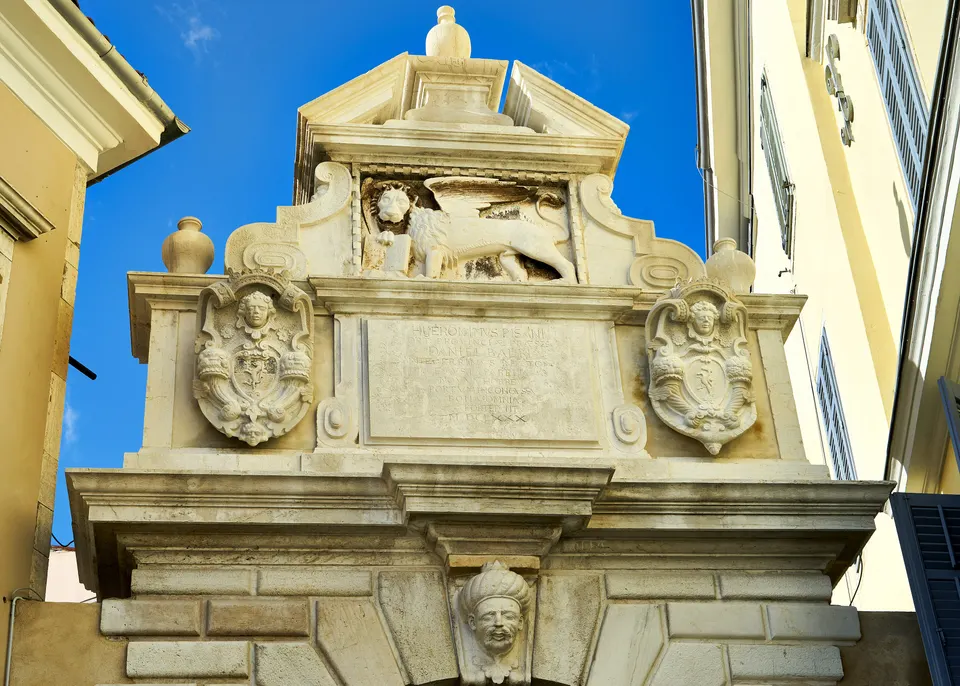
The winged lion, symbol of St Mark the Evangelist and of Venice itself, is the easiest Venetian sign to spot. It appears in stone reliefs over town gates, on loggias, palaces and bell towers, usually with a book under one paw. A popular story says that an open book meant peace and a closed book war, although historians are cautious about reading too much into it. Look for lions above the town gate of Motovun, on Balbi's Arch in Rovinj and on public buildings in many other towns.
Loggias, fonticus and the town square
Every Venetian town had a loggia, an open, arcaded hall on the main square where justice was administered, announcements were read and townspeople met. Many survive. The loggia of Grožnjan, beside the old fonticus, the communal grain store, is one of the most charming. Novigrad's loggia sits on the town walls facing the sea, and Motovun, Buje and Bale each have their own.
The fonticus is a typically Venetian institution: a public warehouse where grain was stored to protect the town from famine and price swings. Its presence tells you that a town was organised, governed and supplied in the Venetian manner.
Once you learn to read the stone, every coastal town becomes a lesson in history.
Rovinj: a Venetian town on the sea
Rovinj is the most Venetian-looking town in Istria. Its tall, narrow houses press together on what was once an island, their windows and balconies opening straight onto the water. The bell tower of St Euphemia was modelled on the campanile of St Mark's in Venice, and the baroque church beside it dates from the eighteenth century. Balbi's Arch, built in the seventeenth century on the site of an old town gate, carries the lion of St Mark and the coats of arms of the Venetian family who paid for it. For the rest of the town, see our Rovinj travel guide.
Poreč, Novigrad and Pula
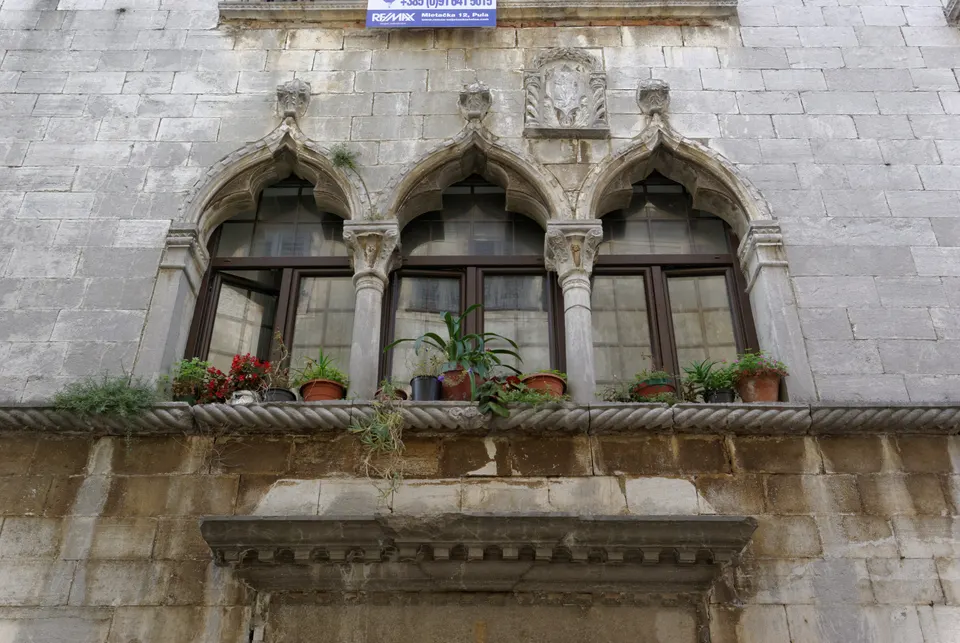
In Poreč, the Roman street plan survived under Venetian rule, and the Decumanus is lined with houses from that period. Look for the Venetian Gothic windows, with their pointed arches and slender columns, and for the carved balconies on the fifteenth-century houses along the street. Our guide to Poreč and the Euphrasian Basilica has more.
Novigrad still has a good part of its town walls, with the loggia and the sea right below. In Pula, the star-shaped fortress on the hill above the old town, the Kaštel, was built by the Venetians in the seventeenth century to defend the harbour, and today houses the Historical and Maritime Museum of Istria.
Wood, stone and glass
Venice did not only govern Istria; it depended on it. White Istrian limestone, quarried along the coast, was shipped across the Adriatic and used in many of Venice's palaces, churches and bridges, because it resists salt water and weather. The oak forests of the Mirna valley around Motovun were protected by the Republic, and their timber was used for the ships of the Venetian Arsenal. Through these exchanges, Istria and Venice shared building traditions for centuries.
Glass followed the same routes. Murano glass, made on the island in the Venetian lagoon, has been part of Istrian interiors for generations, and it still feels at home in these stone houses. If you are curious, our guide to Murano glass lighting explains what it is and how to live with it.
How to spot Venetian Istria
- The lion. A winged lion with a book, over gates, loggias and public buildings.
- The bell tower. Tall, square, often with a pointed spire, set apart from the church in the Venetian way.
- The loggia. An open, arcaded hall on the main square.
- Gothic windows. Pointed arches, twisted columns and carved stone balconies.
- Chimneys. Tall, often flared chimneys on old town houses, a familiar sight in Venetian towns.
- The language. Listen for Istro-Venetian dialect and look for bilingual Croatian and Italian street signs along the west coast.
A living heritage
What makes Venetian Istria special is that it is not a museum. People still live in these tall houses, hang their washing between them, and drink their coffee in the shade of the loggia. The Italian community remains part of everyday life along the coast, and the dialect, the food and the way towns gather on the main square in the evening all carry something of the old Republic. Read the stone, and the towns start to talk.