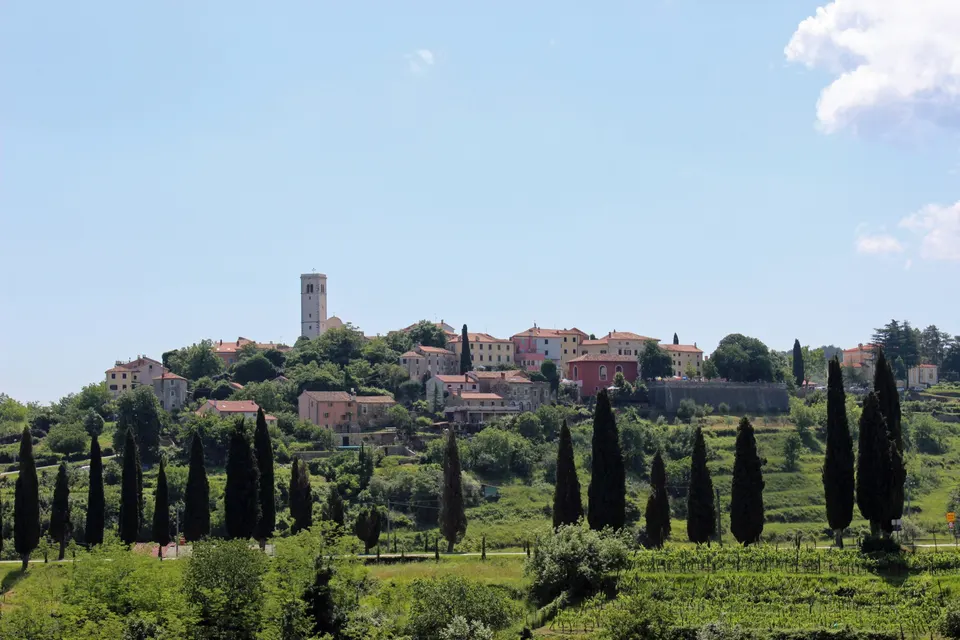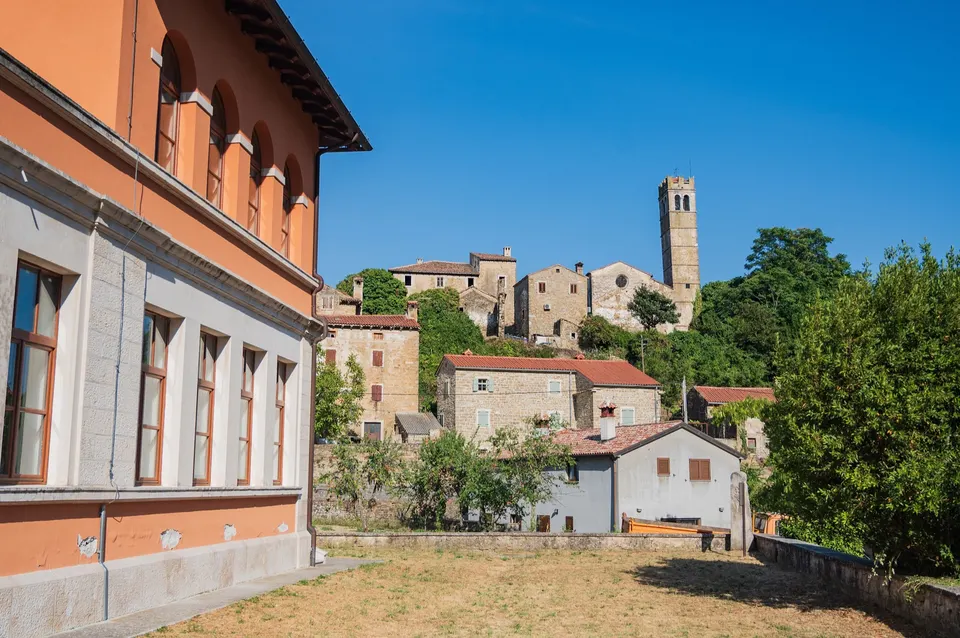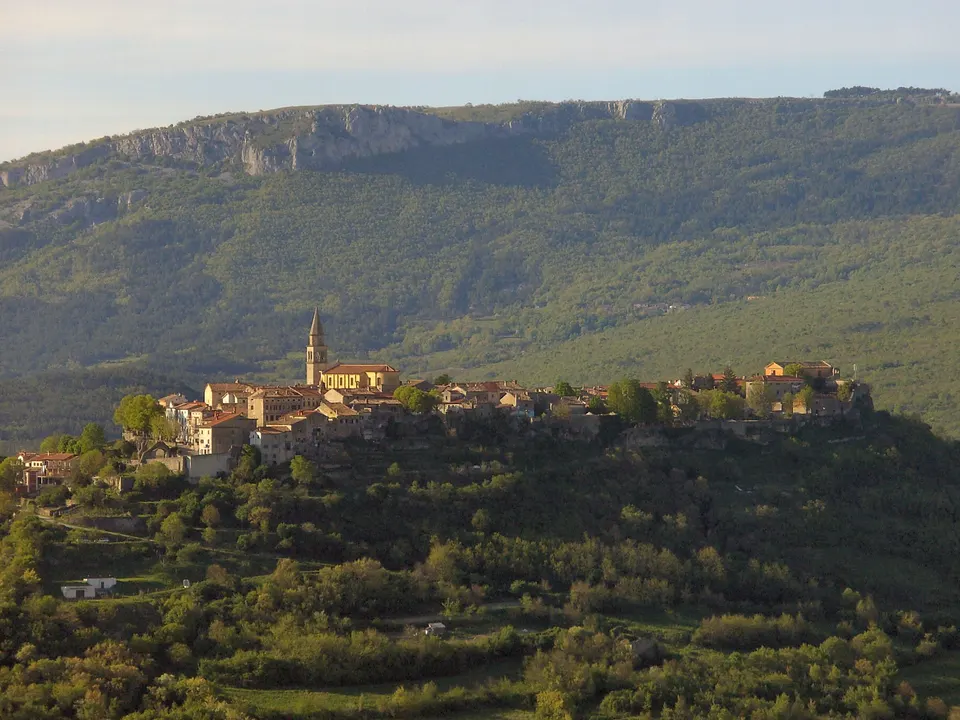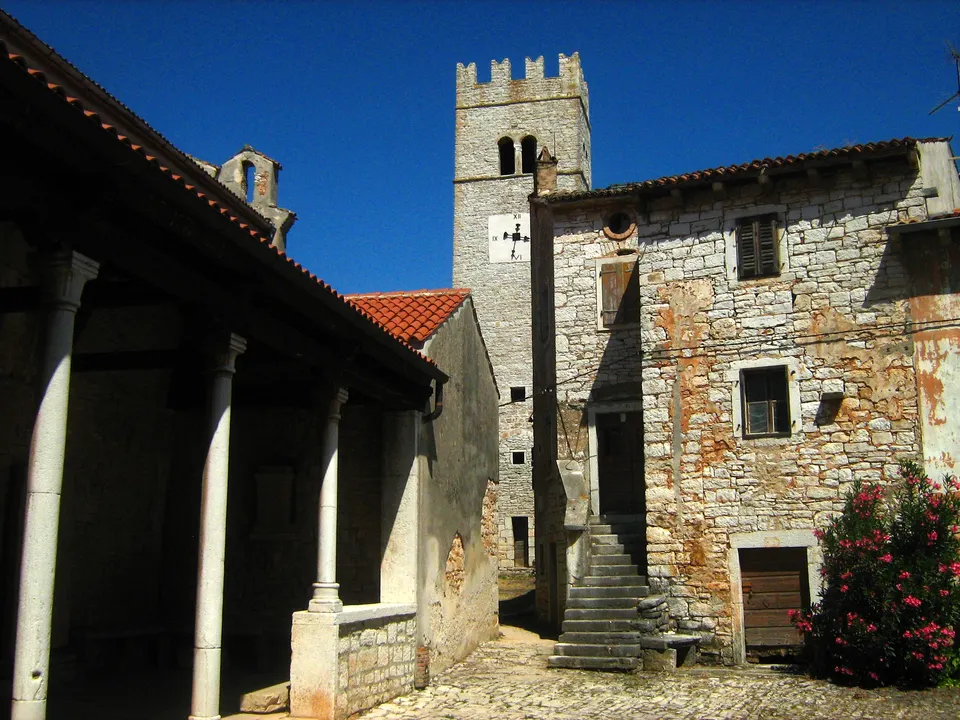
A ring of old walls, a Romanesque church with three apses, a loggia and the lion of St Mark over the gate. One of the best-preserved small fortified towns in Istria, and almost nobody hurries.
Drive inland from Poreč or Vrsar towards Pazin and the landscape changes quickly: fewer villas, more oak woods, fields of red earth and, every so often, a stone village on a low hill. Sveti Lovreč is one of these, and at first sight it looks like many others. Then you walk through the gate and realise you are inside one of the most complete medieval fortified villages in Istria, with its walls, church, loggia and squares still in place and still lived in.
Where is Sveti Lovreč?
Sveti Lovreč, San Lorenzo in Italian, lies in western Istria, a short drive inland from Poreč and Vrsar and not far from the head of Lim Bay. It sits on a gentle rise above the surrounding fields, on the old route between the coast and the centre of the peninsula. Its full name, Sveti Lovreč Pazenatički, distinguishes it from other places named after St Lawrence and recalls its special role in Venetian times.
Why is it called Pazenatički?
For a period in the late Middle Ages, Sveti Lovreč was the seat of the Venetian official responsible for the defence and administration of the Istrian countryside, a territory known as the paisanatico. That is where the second part of the name comes from. The village was strengthened accordingly, with walls, towers and gates, and it became one of the key fortified points of Venetian Istria before the seat was moved further inland.
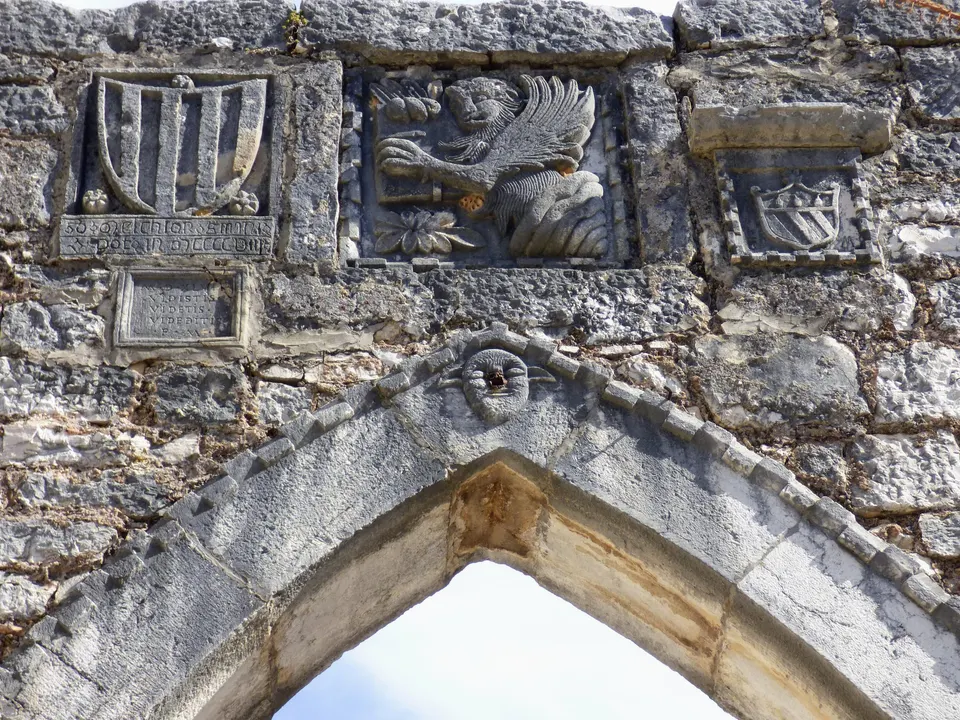
You can still read that history in the stone. Above one of the old gates, coats of arms of Venetian officials are set into the wall beside a winged lion of St Mark, the symbol of the Venetian Republic, which appears on gates and public buildings all over Istria. Our guide to Venetian heritage in Istria explains how to recognise these details elsewhere.
The walls and the layout of the village
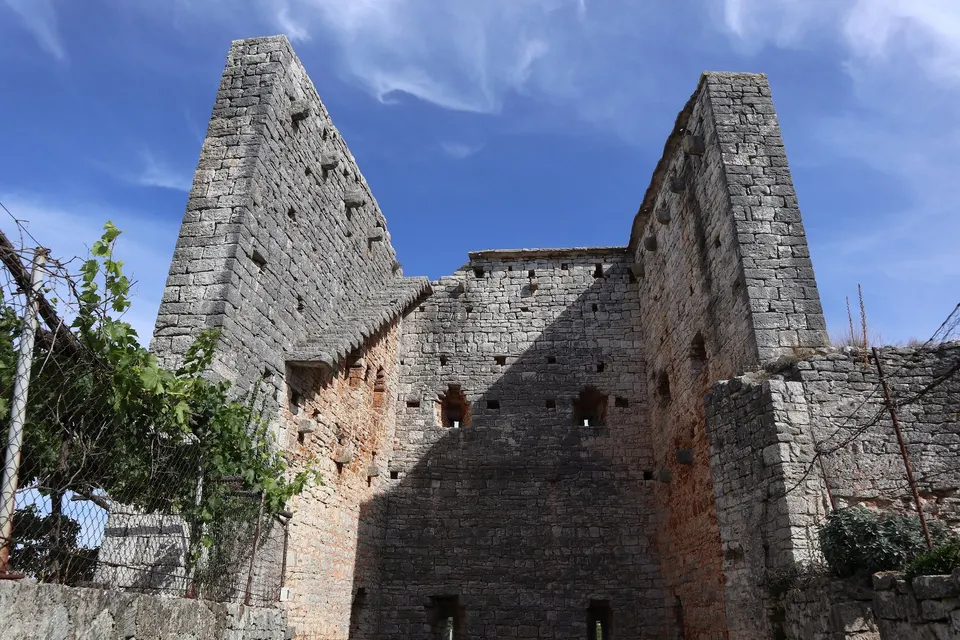
The old village is enclosed by a ring of walls, and many of the houses are built directly into them, so from outside the village looks like a single stone fortress. Inside, the streets follow the curve of the walls, with a main axis leading to the central square. Some sections of the walls and towers survive to a good height; elsewhere they have become the backs of houses, gardens and courtyards. Walking a full circle around the inside and outside of the walls takes very little time and is the best way to understand how the place was built.
The church of St Martin
The great treasure of Sveti Lovreč is the parish church of St Martin, one of the most important early Romanesque churches in Istria. It is a basilica with three naves and three semicircular apses, built around the eleventh century, and its simple, solid architecture has survived remarkably well. Inside, fragments of medieval wall paintings have been preserved. Even if the church is closed, walk around to the back to see the apses, whose rounded forms and small windows are typical of the early Romanesque style.
A village that looks from the outside like a single stone fortress.
The loggia and the square
Next to the church stands the loggia, an open, roofed hall supported by stone columns, where public announcements were read, justice was dispensed and people met to trade and talk. Loggias like this are found in many Istrian towns, but the one in Sveti Lovreč, set beside the church in a small square of old stone houses, is especially charming. In summer it is a shady place to sit, and the square around it still feels like the living room of the village.
Look up as you walk: Gothic and Renaissance window frames, carved stones reused in later walls, outside staircases and small balconies. Sveti Lovreč has no great palaces, but almost every house has something worth noticing.
What to see nearby
- Lim Bay. The long, fjord-like inlet is a short drive away; see our guide to Lim Bay.
- Dvigrad. The haunting ruins of an abandoned medieval town in the woods near Kanfanar; read about Dvigrad.
- Poreč. The UNESCO-listed Euphrasian Basilica is less than half an hour away.
- Pazin. Continue inland to Pazin castle and the abyss in the centre of the peninsula.
- Vrsar. Back on the coast, Vrsar and Funtana are ideal for a late-afternoon swim.
Good to know
- Getting there. Sveti Lovreč is easiest to reach by car from Poreč, Vrsar or the Istrian Y motorway.
- Parking. Park outside the walls and walk in; the village is small and the lanes are narrow.
- Time needed. An hour is enough to see the essentials; stay longer for a coffee or lunch and a slow walk around the walls.
- The church. Access to St Martin depends on the season and on services; check locally if seeing the interior matters to you.
- Best light. Late afternoon, when the stone turns warm and the square fills with shade.
- Footwear. Old paving can be uneven and slippery; wear comfortable shoes.
Why Sveti Lovreč is worth the detour
Sveti Lovreč is small enough to understand in an hour and old enough to keep you looking for much longer. It shows how a whole community could be shaped by walls, a church and a square, and how those same elements still make a place feel calm and protected today. It is the kind of village that makes people wonder about living in a stone house in the Istrian interior, with thick walls, small windows and long, quiet evenings. If that thought appeals, the Lampisa atelier works with exactly these kinds of houses.