A hill town that calls itself the City of Truffles, a tiny walled village that guards the memory of the Glagolitic script, and a road of stone monuments between them. A guide to the green north of inland Istria.
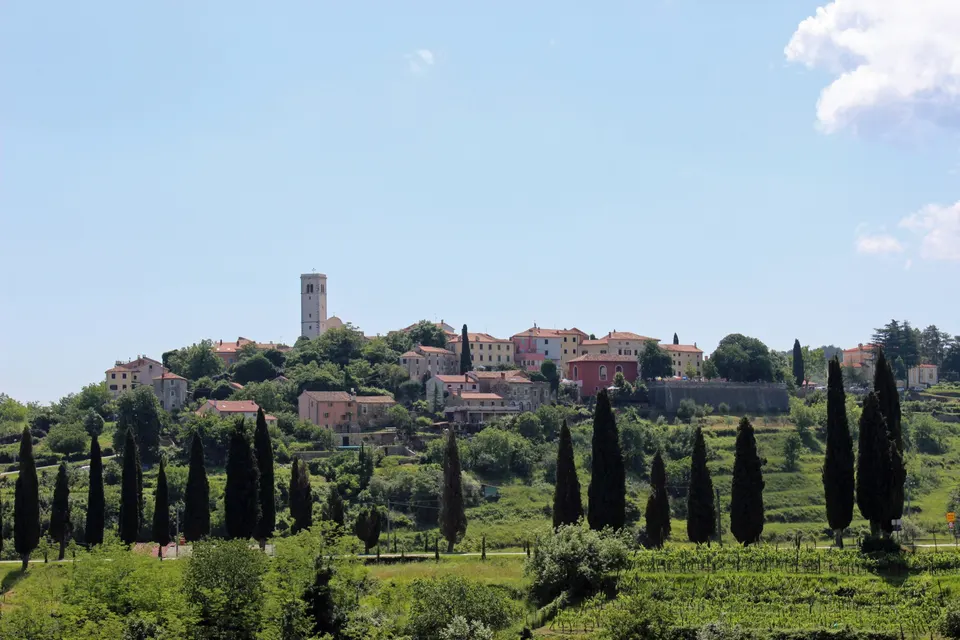
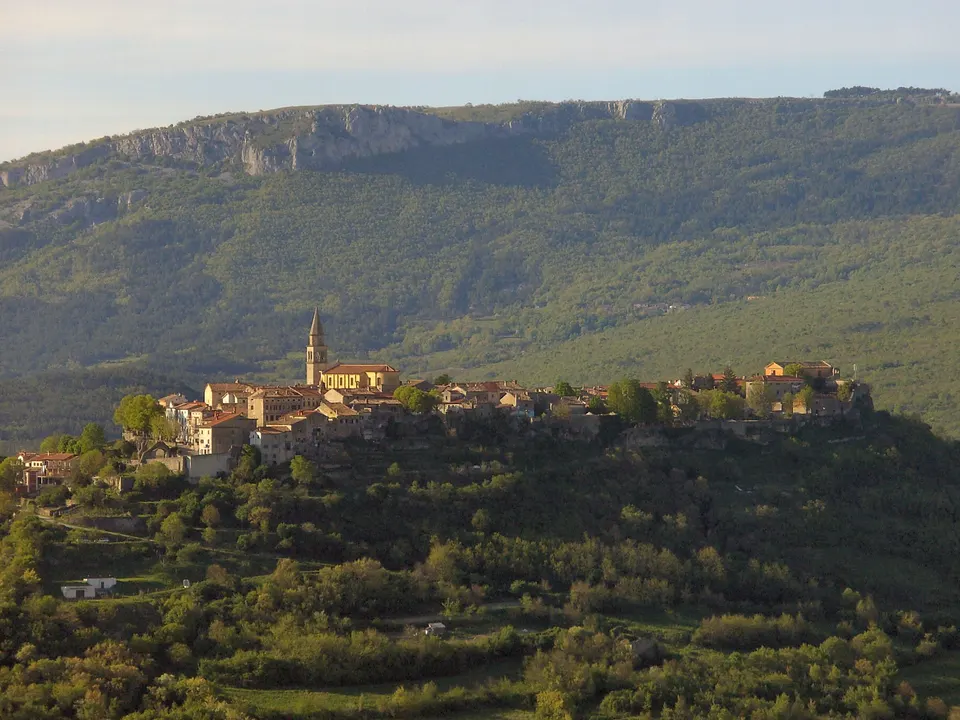
Inland Istria changes as you head north. The hills grow steeper and greener, the limestone ridge of Ćićarija rises along the horizon, and the Mirna river runs through a valley of meadows and oak forest. This is truffle country, and its capital is Buzet, a small town on a hill above the valley. A short drive away lies Roč, one of the smallest and most atmospheric walled villages in Istria, and the starting point of a road lined with stone monuments to the Glagolitic script.
What to see in Buzet
Buzet (in Italian, Pinguente) has two faces. The modern town spreads along the valley floor, practical and lived-in. The old town sits on the hill above it, enclosed by walls and gates from the Venetian period, and it is here that you should spend your time. Its quiet streets lead between stone houses with carved doorways, small squares and churches, and at the top there are wide views over the Mirna valley and the ridge beyond.
- The old town gates. Enter on foot through one of the historic gates and climb into the walled core.
- The baroque cistern. A carved stone well-head on one of the old town squares, a reminder of how hill towns collected their water.
- The local museum. Housed in an old palace in the upper town, with collections on the history and traditions of the Buzet area.
- The walls and viewpoints. Walk the edge of the old town for views across the valley to the forests where truffles are found.
Why is Buzet called the City of Truffles?
The damp oak forests of the Mirna valley and its side streams are some of the best truffle grounds in Europe. Black truffles are found through much of the year, and the prized white truffle appears in autumn. Buzet has built its identity on this: local producers sell truffles and truffle products, restaurants serve them with homemade pasta, eggs and steak, and the season brings visitors from far beyond Istria. Read more in our guide to the truffle season in Istria.
The town's best-known celebration is Subotina, held every September, when a giant truffle omelette is cooked in an enormous pan on the main square and shared among the crowd. It marks the start of the white truffle season and is one of the liveliest days of the year in northern Istria.
In Buzet, autumn smells of woodsmoke, wet leaves and truffles.
Roč: a walled village of the Glagolitic script
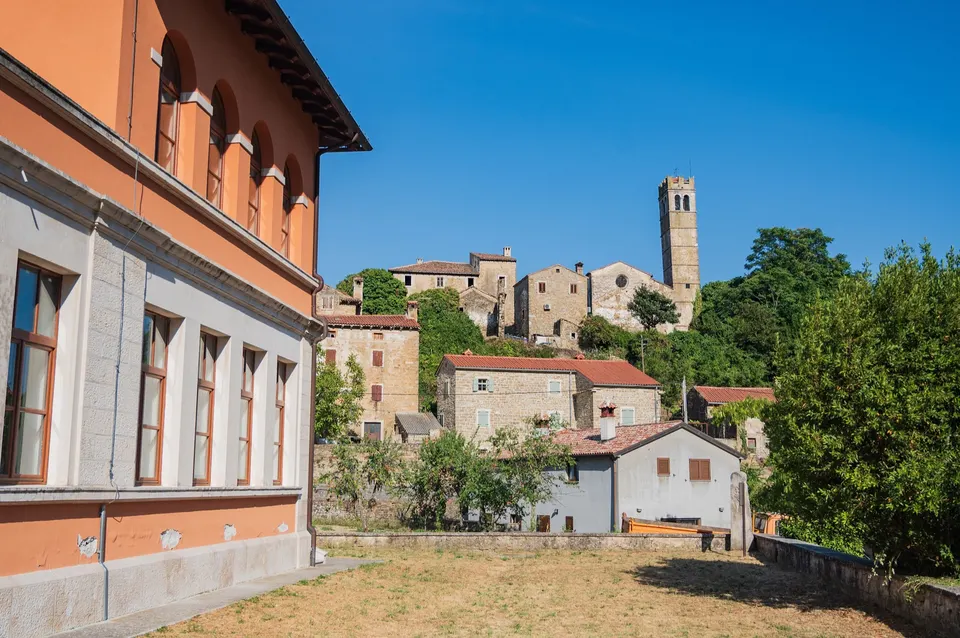
Roč is tiny: a handful of streets inside medieval walls, a few churches, stone houses and a gate or two. Yet it holds a special place in Croatian cultural history. For centuries, priests in this part of Istria used the Glagolitic script, the oldest Slavic alphabet, for liturgy and records, and Roč was one of its centres. Inside the small church of St Anthony is the Roč Abecedarium, a Glagolitic alphabet scratched into the wall in the Middle Ages, one of the oldest such inscriptions in Istria.
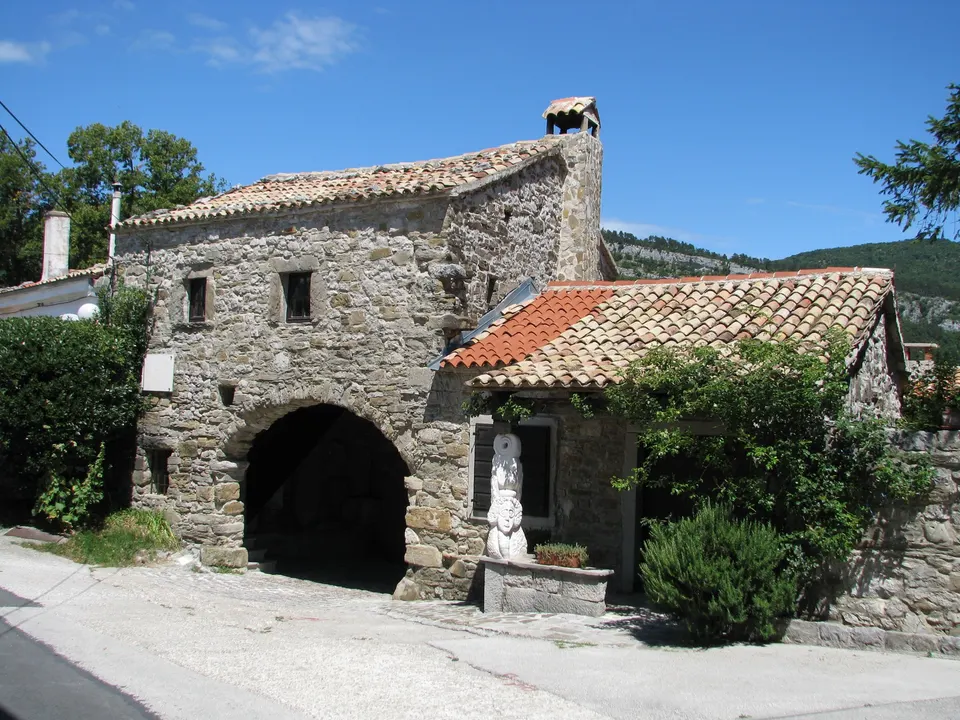
Wander the village slowly. Look for Roman stone fragments set into walls, the Romanesque and Gothic details on the churches, and the views out over the green hills. There is little to do in the conventional sense, and that is the point: Roč is a place to sit in the shade, listen to the bells and imagine how life in a medieval Istrian village sounded.
The Glagolitic Alley from Roč to Hum
Between Roč and Hum, a quiet road of a few kilometres winds through woods and meadows. Along it stands the Glagolitic Alley, a series of stone monuments created from the 1970s onwards to honour the Glagolitic script and the people who kept it alive. There are columns, gates, a stone table and seats, each inscribed with Glagolitic letters. The road ends at Hum, often described as the smallest town in the world. See our guide to Hum.
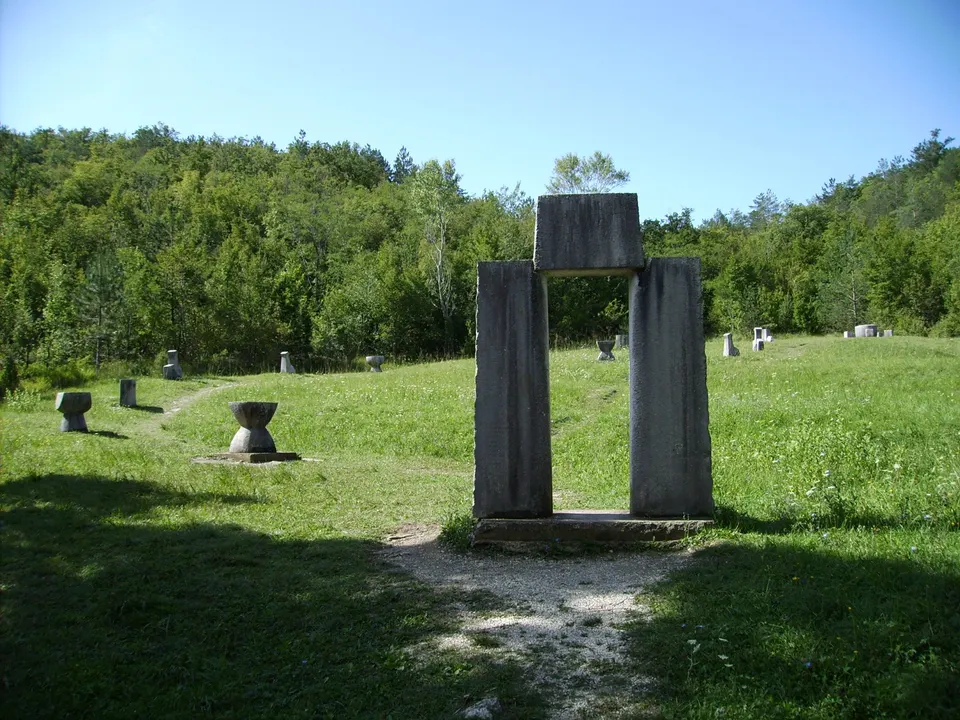
The alley can be driven, but it is best enjoyed on foot or by bicycle, stopping at each monument. Allow a few hours for the walk there and back, or arrange to be collected in Hum.
Good to know
- Getting there. Buzet is in the north of inland Istria, close to the Istrian Y motorway and not far from the Slovenian border. Roč and Hum are a short drive south-east.
- When to come. Autumn is the classic season, for truffles, mushrooms and colourful forests. Spring is green and quiet, with wildflowers along the Glagolitic Alley.
- Food. Try fuži or pljukanci with truffles, fritaja (omelette) and local cheese. In Hum, ask about biska, a herbal brandy made with mistletoe.
- Nearby. The abandoned mill village of Kotli, on the Mirna, has small waterfalls and natural pools; Motovun and its forest are within easy reach.
Buzet and Roč show a side of Istria that many visitors never see: greener, cooler, more rural and deeply rooted in its history. Come for the truffles, stay for the quiet roads, stone villages and the sense that time moves more slowly here. And if you are dreaming of a stone house in these hills, the slow pace is part of what makes them worth it.