Round, roofed in stone and built without a drop of mortar, the kažun has become the symbol of Istria. What it was for, how it was built, and where to see one.
Drive through southern Istria, between Vodnjan, Bale and Svetvinčenat, and you will start to notice them: small round stone huts with pointed roofs, standing alone in olive groves, at the corner of a vineyard or half hidden in the scrub. These are kažuni, the dry-stone field huts of Istria. They were built by farmers, without plans, without mortar and without any material other than the stones they cleared from their own fields. Today they are the best-loved symbol of the Istrian countryside, and one of its most interesting pieces of architecture.
What is a kažun?
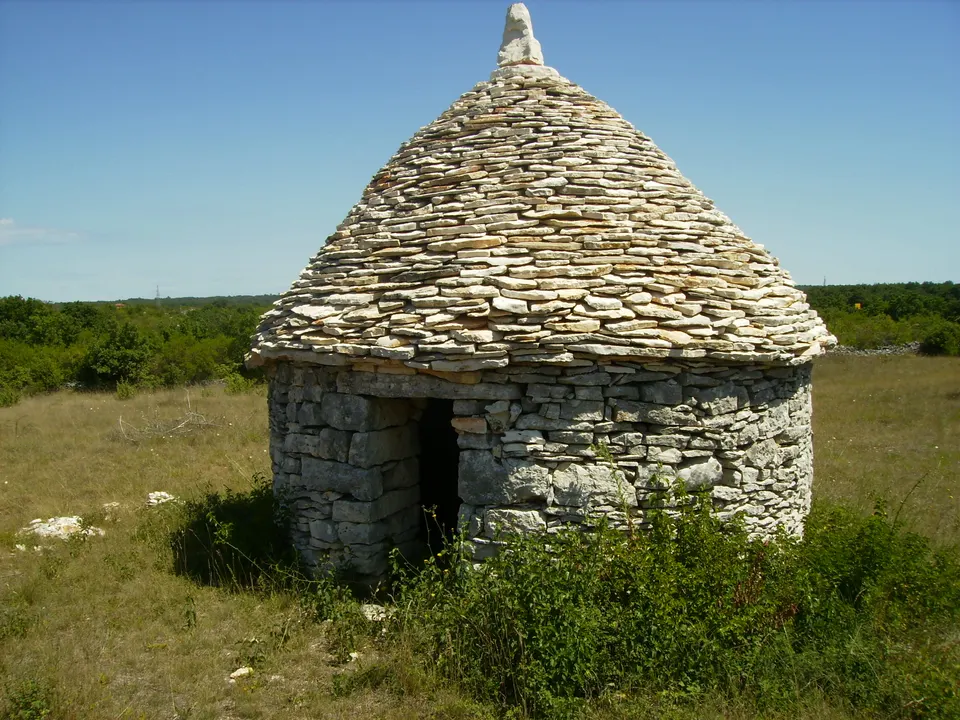
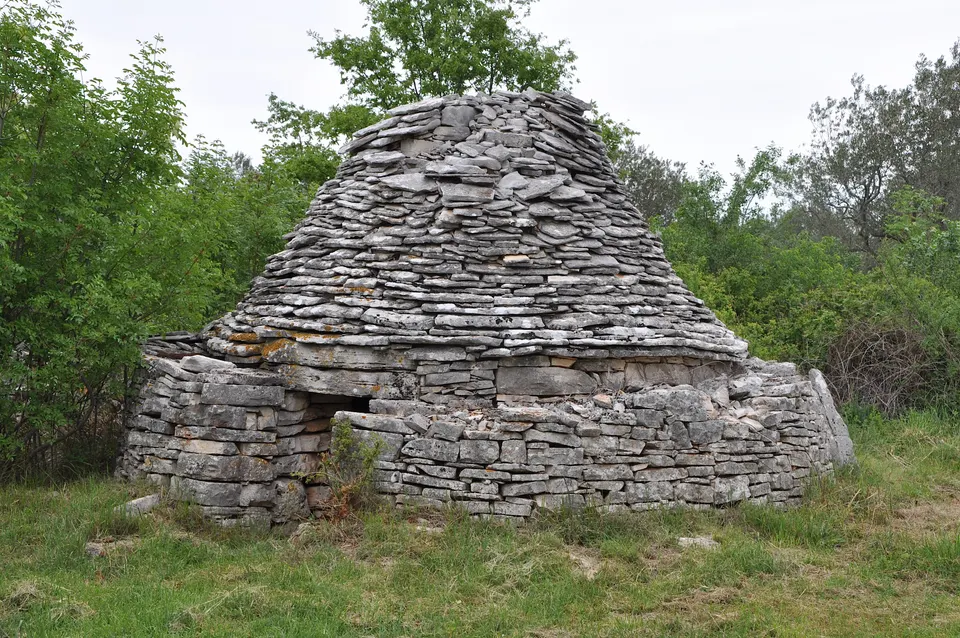
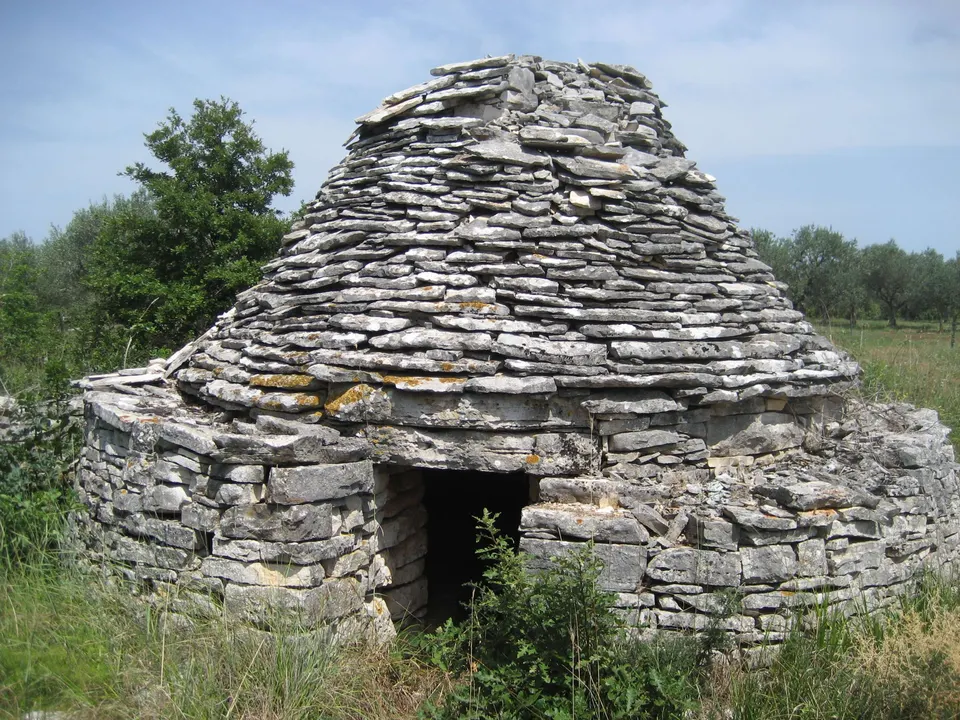
A kažun is a small shelter built entirely of dry stone, which means stone laid without any mortar or binder. Most are round, with a single low doorway and a roof that rises into a cone or dome, also made of stone. Some are square or rectangular, and a few are built into the thick field walls around them. They are usually just big enough for a few people to shelter inside.
Similar huts exist in many parts of the Mediterranean, from the trulli of Apulia to the stone huts of Provence and the bunje of Dalmatia. Each region has its own name and its own variations. In Istria the word kažun comes from the local Romance dialects and is related to words for a house or hut.
What were kažuni used for?
The kažun was a working building. Farmers and shepherds used it as a shelter from sudden storms and the midday sun, as a place to keep tools, and sometimes to store a harvest or protect animals. Fields were often a long walk from the village, and a stone hut on the spot meant that a day of work did not have to stop when the weather changed.
They were also a practical answer to the land itself. The red soil of southern Istria is full of limestone. Before a field could be ploughed or planted, the stones had to be cleared, and they were used to build field walls, terraces and huts. In that sense the kažun is not only a building but a record of how hard the land was worked.
How is a kažun built?
The technique is simple in principle and demanding in practice. The walls are built of roughly shaped stones, laid carefully so that each one sits firmly on those below. The walls are thick, often with an inner and outer face filled with smaller stones, which makes them stable and keeps the inside cool.
The roof is the clever part. Instead of beams, it is made by corbelling: each ring of flat stones is set a little further inwards than the one below, until the rings close at the top, where a single stone caps the cone. The slabs slope slightly outwards so that rain runs off rather than into the hut. Built well, without a single nail or drop of mortar, a kažun can stand for generations.
No plans, no mortar, nothing but the stones cleared from the field. And still they stand.
Dry stone as world heritage
The skill behind the kažun is part of a much wider tradition. In 2018, the art of dry stone walling, its knowledge and techniques, was inscribed on UNESCO's list of the Intangible Cultural Heritage of Humanity, as a shared heritage of several European countries, including Croatia. In Istria, local associations and volunteers organise workshops where people learn to repair walls and huts by hand, keeping the craft alive.
Where to see kažuni
- Around Vodnjan. The fields around the town have one of the highest concentrations of kažuni. Vodnjan also has a park dedicated to them, an open-air display of huts and the stages of building one. See our guide to Vodnjan.
- Bale and Svetvinčenat. The countryside between the two towns is rich in field walls and huts. Our guide to Bale and Svetvinčenat covers both.
- By bike or on foot. Many kažuni stand along farm tracks and are best discovered slowly, on two wheels or on foot.
- Respect private land. Most huts are on private property. Look from the track, and do not climb on walls or roofs.
If there is a kažun on your land
Many people who buy land or an old house in Istria find a kažun or a stretch of dry-stone wall on the property. It is worth treating as an asset rather than an obstacle. A few principles help:
- Ask before you change anything. Rules on repairing, moving or converting traditional structures depend on the location and the plot. Check with your architect and the local authorities before starting work.
- Repair with the same method. Use dry stone and, ideally, someone who knows the technique. Cement repairs trap water and often do more harm than good.
- Keep roots away. Ivy, fig trees and brambles growing into the walls are the most common cause of collapse.
- Let it be what it is. A kažun makes a beautiful garden feature, a shady spot or a simple store. It rarely makes a good bedroom.
For wider advice on old buildings, read our guide to restoring a stone house.
What the kažun teaches
It is easy to see the kažun as a postcard image, but it carries real lessons for anyone building in Istria today. Use local materials. Build thick walls against the heat. Make the most of what the site gives you. Keep the form simple and let the craft show. Architects working in the region often return to these ideas, and the best new houses share the kažun's quiet confidence: stone, shade and nothing unnecessary. Inside, the same thinking works for furniture too: honest materials and pieces made to fit the space, like the made-to-measure plywood furniture of the Lampisa atelier.