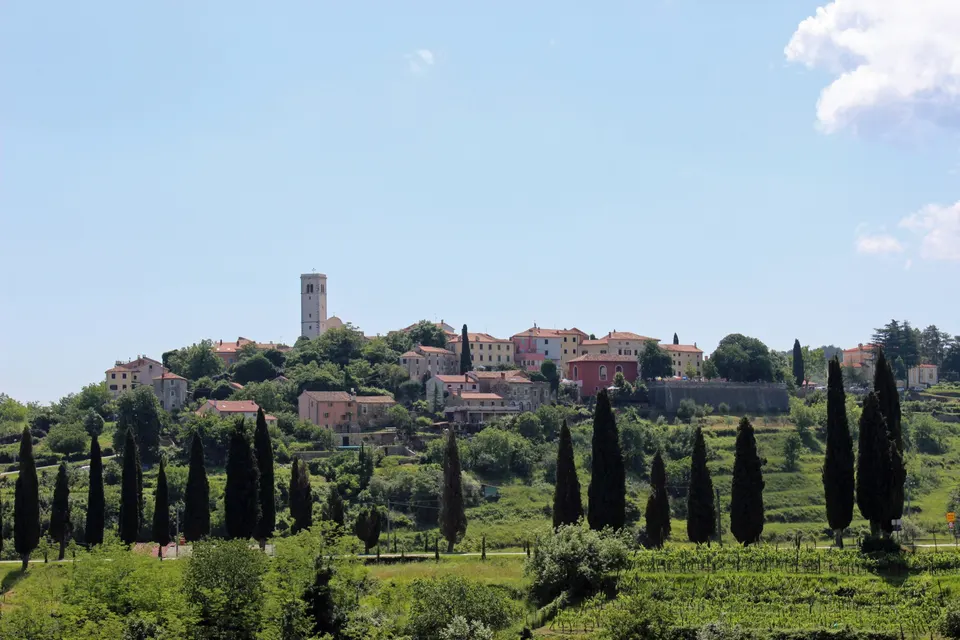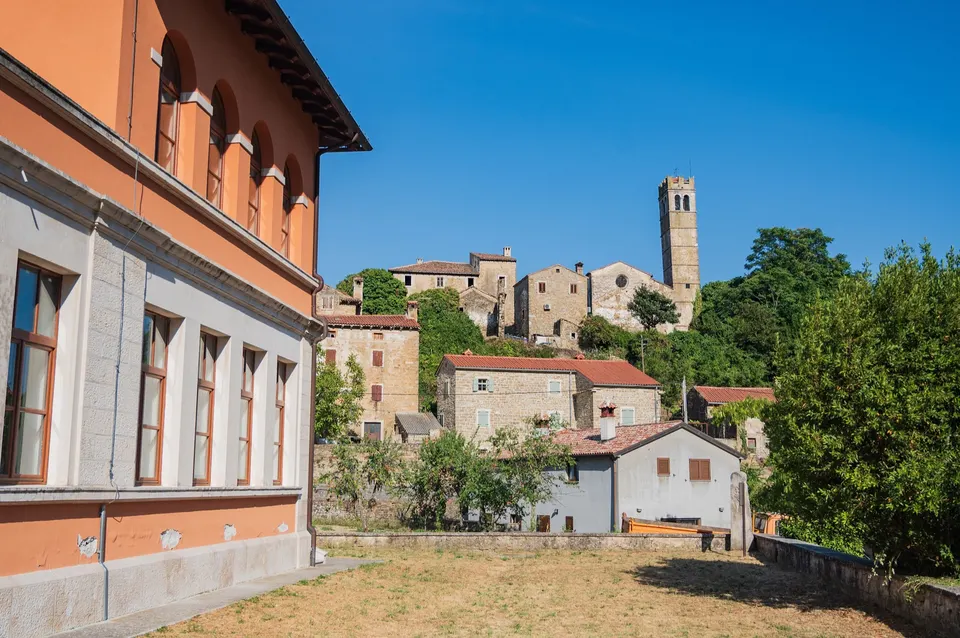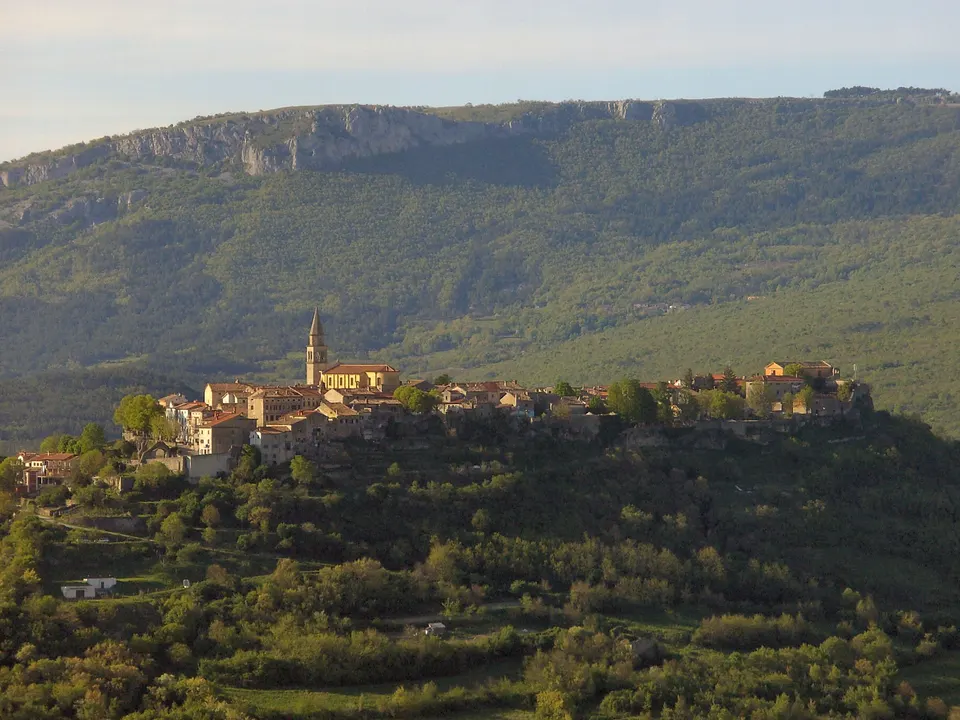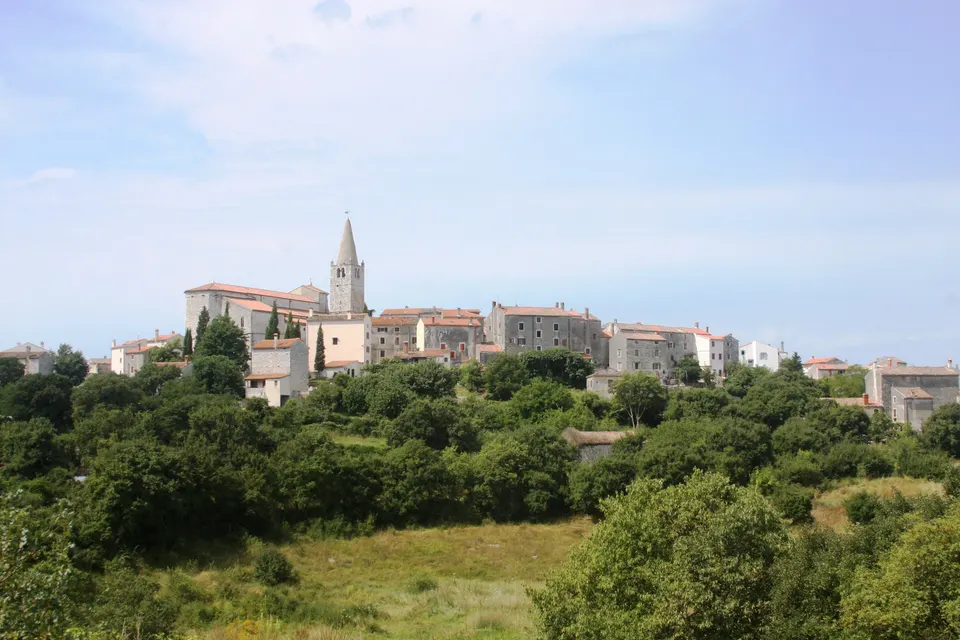
A hilltop town wrapped around a Venetian castle, and a Renaissance square with a fortress on one side. Two small places that reward a slow afternoon.
Southern Istria is famous for its coast, but some of its most atmospheric places are a few kilometres inland, where the traffic thins out and the towns still look much as they did centuries ago. Bale and Svetvinčenat are two of the best. Neither is large, neither takes more than a couple of hours to see, and both are easy to reach from Rovinj, Vodnjan or Pula. Together they make an ideal day away from the beach.
Bale: a stone town on a hill
Bale, Valle in Italian, sits on a low hill between Rovinj and Vodnjan, close enough to the sea that you can sense it on the horizon. The old town grew in rings around the top of the hill, so its outer houses form a kind of wall, and the lanes curve gently as they follow the slope. The result is a town that feels enclosed and protective, with arched passages, stone stairs and small squares that open up unexpectedly.
Like many Istrian towns, Bale has layers of history: prehistoric hill settlement, Roman presence in the area, and centuries under Venetian rule, which left the strongest mark on its architecture. Walk slowly, look at the doorways and window frames, and you will see Gothic and Renaissance details in the plain local limestone.
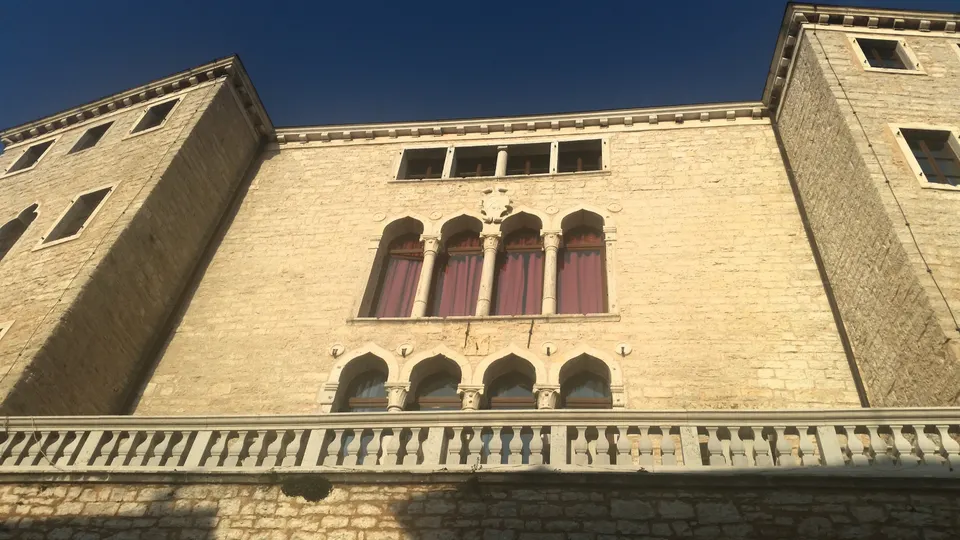
The Soardo-Bembo castle
The main landmark of Bale is the Soardo-Bembo castle, a fortified palace built into the old town walls, named after the noble families who owned it. Its facade, with elegant Gothic windows and a long balcony, is one of the finest pieces of secular architecture in the Istrian interior. It stands beside the old entrance to the town, so it is the first thing you see as you arrive on foot.
Nearby, the parish church and its separate bell tower dominate the top of the hill. The church in its present form is relatively recent, but the site has been sacred for far longer, and older stone fragments have been found and preserved in and around it. From the edge of the old town there are wide views over fields, woods and, on clear days, towards the sea.
Svetvinčenat: the Renaissance square
Svetvinčenat, known locally as Savičenta and in Italian as San Vincenzo, lies further inland, roughly between Pula and Pazin. It is a small place, but it has one of the most beautiful squares in Istria. The square was laid out in the Renaissance as a deliberate composition: the castle on one side, the parish church on another, and town houses closing the space around a broad open centre.
A square that feels designed rather than grown, and still works as the heart of the village.
What makes it special is the sense of proportion. The square is wide and calm, the buildings are modest in height, and the stone glows warm in the late afternoon. It feels designed rather than grown, and yet it still works as the everyday heart of the village, with children playing, neighbours talking and the occasional tractor passing through.
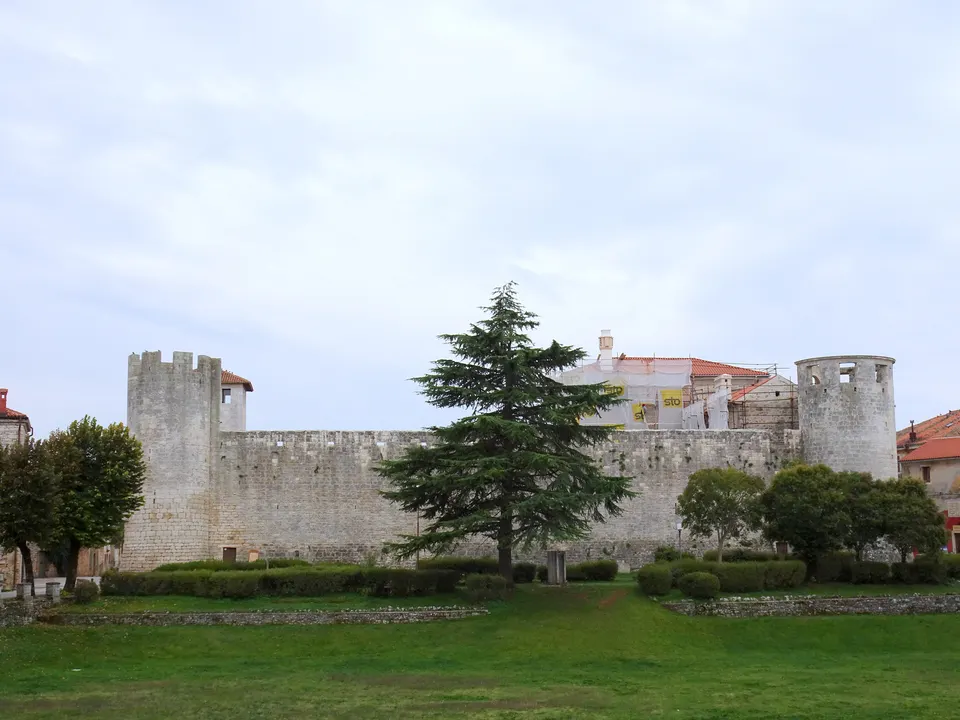
The Morosini-Grimani castle
The castle that closes one side of the square is the Morosini-Grimani castle, a fortress with high walls and corner towers, rebuilt in its present form under Venetian rule and named after the Venetian families who held it. It is one of the best-preserved castles in Istria, and its courtyard and walls are used for cultural events in the summer.
The castle also carries one of Istria's darker stories. According to local tradition, a young woman named Marija Radoslović was accused of witchcraft in the seventeenth century and burned in Svetvinčenat. The tale is still told in the village and has been retold in plays and performances. It is a reminder that these calm stone squares have seen difficult times too.
Take time, too, for the parish church of Svetvinčenat, whose Renaissance facade closes the eastern side of the square, and for the small streets behind it, where farmhouses with stone courtyards and outside staircases show how the village has lived for centuries. Just outside the centre, the cemetery church of St Vincent, which gave the village its name, is a quiet place to finish the walk.
How to combine Bale and Svetvinčenat in one day
The two towns are a comfortable drive apart, and the route between them passes through quiet countryside of fields, oak woods and small villages. A sensible plan is to start in Bale in the morning, when the lanes are cool and quiet, then have lunch and drive inland to Svetvinčenat for the afternoon light on the square. If you have time, add Vodnjan for an olive oil tasting, or continue north to Pazin and its abyss.
Good to know
- Getting there. Bale is a short drive from Rovinj and Vodnjan; Svetvinčenat is easiest to reach from Pula, Vodnjan or Pazin. A car is the practical choice.
- Parking. In both towns, park just outside the historic centre and walk in.
- Opening times. Access to the castles, churches and small museums depends on the season and on events, so check locally before you go.
- Summer events. Both towns host concerts, festivals and performances in the warmer months; Svetvinčenat's square and castle make a memorable stage.
- Footwear. Old stone paving can be smooth and slippery; wear shoes with some grip.
- Pace. Allow time to sit. These are towns for a coffee in the shade, not a checklist.
Why go inland
Bale and Svetvinčenat show a side of Istria that is easy to miss if you stay on the coast: quieter, older, built for farming communities rather than visitors. They are also a lesson in how stone, proportion and shade can make a place comfortable without any decoration at all. It is no surprise that many people who discover these villages start thinking about a stone house of their own somewhere nearby.