A walled town of a few streets, a copper gate, a mayor chosen by notches on a stick, and a road of stone monuments to an ancient alphabet. Hum in a day.
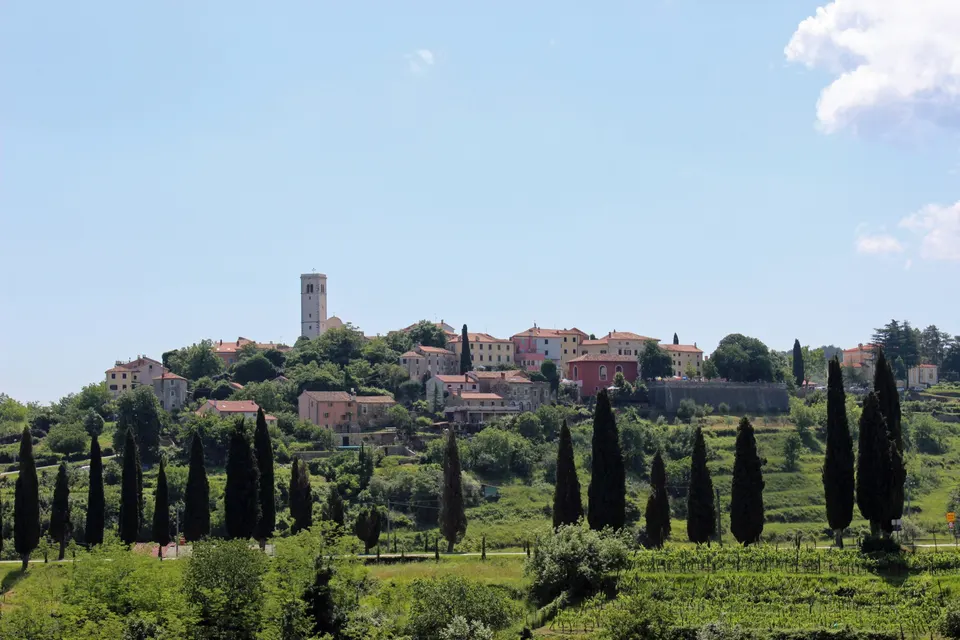
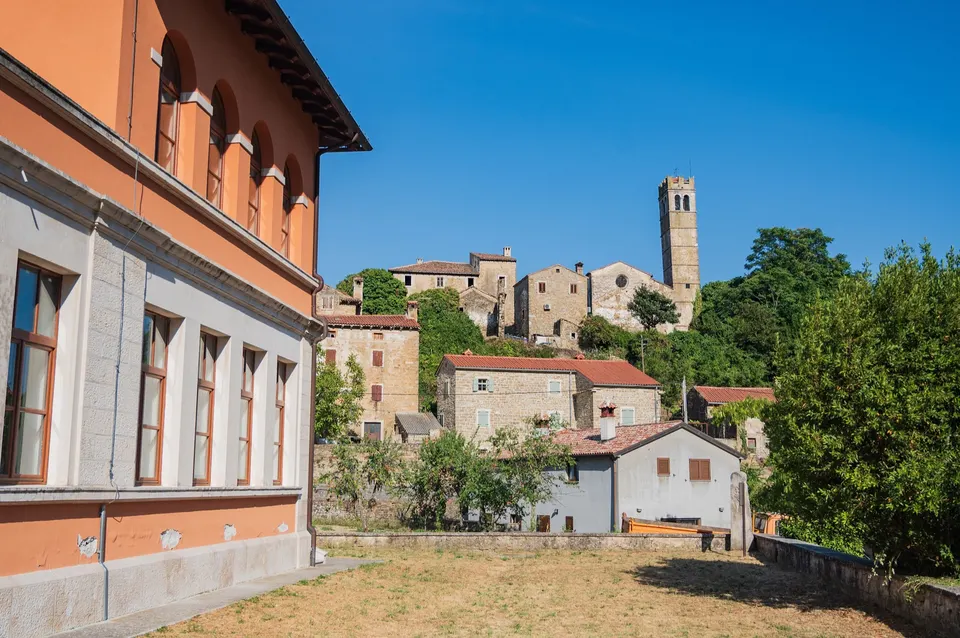
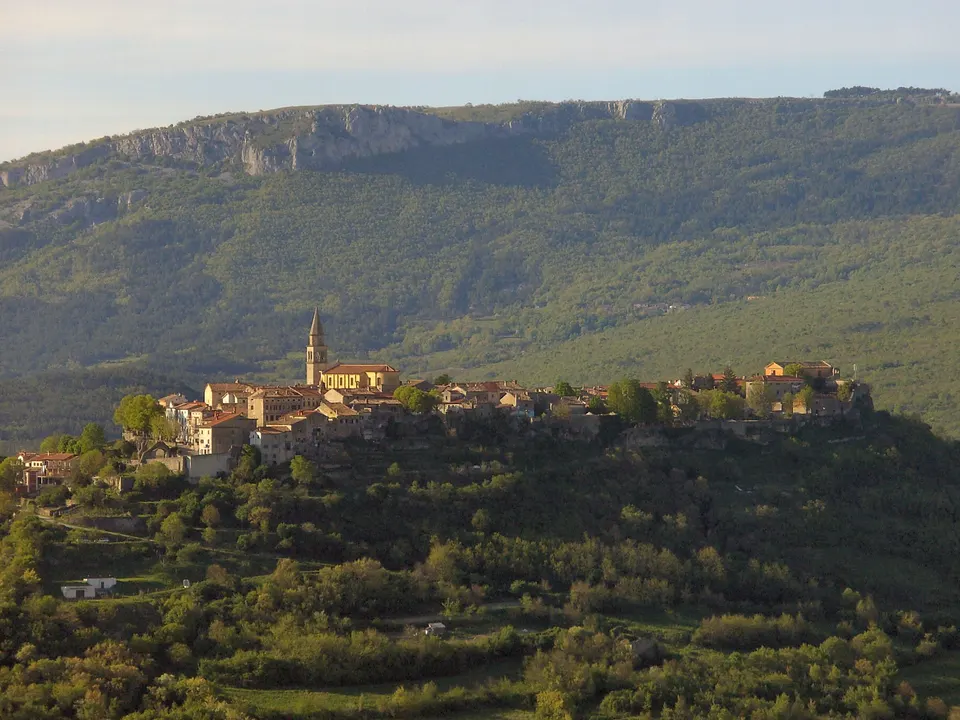
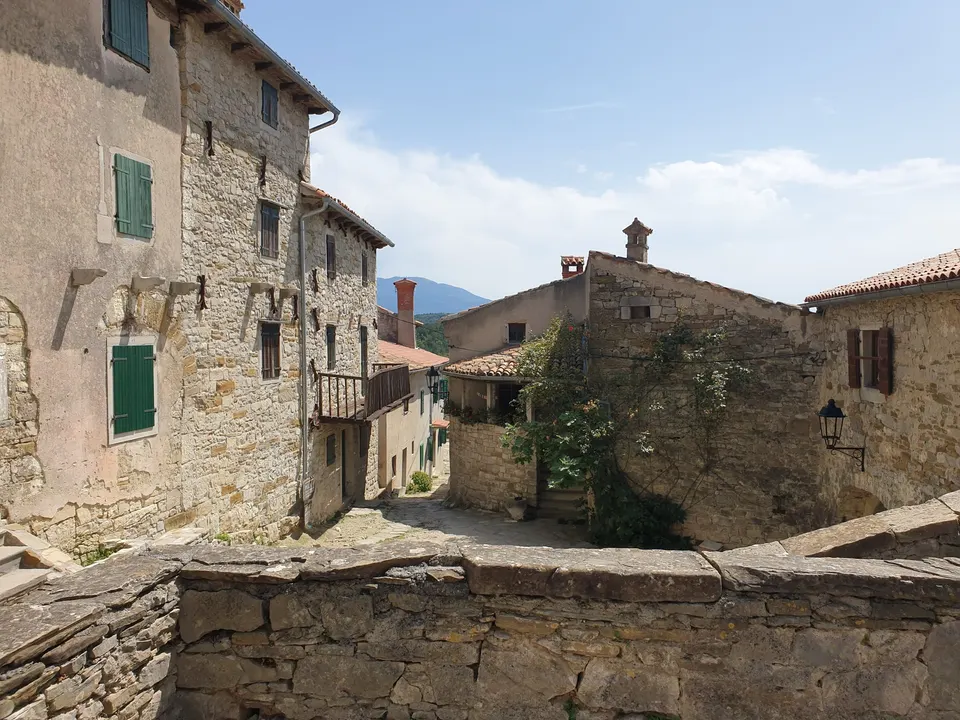
Hum calls itself the smallest town in the world, and when you stand inside its walls it is hard to argue. There are only a few streets, a square, two churches, a loggia and a handful of stone houses, all enclosed within a ring of walls on a hilltop in the green interior of Istria, near Buzet. Its permanent population can be counted in dozens rather than hundreds. Yet Hum has always been a town, not a village, with its own walls, its own gate and its own mayor, and it takes that status seriously.
Why is Hum called a town?
Hum grew up as a fortified settlement in the Middle Ages and kept the institutions of a town: walls, a gate, a loggia for public business and a parish church. One tradition says that Hum was built from the stones left over after the giants had built the towns of the Mirna valley, which is why it came out so small. The legend is charming, but the real story is a familiar one in inland Istria: a defensive hilltop community that remained small, and never needed to grow beyond its walls.
One custom shows how seriously Hum takes its civic life. Every year the townspeople elect a župan, a mayor, and by tradition the votes are recorded by carving notches into a wooden stick called a rovaš. The election is followed by a celebration, and it remains one of the most distinctive local customs in Istria.
What to see in Hum
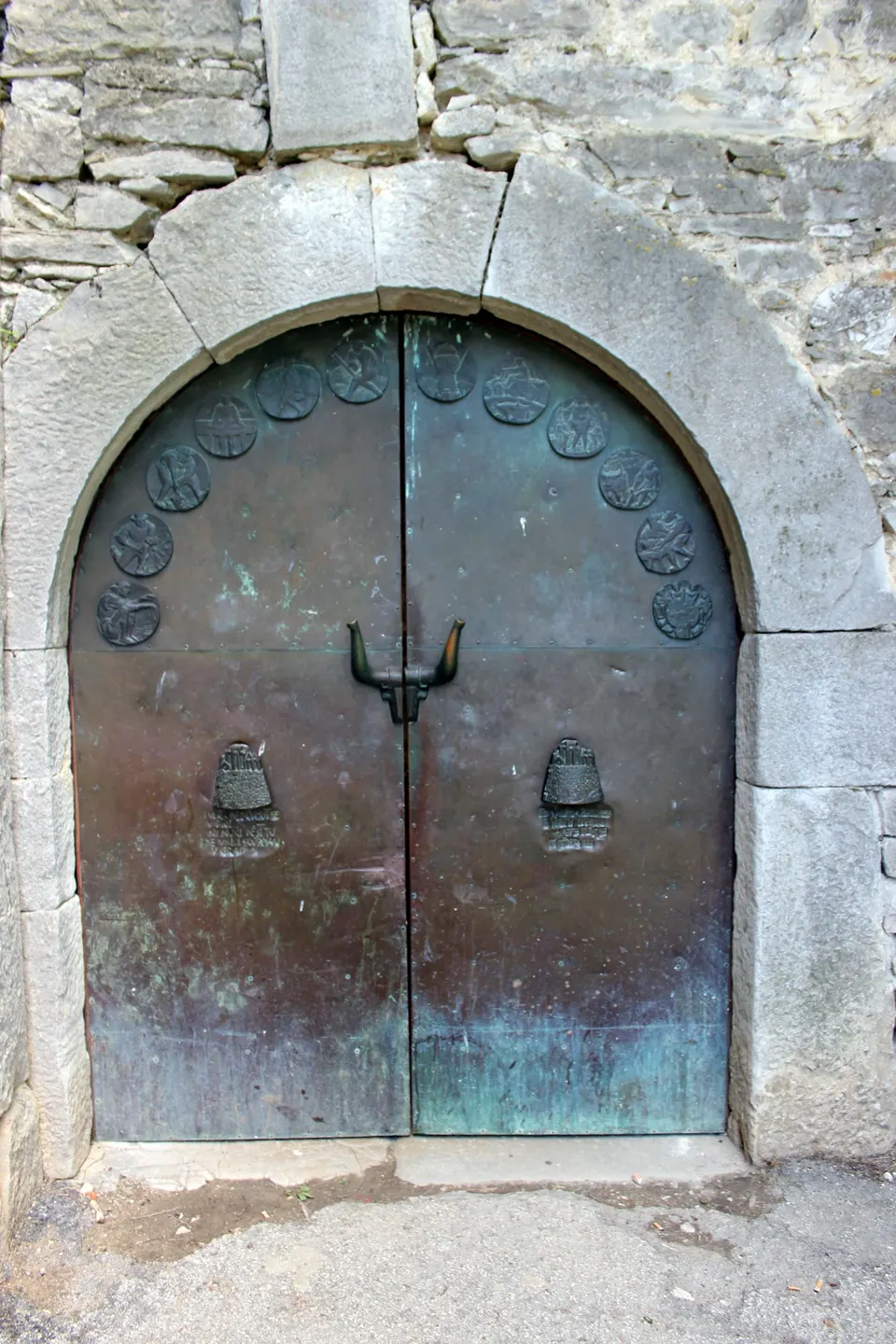
You enter through the town gate, whose heavy copper-clad doors carry decorative medallions with a calendar theme and handles shaped like the horns of an ox. Inside, the town is so compact that you can see it all in half an hour; the pleasure lies in slowing down.
- The parish church. The Church of the Assumption of the Blessed Virgin Mary dates from the early nineteenth century. Its bell tower, much older, also served a defensive role.
- The Church of St Jerome. A small Romanesque church by the cemetery, known for its medieval wall paintings and for inscriptions in the Glagolitic script.
- The loggia. Where the town's public business was once carried out, by the main street.
- The walls and the view. From the edges of the town, the view opens over wooded hills and the valley below.
What is biska?
Biska is a traditional Istrian brandy flavoured with white mistletoe and herbs, and Hum is the place most closely associated with it. It is usually served as a small glass before or after a meal, with a gentle bitterness and a herbal aroma. You will find it offered in the town and in the surrounding villages, often alongside other homemade spirits.
Hum has always been a town, not a village, with its own walls, its own gate and its own mayor.
The Glagolitic Alley: from Roč to Hum
The road that leads from the small walled town of Roč to Hum is known as the Glagolitic Alley (Aleja glagoljaša). Along it stand eleven stone monuments dedicated to Glagolitic, the oldest Slavic alphabet, and to the people who used and preserved it in Istria and Croatia for centuries. The monuments were created by the sculptor Želimir Janeš in the late 1970s and 1980s and placed along the road between the two towns, in the open countryside.
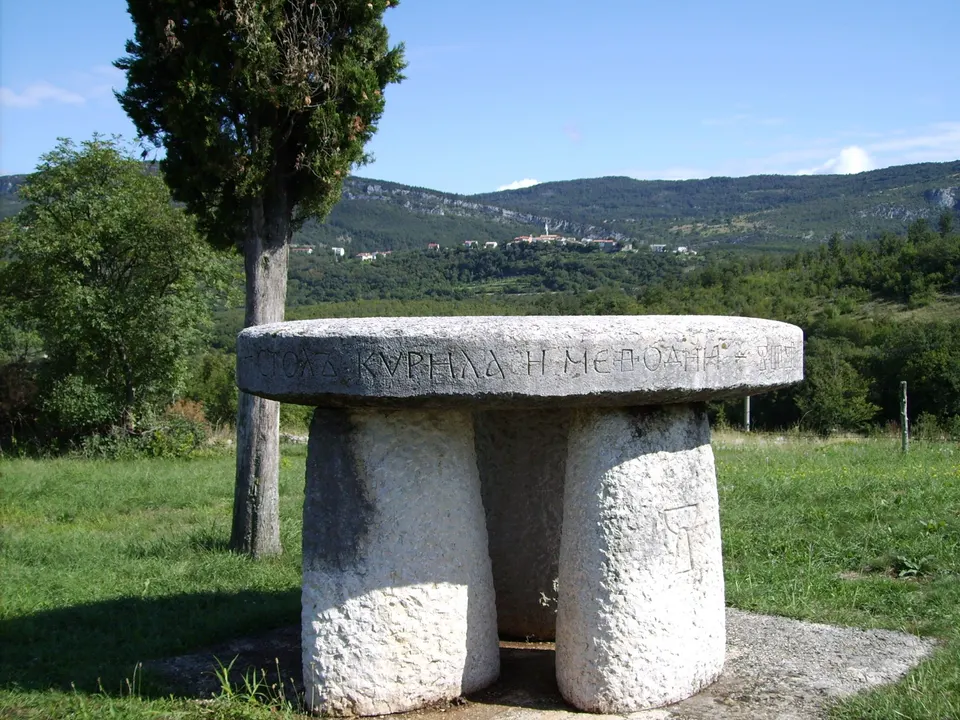
Each monument has its own theme. Among them are the Column of the Čakavian Council at the start of the route, the stone Table of Cyril and Methodius, honouring the two brothers associated with the creation of the Slavic alphabet, and the Seat of Clement of Ohrid, one of their disciples. Others recall the Istrian Demarcation, an important medieval document written in Glagolitic, and the Croatian Protestants of the sixteenth century. The last monument is the town gate of Hum itself.
The Alley is about seven kilometres long and can be followed by car, by bicycle or on foot. Walking or cycling it is the best way to appreciate it, stopping at each monument and taking in the quiet countryside between them.
How to plan a visit
- Getting there. Hum lies in the north of inland Istria, near Buzet and Roč. A car is the easiest option; public transport in the area is limited.
- Parking. Leave the car outside the walls. The town itself is entirely on foot.
- Time. An hour is enough for Hum itself. Add a couple of hours for the Glagolitic Alley and a visit to Roč.
- Season. Spring and autumn are ideal. In autumn, combine your visit with truffle season around Buzet.
- Food. Hum is small, so check in advance whether places to eat are open, especially out of season.
Combine it with
Hum fits easily into a day of inland Istria. Roč, with its own walls and Glagolitic heritage, is the natural starting point. Buzet, on its hill, is the centre of truffle country. To the south, the frescoes of Beram near Pazin, with their famous Dance of Death, continue the story of medieval art in the interior; see Beram and the Dance of Death. On the way, keep your eyes open for viewpoints over the green hills, which are among the most beautiful in the peninsula.
Hum is not a place to tick off. It is a place to understand how inland Istria has always lived: on a hill, inside a wall, with its own rules and its own memory. Stand at the gate as the evening falls and the silence around the town will tell you the rest.