In a small church in the woods near Pazin, a fifteenth-century painter covered every wall with colour. His Dance of Death is one of the great images of medieval Europe.
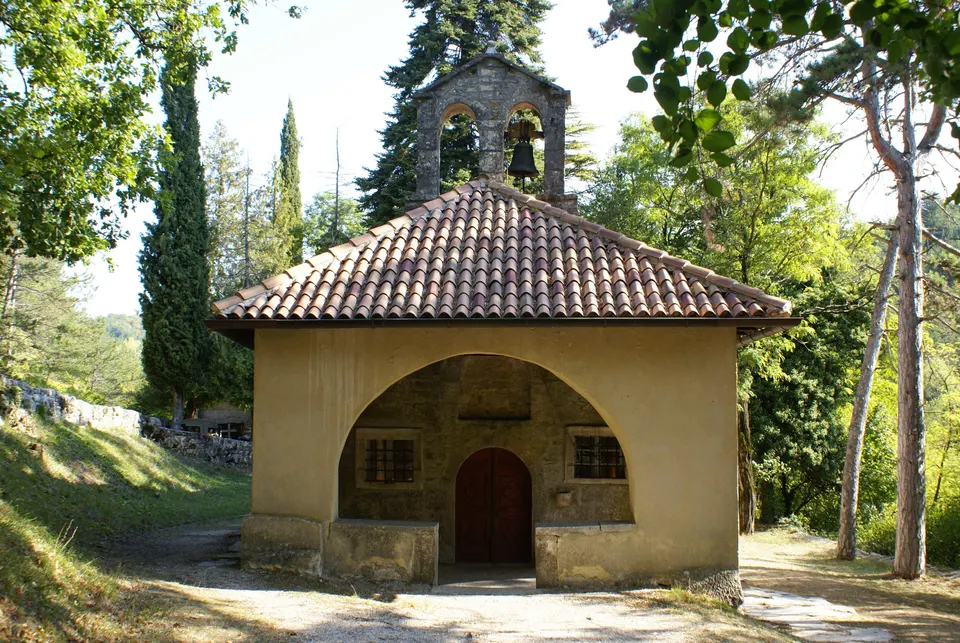
From the outside, it looks like nothing much: a small, plain church with a tiled roof and a deep porch, standing among trees a short walk from a hilltop village in central Istria. Step inside, and every surface is alive. Kings ride across the walls in a long procession, angels and saints fill the spaces between the windows, and on the back wall a line of skeletons leads people of every rank towards the grave. The church of St Mary on Škriljine, near Beram, holds one of the most complete cycles of medieval wall painting in Croatia, and it is one of the most moving places in Istria.
Where is Beram?
Beram is a small village on a hill a few kilometres north-west of Pazin, in the green heart of the peninsula. The church stands outside the village, in a quiet place by the old cemetery. Its name, Sv. Marija na Škriljinah, refers to the flat stone slabs of the surrounding land. Pazin, with its castle on the edge of a deep gorge, is close by and easy to combine in one trip; see our guide to Pazin and its castle above the abyss.
Who painted the frescoes?
An inscription in the church records that the paintings were completed in 1474 by Master Vincent of Kastav, a painter from the town of Kastav above Rijeka. Very little is known about his life, but his work shows a painter who knew the art of the wider Alpine and Adriatic world and translated it into something direct, lively and local. The inscription is written in Glagolitic, the old Slavic script that was used in Istria for church books and inscriptions for centuries, a reminder of how deeply rooted that tradition was here.
Beram was an important centre of Glagolitic writing. Two fifteenth-century liturgical books from the parish, known as the Beram Missal and the Beram Breviary, are among the most important Glagolitic manuscripts of the period. For another side of the same tradition, visit Hum and its Glagolitic Alley; see Hum, the smallest town in the world.
What do the frescoes show?
The walls tell the stories of the life of the Virgin Mary and of Christ, from the Marriage of Mary and Joseph and the Flight into Egypt to the Kiss of Judas and the Mount of Olives. Saints stand in their own panels: St George, St Martin with the beggar, St Michael weighing souls, St Catherine and others.
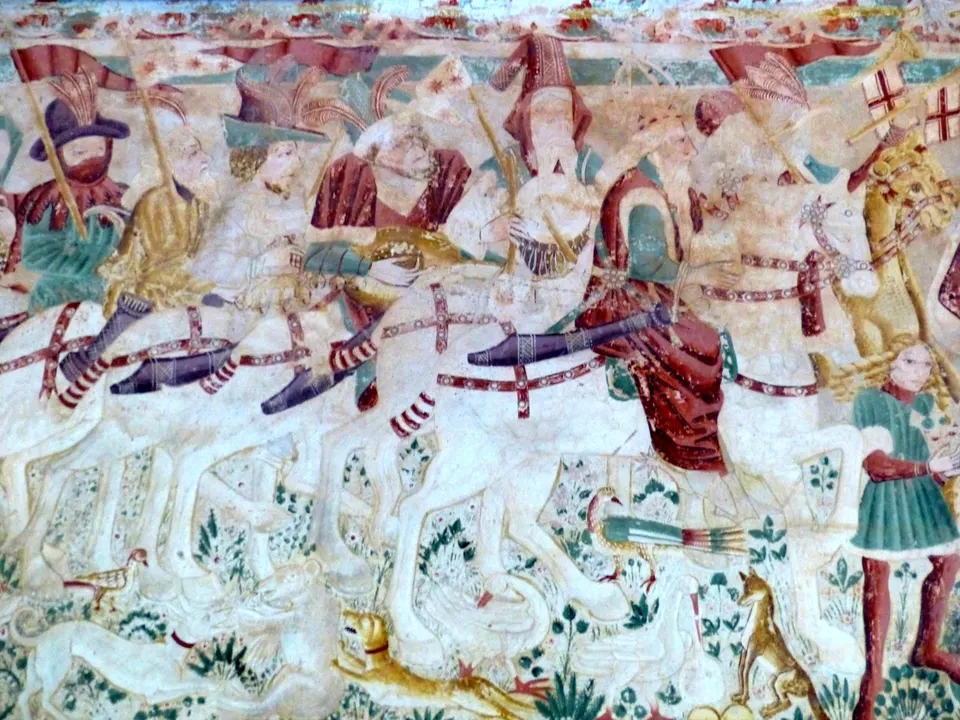
The most famous scene on the side walls is the Adoration of the Magi, a long, crowded procession of kings, knights and attendants on horseback, with banners, falcons and dogs, winding towards the Holy Family. It is full of the details of fifteenth-century life: costumes, hats, weapons, harnesses. It reads almost like a picture of a real princely cavalcade passing through the Istrian countryside.
The Dance of Death
Above the entrance, on the west wall, is the scene that has made Beram famous: the Dance of Death. A procession of skeletons, some playing instruments, leads a line of living people towards the grave. Every rank of society is there, from the pope, cardinals and bishops to the king and queen, the merchant with his money, the soldier, the beggar and the child. Each of the living is partnered by his own Death, and none of them can escape.
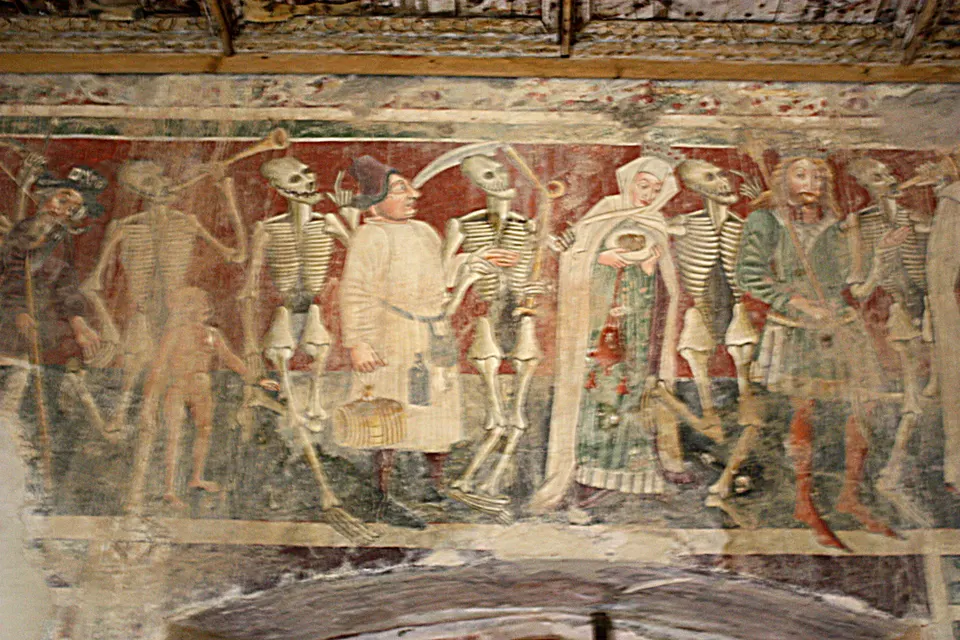
The Dance of Death was a popular theme across Europe in the late Middle Ages, a time shaped by plague and war. Its message is simple and universal: death treats everyone the same, so live well. What makes Beram so striking is its freshness. The skeletons are almost cheerful, the living are painted with individual faces and gestures, and the whole scene feels less like a sermon than a story told by someone who knew these people. Not far away, across the border in Slovenia, the church at Hrastovlje holds another celebrated Dance of Death painted some years later by another master from Kastav, and the two are often visited together.
Death treats everyone the same. At Beram, it even seems to smile about it.
How to visit
The church is small and usually kept locked to protect the paintings, so a visit needs a little planning. Arrangements for opening it change over time, so contact the tourist board in Pazin or ask in Beram before you go. Allow time to look slowly. The paintings reward patience: the more you look, the more you notice, from the expressions on the faces to the small animals tucked into the corners.
- Plan ahead. Check in advance how the church can be opened; do not count on finding it open by chance.
- Light. The interior is dim. Let your eyes adjust before you start looking at details.
- Respect the walls. Do not touch the paintings, and follow any rules about photography.
- Combine. Pazin Castle and the gorge, the hill town of Motovun, or Hum and Roč make a good day in central Istria.
- Seasons. Spring and autumn are ideal: the countryside is green, the roads are quiet, and the walk to the church is pleasant.
Why it matters
Istria is often seen as a place of beaches and food, and its medieval inland is easy to miss. Beram is the best argument against that. Across the interior there are dozens of small churches with painted walls, many of them still in use, and together they form one of the richest groups of medieval wall painting in this part of Europe. Beram is the finest of them, and it is worth crossing the peninsula for a single hour inside its walls.
It is also a lesson in how much a small, simple building can hold. A plain roof, thick stone walls and a modest porch were enough to protect a masterpiece for more than five centuries.