Town walls on the water, a cathedral with a Romanesque crypt, a fishing harbour and the mouth of the Mirna. Novigrad is the calm alternative on Istria's west coast.
Between Umag and Poreč, on a small peninsula where the Mirna river meets the sea, lies Novigrad. It has everything that draws people to the west coast of Istria: an old town on the water, Venetian walls, a bell tower above the roofs and sunsets over the open sea. What it does not have is the crowd. Novigrad is calmer than its better-known neighbours, and for many visitors that is precisely the point.
Its Italian name is Cittanova, "new town", the same meaning as the Croatian. The name is old, though: there has been a settlement here since antiquity, and for many centuries Novigrad was the seat of a bishop, which explains the size of its main church.
Like the other towns of the west coast, Novigrad spent centuries under Venetian rule, and the Venetian imprint is everywhere: in the walls, the loggia and the stone balconies of the old houses. The bishopric was eventually abolished in the nineteenth century, and the town settled into the life of a small fishing port. That modesty is what preserved it. Novigrad never grew into a large resort, and its old town still feels like a place where people live rather than a stage set for visitors.
What to see in Novigrad
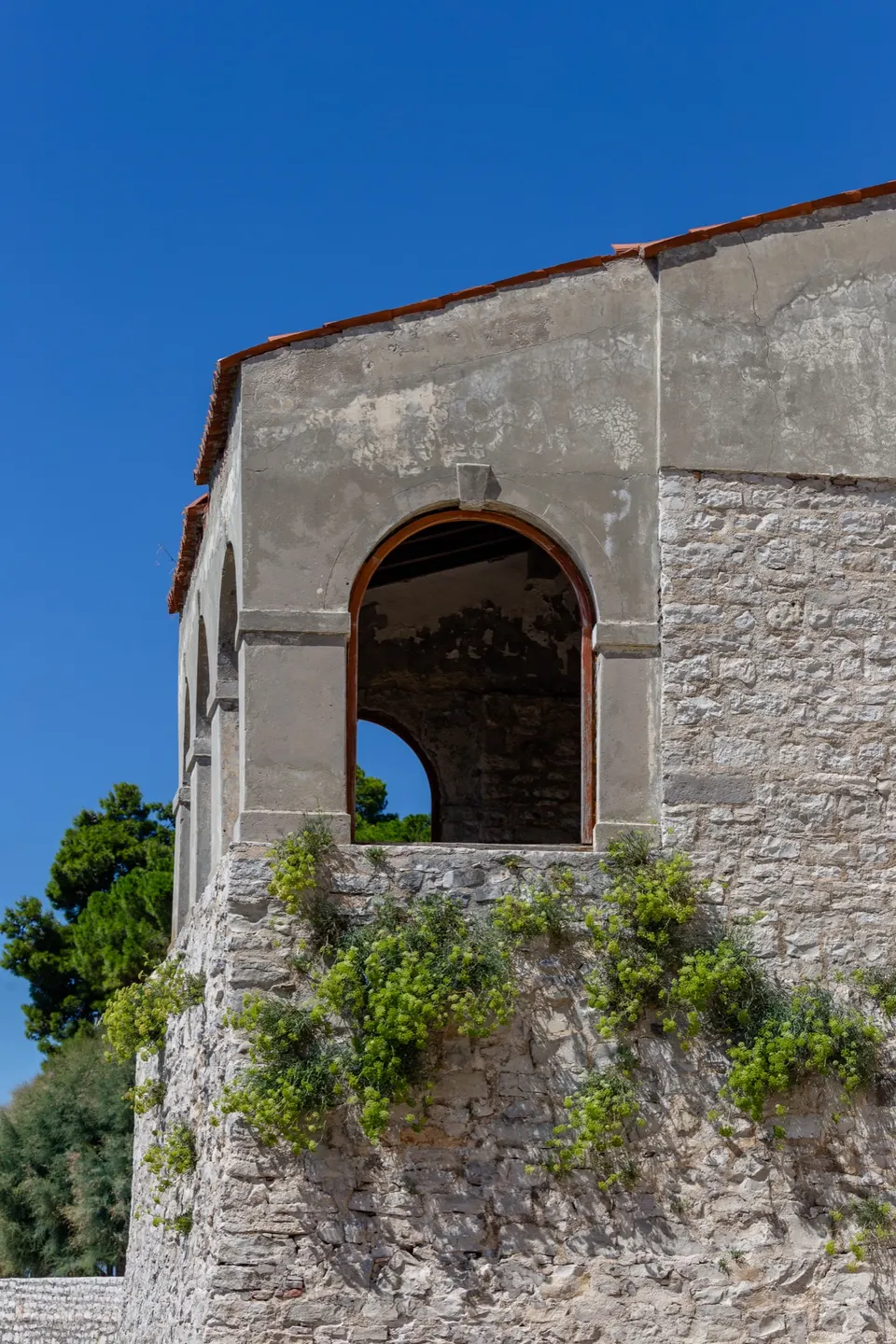
Start with the walls. Substantial sections of the medieval town walls still stand, especially on the side facing the sea, with towers and a semicircular bastion. Built into them is the town loggia, open on the seaward side like a window cut into the wall, where you can sit in the shade and watch the waves. It is one of the most unusual loggias in Istria and one of the best places in town to see the sunset.
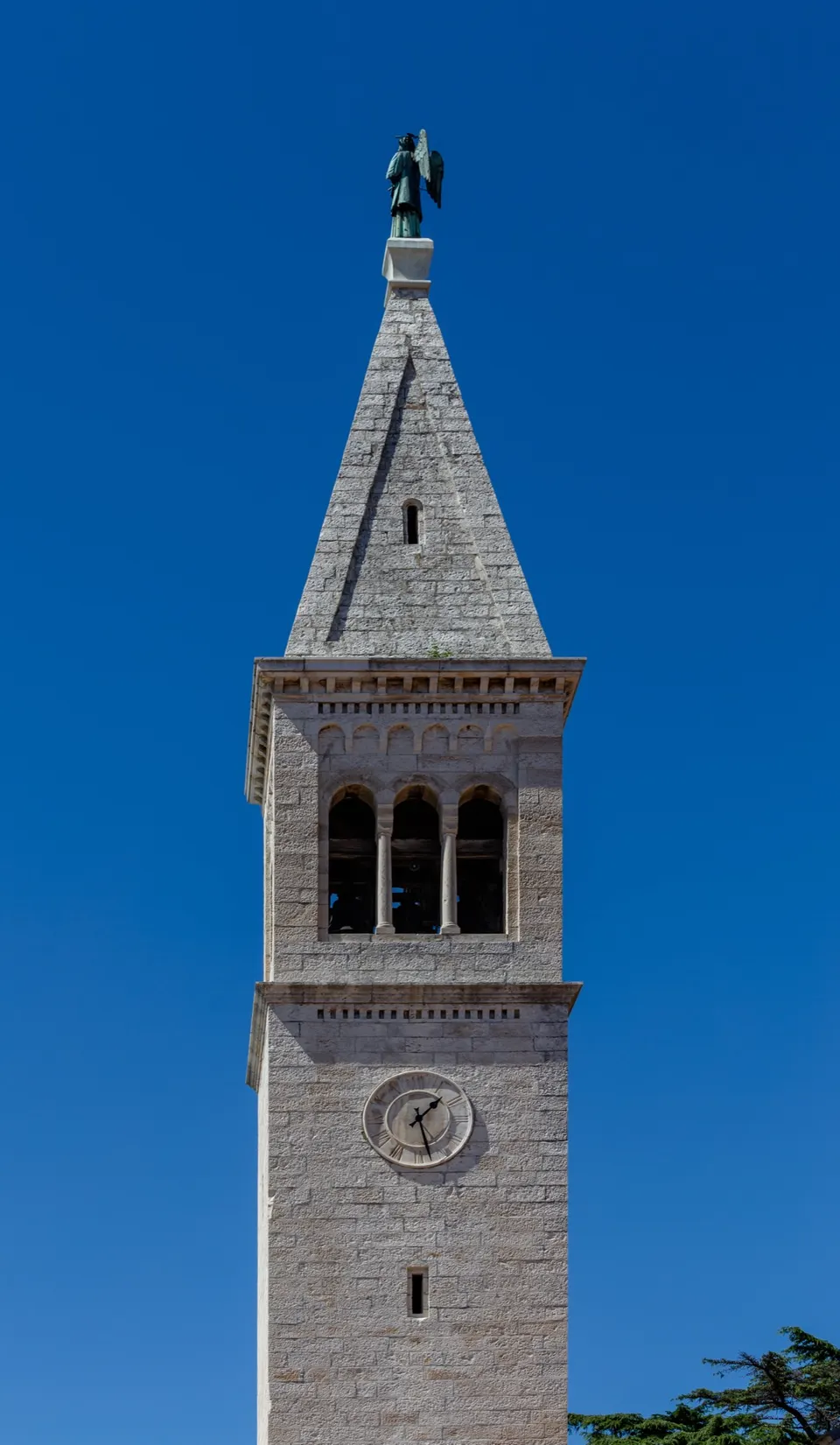
In the centre of the old town stands the Church of St Pelagius, the patron saint of Novigrad and the former cathedral. The building has been rebuilt several times, but beneath the presbytery lies a Romanesque crypt, one of the oldest and most atmospheric spaces in Istria. The separate bell tower, crowned by a statue of the saint, rises in the Venetian manner above the roofs and is visible from far along the coast.
- The Lapidarium. A museum of carved stone fragments from Novigrad's past, including early medieval decoration from the town's churches, displayed in a contemporary building.
- Galerion. A small private museum devoted to the maritime history of the Austro-Hungarian navy.
- Venetian palaces. Look for baroque and Gothic details on houses around the main square and along the narrow streets.
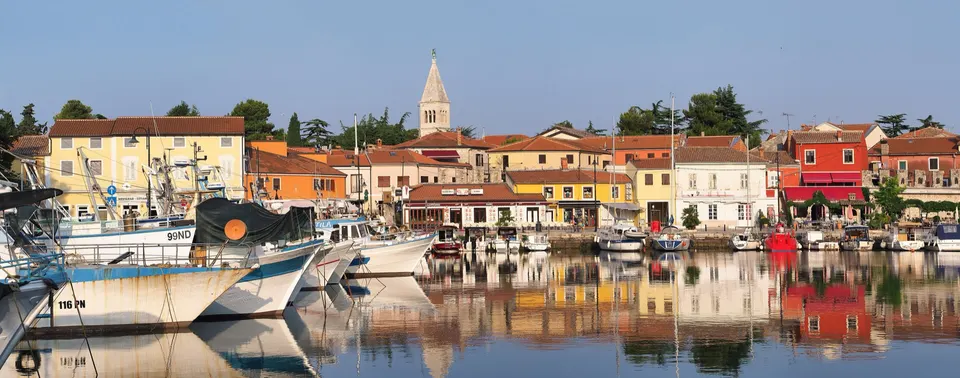
- Mandrač. The old fishing harbour, still full of working boats, and the liveliest corner of town in the evening.
The town loggia opens towards the sea like a window cut into the wall.
Why is Novigrad known for seafood?
Novigrad lies at the mouth of the Mirna, where fresh water from the river mixes with the sea. This rich, brackish environment is good for fish and shellfish, and the town has a long fishing tradition. The local fleet still goes out from Mandrač, and Novigrad's restaurants are known across Istria for fresh fish, scampi, mussels and other seafood. Simple preparations are the rule: grilled, na buzaru with wine, garlic and parsley, or served raw with good Istrian olive oil. For more on the regional table, see our guide to Istrian cuisine.
Where to swim in and around Novigrad
Novigrad does not have long sandy beaches, but it has plenty of places to swim. Rocky stretches and concrete platforms along the shore near the old town make it easy to get into the water, and pebble beaches and coves continue north and south along the coast. The sea here is shallow in places and warms quickly in early summer, which suits families. The west-facing shore also makes Novigrad one of the best places in Istria to watch the sunset.
What is there to do nearby?
- The Mirna valley. Follow the river inland towards Motovun, through a flat green valley lined with forests, vineyards and hill towns.
- Dajla. A former monastery just south of Novigrad, a striking neoclassical building on the coast.
- Umag and Savudrija. To the north, Umag has its own small old town, and Savudrija, the westernmost point of Croatia, has a historic lighthouse.
- The hill towns. Buje, Grožnjan and Momjan are a short drive inland, with wine roads and views. See our guide to Grožnjan.
Good to know
- Getting there. Novigrad is on the north-west coast of Istria, close to the main coastal road. Trieste and Pula are the nearest airports in practice, with Ljubljana also within reach by road.
- Parking. Leave the car outside the old town; the centre is compact and easy to walk.
- Best time. Late spring and September are ideal: warm sea, quiet streets and open restaurants.
- Evenings. Walk along the walls at sunset, then head to the harbour for dinner.
Novigrad is not a town that tries to impress. Its charm lies in its proportions: walls you can walk around in a few minutes, a harbour where fishermen still mend their nets, and a loggia open to the sea where time seems to slow down. It is the kind of place people return to every year, and sometimes the kind of place where they decide to stay.