Estimate the job yourself, check the builder's quote, then spot-check material prices. Three free tools, in this order, take about ten minutes and leave you with better questions.
The moment before you sign a builder's quote is the cheapest moment to catch a problem. Once work starts, every change is a negotiation. Yet most people spend more time choosing tiles than checking the document that decides what they will pay.
Here is a short routine that fits into a coffee break. It uses Atrij's three free tools in a deliberate order: first the renovation calculator, then the builder's quote check, then building material prices. None of them needs an account, and the basic result of each is free.
Why this order?
If you look at the builder's total first, it becomes your anchor; every other number is judged against it. Making your own rough estimate first gives you an independent reference point before you have seen anyone's price. Then the quote check looks inside the builder's document and compares its lines with market ranges. Finally, a few material prices show you whether the biggest lines are in a sensible range. Each step answers a different question.
- Calculator, about 3 minutes: what should a job like mine roughly cost?
- Quote check, a couple of minutes: how does this quote rate, and which lines sit furthest above the market?
- Material prices, a few minutes: what do the main materials cost at the retailers?
Minutes 0–3: your own estimate
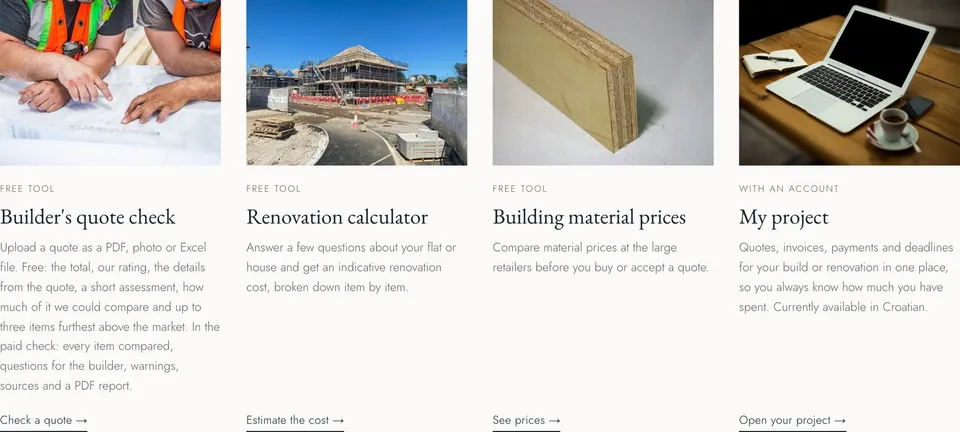
The renovation calculator asks one question per screen and shows how far along you are. The page says it takes about three minutes. You choose what you are renovating (a flat, a house, a holiday apartment or commercial space), the county, the floor area and the age of the property. Then comes the question that matters most: is the renovation cosmetic, partial or complete?
The rest follows from your answers: demolition, electrical installation, plumbing, how many bathrooms and whether they are being done completely, floors, windows, walls and painting, kitchen, heating and air conditioning, the level of finish and any extras such as lighting or interior doors. The number of questions changes with your answers; a cosmetic job skips the questions about installations. Where you do not know, many questions offer a “Not sure” option.
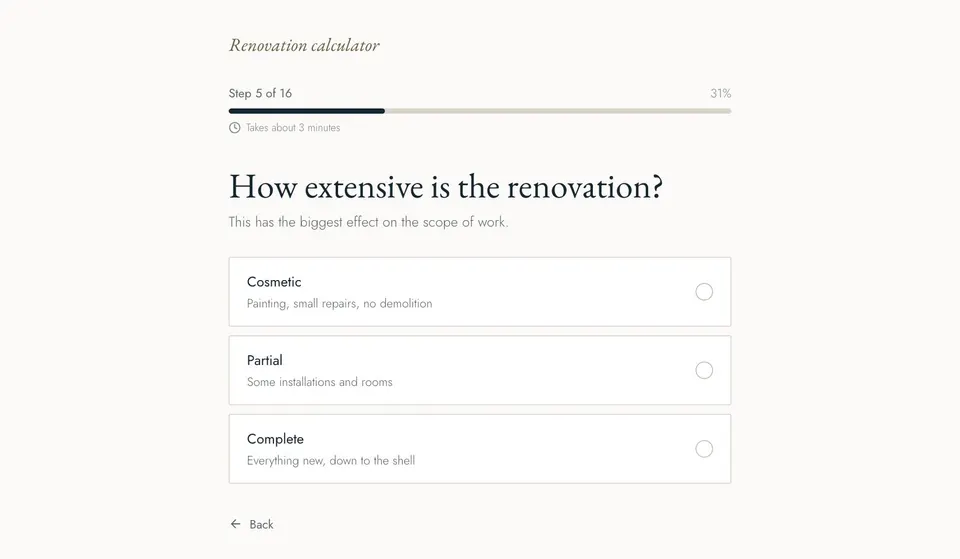
The result is an indicative range, not a single figure, broken down so you can see where the money goes. Write the range down before you open the builder's quote. Atrij's sample result page shows what such a range looks like, together with a reserve for unforeseen work. Our article on why renovations go over budget explains why that reserve matters.
Minutes 3–6: check the quote itself
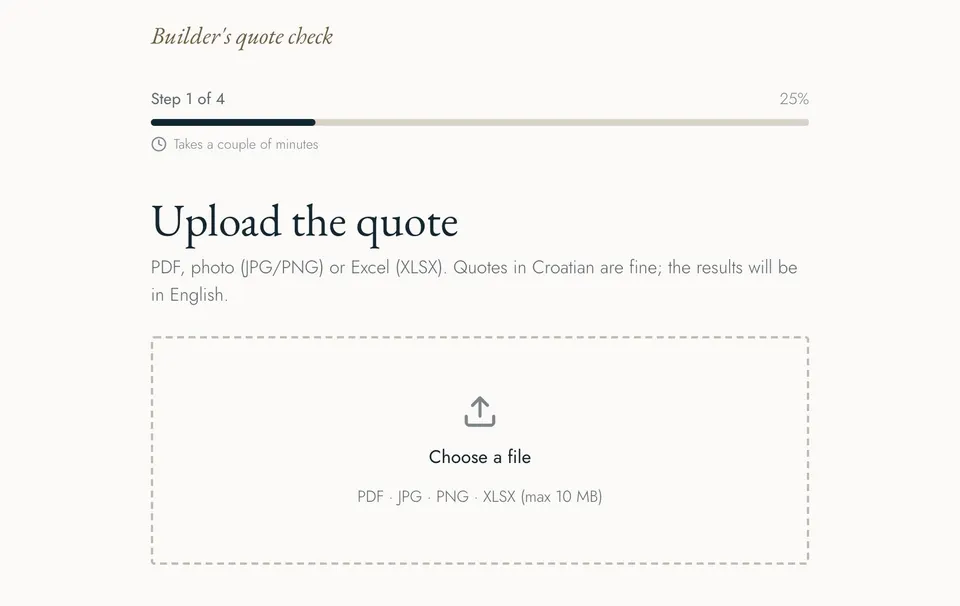
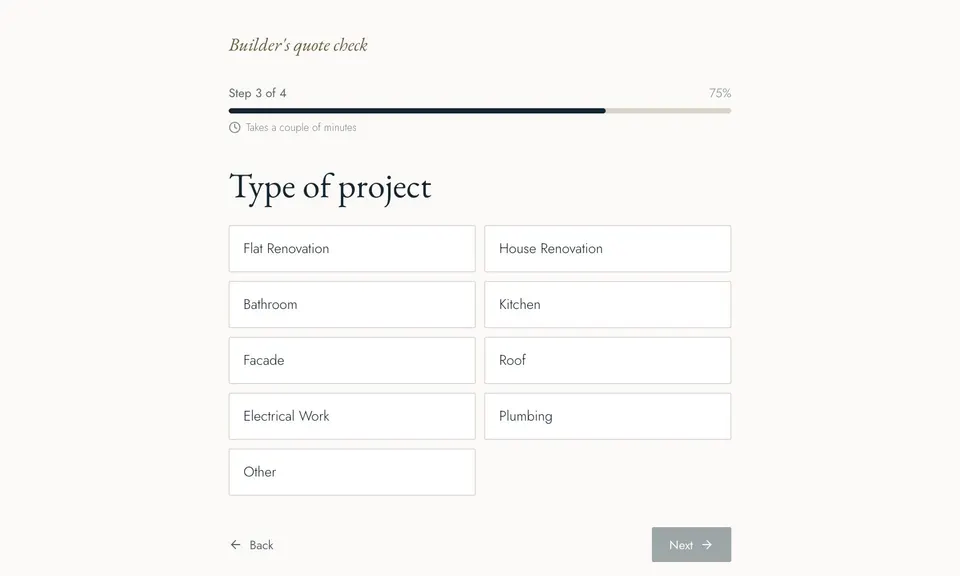
Now open the quote check. Four steps: upload the quote (PDF, photo or Excel, up to 10 MB; Croatian is fine), choose the county, choose the type of project, and add a few optional details such as floor area and whether materials and VAT are included. Then press “Check the quote”.
The free result gives the quote a rating and lists up to three items that sit furthest above the market range for the region; every item, the warnings and questions for the builder are in the paid detailed check. Put it next to the range from the calculator. If the quote sits well above your range, you now have specific lines to ask about. If it sits well below, be just as curious: a low quote often means something has been left out, to come back later as extra work.
A low quote deserves the same questions as a high one. Missing items rarely stay missing; they come back as extras.
Minutes 6–10: spot-check the materials
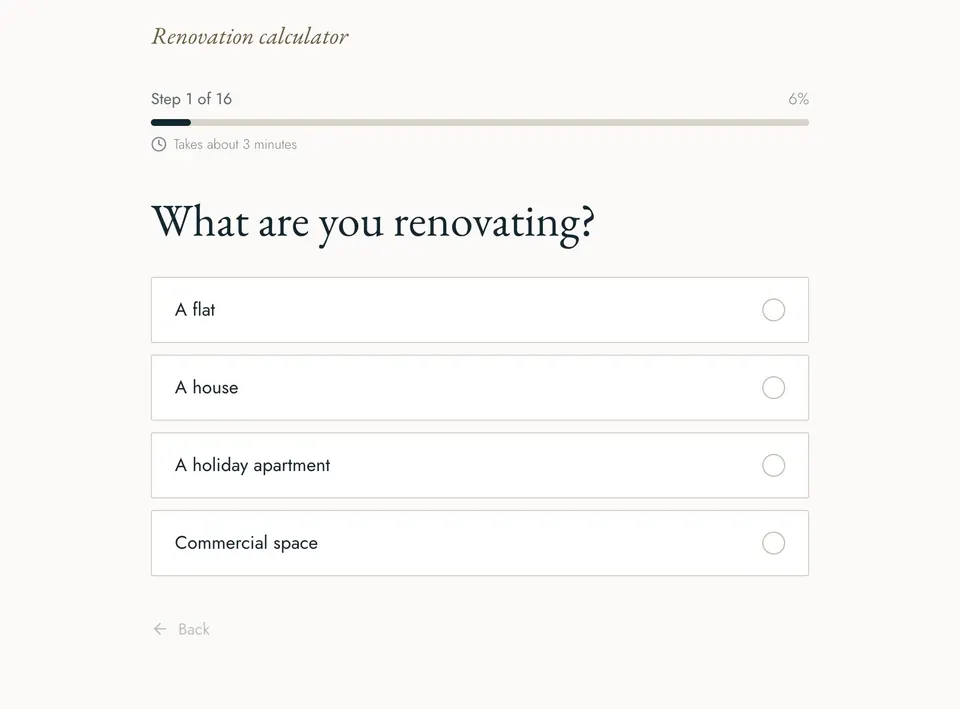
Pick the two or three lines with the most material in them: adhesive and grout for tiling, insulation boards, cement or screed. Search for them in building material prices. The tool lists published prices at large retailers in Croatia, each with the date it was last checked and a link to the retailer. Product names are in Croatian, so search in Croatian: ljepilo za pločice for tile adhesive, fugir for grout, stiropor for EPS boards.
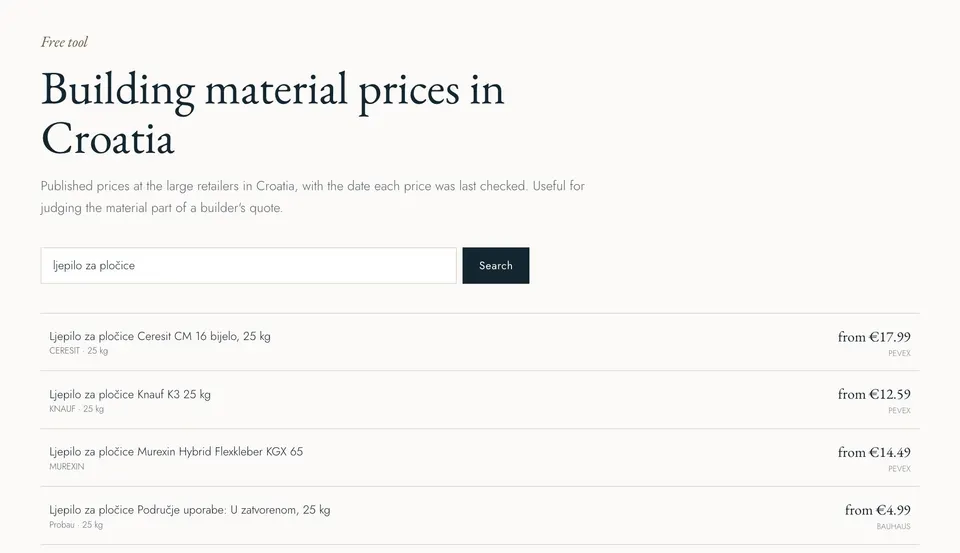
Remember what a builder's line includes besides the material: labour, transport, waste, tools and the builder's overheads. The aim is not to find the builder's margin to the cent. It is to see whether a line is roughly in proportion, and to notice when a material is specified so vaguely that you cannot tell what you are getting.
What to do with ten minutes of notes
- Write down your questions. Start with the lines the quote check flagged, plus any line where you could not find the material or the quantity.
- Ask for the missing items in writing. An updated quote is better than a verbal “that is included”.
- Ask about VAT and materials. If either was unclear, get it stated at the top of the quote.
- Check the quantities. Square metres of tiling and painting should make sense against your floor plan; see the bill of quantities (troškovnik).
- Compare like with like. With more than one quote, follow how to compare builder quotes fairly.
- Keep a reserve. Plan for the unforeseen before you sign, not after.
What ten minutes cannot do
The tools' terms say it plainly: the estimates and checks are informative, not binding offers, not an expert report and not a substitute for a licensed engineer or architect. They know nothing about damp in your walls or the state of your roof. Use them to arrive at the conversation with the builder prepared, and for anything structural, bring in a professional who has seen the property.
The same habit pays off at the other end of the job. Before the final payment, go through the handover checklist. And if the quote includes a kitchen or built-in wardrobes as one lump sum, ask for them to be priced separately; our partner atelier makes fitted furniture to measure in plywood and shows it as a render before anything is made.