A free renovation calculator for flats, houses and holiday apartments in Croatia: which questions it asks, how to answer them and what the price range at the end really means.
Most renovations start with the same question: roughly how much will this cost? Builders are reluctant to say before they have seen the property, and a figure picked up from a neighbour or a forum rarely matches your house. The Atrij renovation calculator gives you a starting point before the first site visit: a price range for your project, split by phase, based on a short set of questions about the property and the work.
This guide explains how the calculator works today, how to answer each question without overthinking it and how to read the result. It is free, it needs no account, and the page says it takes about three minutes. The calculator works in Croatian, English and German; readers in Slovenia and Italy can use the English version.
The questions, in order
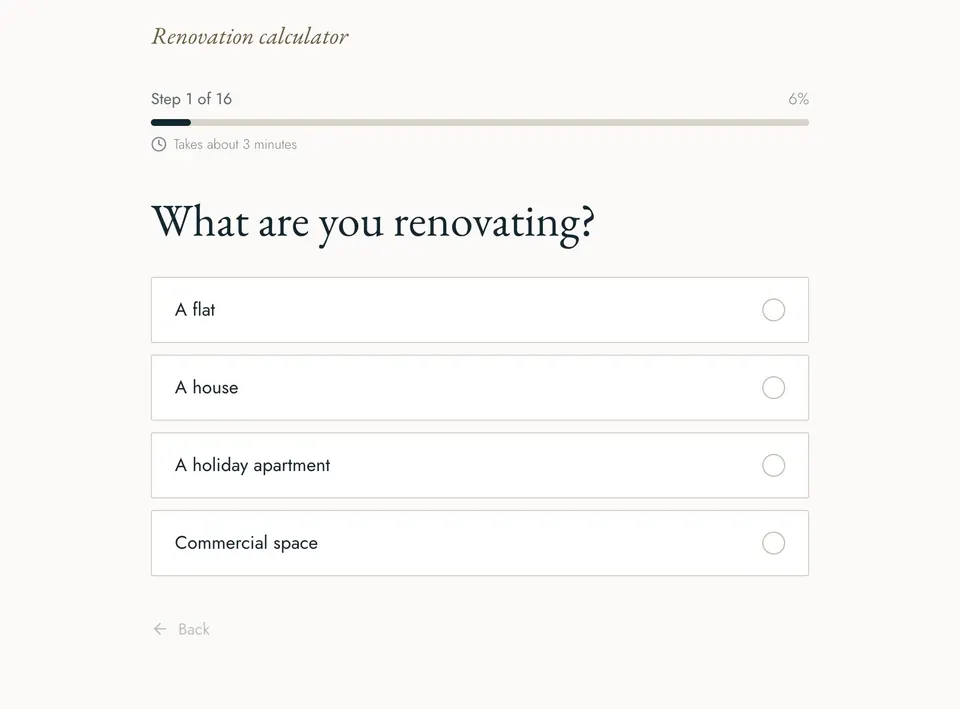
The calculator asks one question per screen, with a progress bar at the top. In the standard path there are sixteen steps, and the number shifts as you answer: choose a cosmetic renovation and the questions about demolition and installations drop out; say you are renovating a bathroom or replacing windows and a follow-up question appears. Single-choice answers move you on automatically; where you can choose several options, press Next.
- What are you renovating? A flat, a house, a holiday apartment or commercial space.
- Where is the property? The county. Prices differ between Croatian counties, and Istria is a county of its own.
- What is the floor area? In square metres.
- How old is the property? From up to ten years to more than fifty.
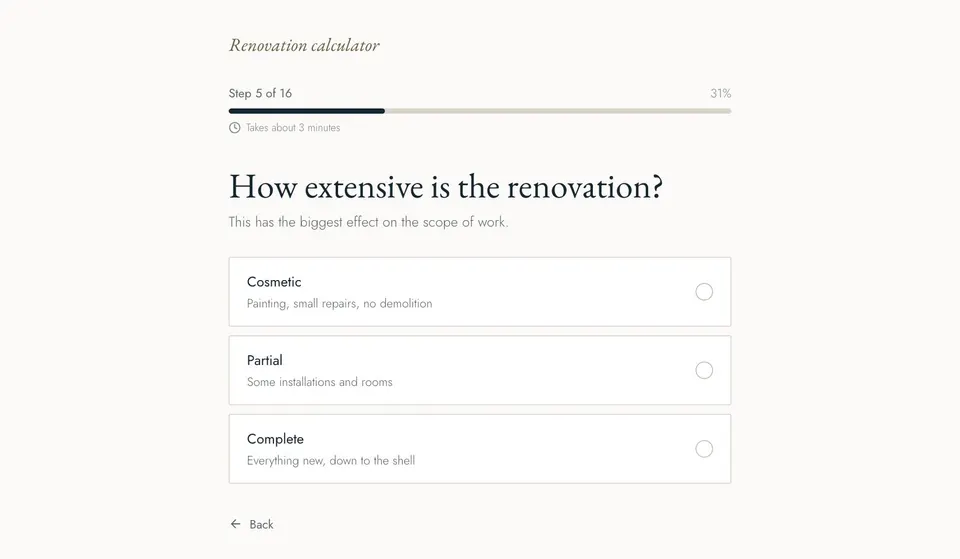
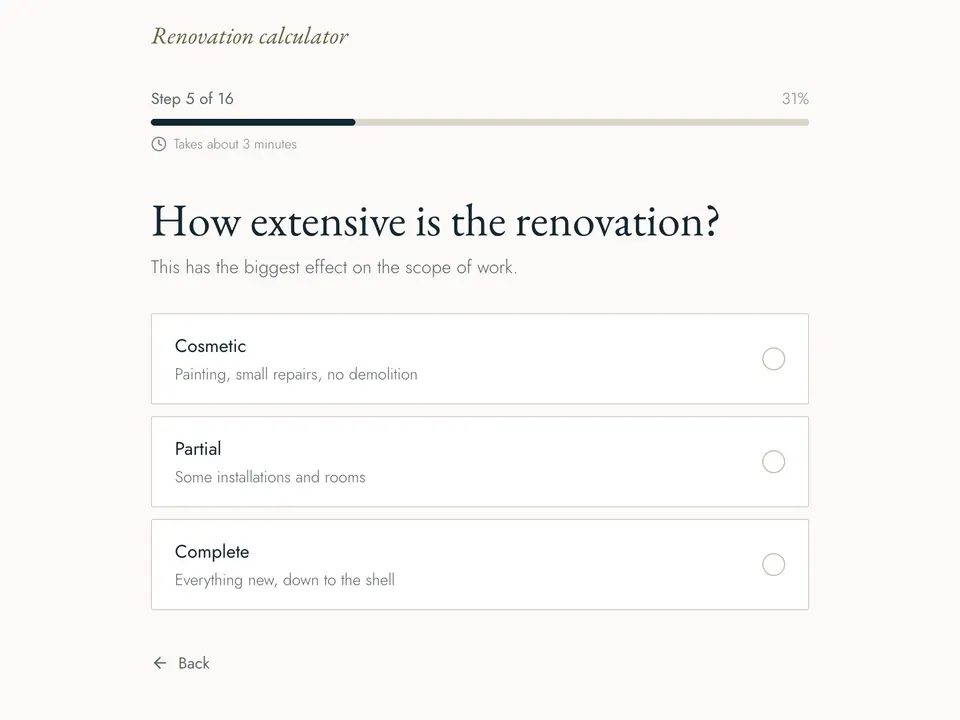
- How extensive is the renovation? Cosmetic, partial or complete.
- Demolition, electrical installation and plumbing. How much of each, from nothing to completely new.
- Bathrooms. How many, and whether each is a complete renovation.
- Floors and windows. Tiles, parquet, laminate or a combination; PVC, aluminium or timber windows, and how many.
- Walls, kitchen, heating and air conditioning. From full skimming and painting to none; kitchen from not included to premium.
- Level of finish and extras. Economy, standard or premium, then lighting or interior doors if you want them.
How to answer when you are not sure
The question that matters most is the scope. The calculator itself says it has the biggest effect on the amount of work, and it is worth being honest here. Many older stone houses in Istria look like a partial job and turn out to be complete ones once the plaster comes off. If the wiring and pipes have not been touched for decades, assume they will need replacing.
For the number of windows there is a ‘Not sure’ option; the calculator then estimates from the floor area. For the level of finish, think about what you will actually buy, not what you saw in a showroom. You can always go back a step and change an answer before the result is shown.
What the result shows
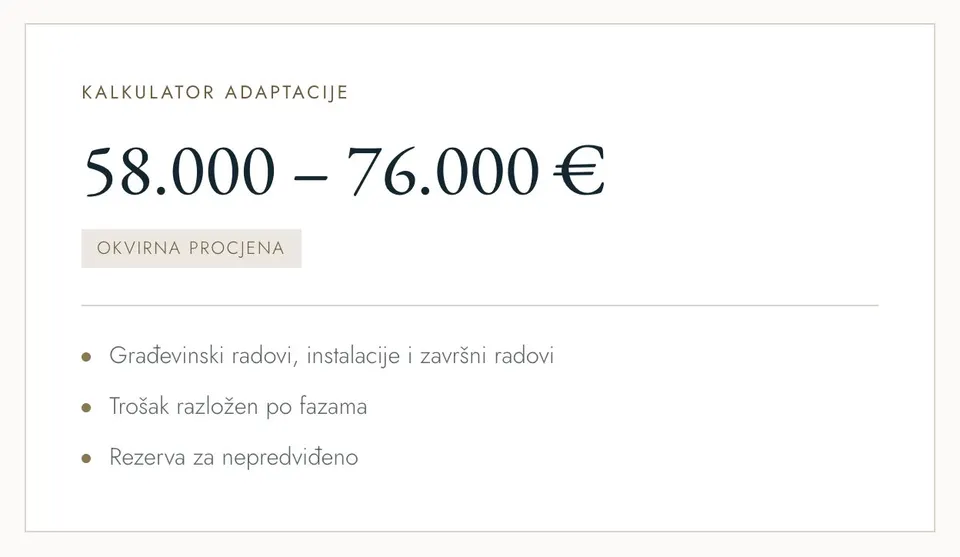
After the last question, ‘Show the result’ takes you to a page with an estimated renovation cost as a range, from a lower to an upper figure, described as an indicative estimate based on your answers. A note underneath explains that it is a preliminary estimate, and that the final price depends on the actual condition of the property, the materials you choose and the builders' quotes.
Below the total is an overview by phase, each with its own range and a bar showing its share of the whole: preparation and demolition; installations (electrical, plumbing, heating); building and masonry work; floors and tiling; windows and doors; kitchen; finishing work; and other extras. Phases you did not include simply do not appear. This view is free.
A detailed estimate is available as a separate one-off payment: an item-by-item breakdown, labour and material, economy, standard and premium scenarios, a contingency reserve, where you can save, an indicative cash flow by phase and a PDF report. At the time of writing, payment for it is marked as coming soon on the site; the range and the phase overview remain free.
What the range really means
A range is the honest answer to an early question. The lower figure assumes the work goes as described; the upper one allows for the same work at the dearer end of the market. Neither is a quote, and neither includes the surprises that only appear once walls are opened. The detailed estimate suggests setting aside a contingency on top, and our piece on why renovations go over budget explains where overruns usually come from.
One more caveat, stated plainly on the result page itself. While the price data behind the calculator is being built up, the result carries a ‘Sample prices’ notice, which means the amounts show how a result is structured and are not real market prices. When you see that notice, use the result to understand which phases drive the cost and what to ask builders about, not as a budget.
An estimate tells you which questions to ask. A builder's quote tells you what you will actually pay.
From estimate to quote
The calculator is most useful at the start and again when quotes come in. Before the first site visit it shows which parts of the job carry the weight, so you can describe the work clearly to builders. Once quotes arrive, you can put each one through the builder's quote check and compare its phases with the calculator's overview. A bathroom quote far above the bathroom phase is not proof of anything, but it is a good reason for a conversation. The bathroom renovation steps guide explains what that phase usually involves.
From the result you can also turn the estimate into My project, where actual costs, quotes and payments are tracked against it. My project is currently available in Croatian only.
Good to know
- Free, no account. The range and the phase overview cost nothing.
- Three languages. Croatian, English and German.
- Prices by county. Choose the county where the property is, not where you live.
- Rounded figures. Amounts are rounded, as befits an estimate.
- Not a quote. The final price comes from builders who have seen the property.
If you are planning work this winter, run the calculator once with your honest answers and once with the scope you hope for. The gap between the two is often the most useful number of all.