Two thousand years ago Istria was a Roman province of colonies, farms and seaside villas. Much of it is still standing, often in the middle of everyday life.
In many places, Roman history is something you visit behind a fence. In Istria, you often walk straight through it. A Roman arch stands at the end of a shopping street, a temple faces the town hall across a square of café tables, and the old Roman street plan still shapes the way you walk through a seaside town. This guide gathers the main Roman sites of the peninsula and explains how they fit together.
How did the Romans come to Istria?
Before the Romans, the peninsula belonged to the Histri, the people who gave Istria its name. Their stronghold was Nesactium, on a hill above the bay of Budava in the south-east. In 177 BC, after a series of wars, the Romans took Nesactium and Istria became part of the Roman world. Over the following two centuries they founded colonies, laid out farmland in regular plots, built roads and planted olive groves and vineyards across the countryside. Under Augustus, Istria became part of Italy itself, and the coast filled with villas, ports and workshops producing olive oil, wine and the amphorae to carry them.
Pula: the Roman city
Pula, the Roman colony of Pietas Iulia, is the richest Roman site in Croatia and the natural place to start. The city kept so much of its ancient fabric that you can follow a Roman itinerary in a single morning.
The Arena
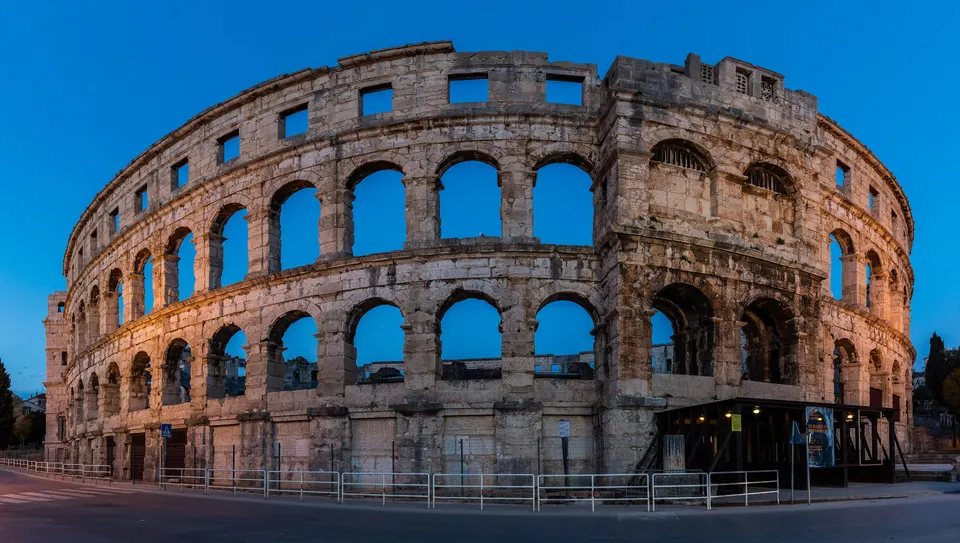
The amphitheatre was built in the first century AD and could hold many thousands of spectators for gladiator games. It is one of the largest surviving Roman amphitheatres and, unusually, its outer ring still stands almost complete, with all three storeys on the side facing the sea. Look for the four towers built into the outer wall, a feature rarely found elsewhere. In the underground passages, where the machinery of the games once stood, there is an exhibition about olive oil and wine production in Roman Istria. In summer the Arena is still used for concerts and the Pula Film Festival.
The Forum and the Temple of Augustus
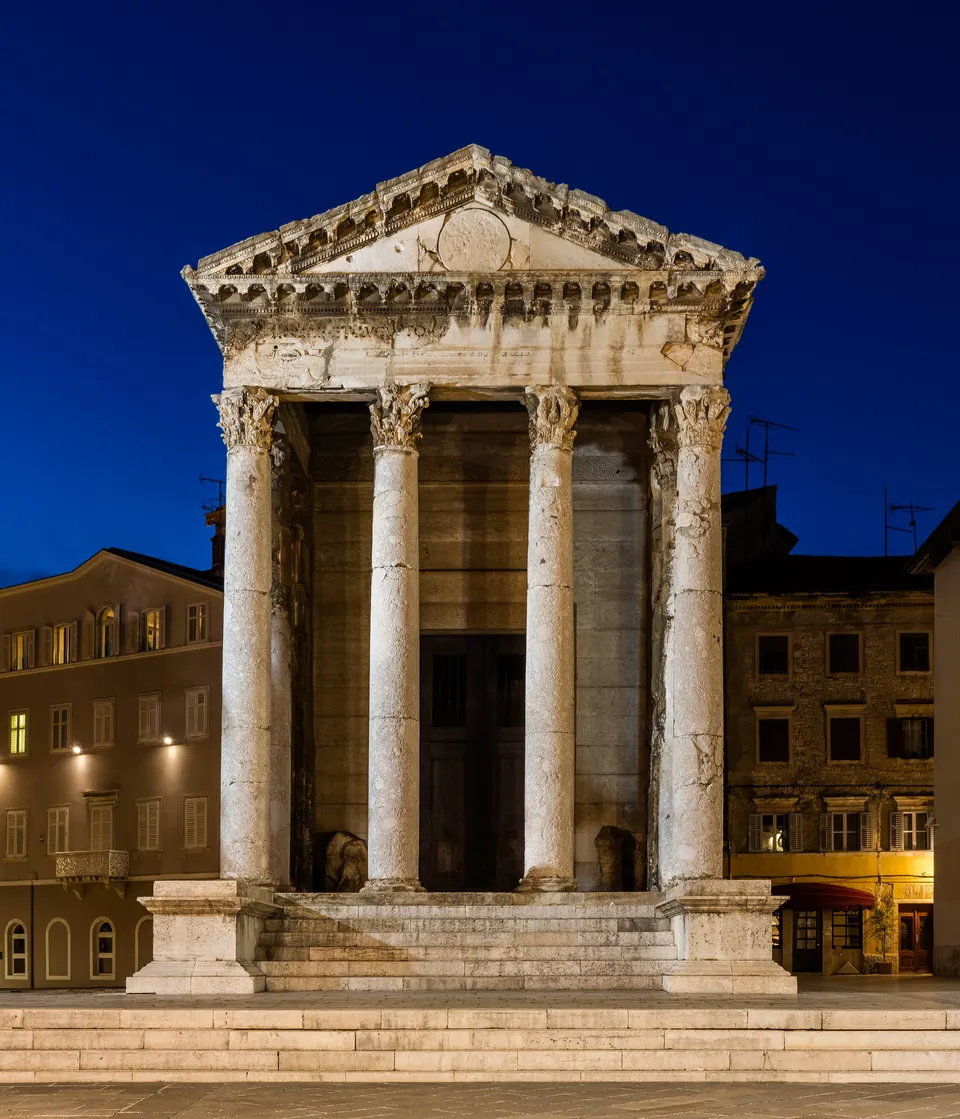
The Forum, the main square of the Roman city, is still Pula's main square. On one side stands the Temple of Augustus, built in the early first century AD and dedicated to Rome and the emperor. It is a small, elegant temple with a porch of Corinthian columns, and one of the best-preserved Roman temples outside Italy. It was badly damaged by a bomb in the Second World War and carefully rebuilt afterwards. Next to it, the town hall incorporates the back wall of a second, twin temple.
The gates and the Arch of the Sergii
The Arch of the Sergii, a triumphal arch from the late first century BC, was built by a wealthy local family to honour three of its members. It once stood against a city gate; today it frames the entrance to the old town's main shopping street. Around the old town you can also find the Twin Gates and the Gate of Hercules, as well as the remains of a Roman theatre on the slope below the Venetian fortress. For more of the city, read Pula beyond the Arena.
In Istria you rarely visit Roman history behind a fence. You walk straight through it.
Poreč: a Roman town plan you can still walk
Poreč, Roman Parentium, sits on a small peninsula, and its old town still follows the Roman grid. The main street, the Decumanus, runs the length of the peninsula and crosses the Cardo near the centre, just as it did two thousand years ago. At the tip, on Marafor square, you can see the foundations of Roman temples. Poreč is best known for the Euphrasian Basilica, a UNESCO World Heritage Site from the early Byzantine period, whose complex grew on top of earlier Christian buildings of the late Roman town. Our guide to Poreč and the Euphrasian Basilica covers it in detail.
Villas by the sea: Brijuni and the coast
Wealthy Romans loved this coast. Along the shore of southern and western Istria, archaeologists have found the remains of dozens of country houses, from working farms to luxurious seaside residences.
The most impressive is in Verige Bay on Veliki Brijun, the largest island of the Brijuni National Park. Here a grand villa wrapped around the bay, with temples, baths, terraces, gardens and a private harbour. Walking among its walls, with the sea on one side and the meadows on the other, you can easily imagine the life of leisure it was built for. A visit is part of the national park tour; see our guide to Brijuni National Park.
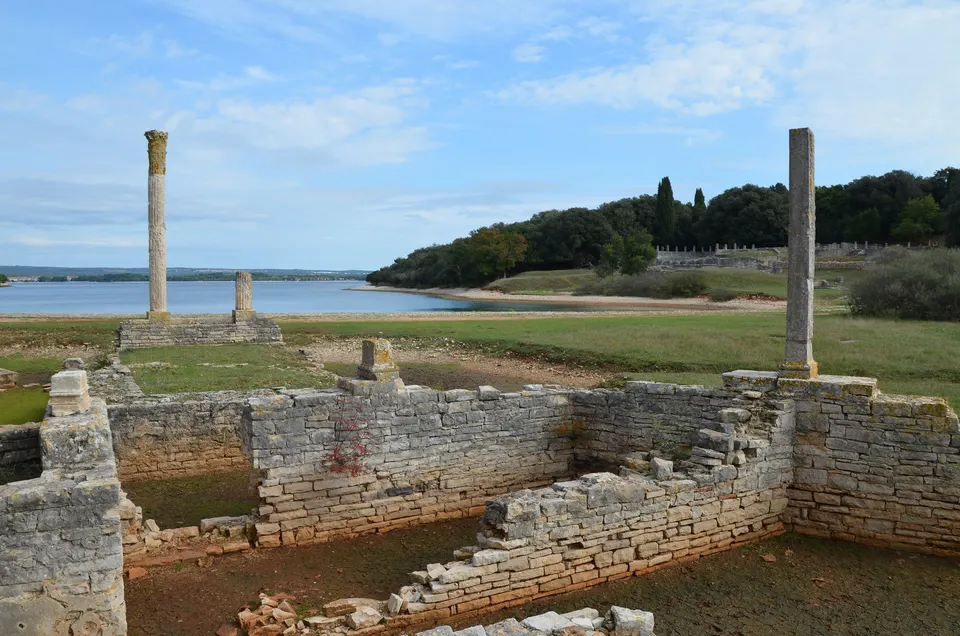
On the mainland, the Vižula peninsula near Medulin holds the ruins of another seaside villa, right beside a popular swimming spot. Fažana, opposite Brijuni, was home to a large Roman workshop making amphorae, the clay jars used to ship Istrian olive oil across the empire.
Nesactium: where Roman and pre-Roman meet
Near the village of Valtura, a short drive from Pula, the archaeological site of Nesactium lies on a quiet hill above the sea. It is one of the few places in Istria where you can see both the world of the Histri and the Roman town that grew on top of it: foundations of temples, a forum, baths and early Christian churches. It is rarely crowded, and the view over the bay makes it a fine place to end a Roman day.
A Roman itinerary
- Morning in Pula. The Arena early, before the heat, then the Arch of the Sergii, the Forum and the Temple of Augustus.
- Afternoon at Nesactium. A short drive east, quiet and atmospheric.
- A second day. Take the boat from Fažana to Brijuni for the villa in Verige Bay.
- A third day. Walk the Decumanus in Poreč and visit the Euphrasian Basilica.
- Before you go. Opening hours and tickets change with the season; check the official sites.
The Roman inheritance today
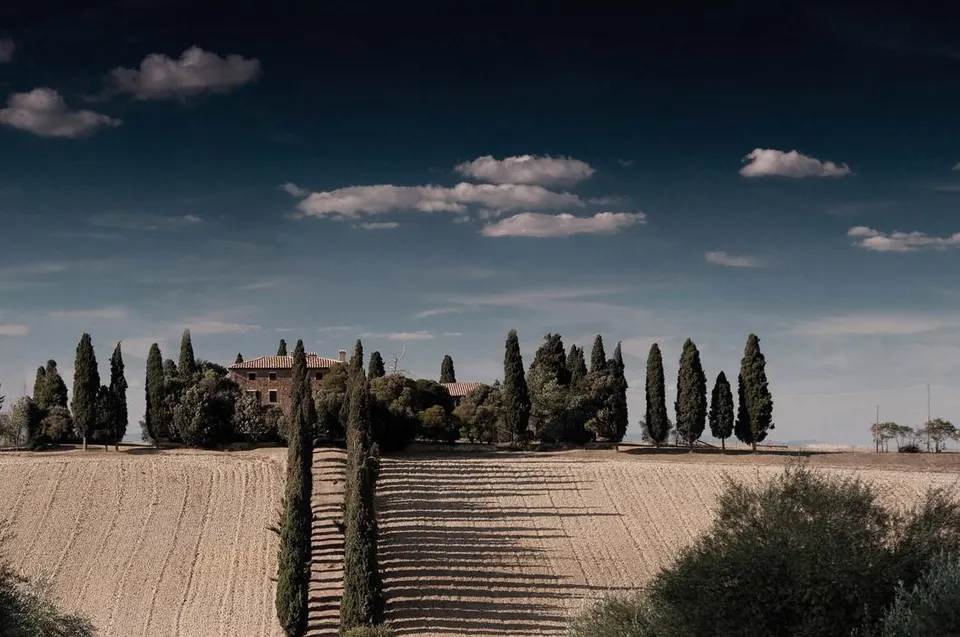
The Romans left more than monuments. The pattern of fields in parts of southern Istria still follows their land divisions, olive oil and wine remain the backbone of rural life, and the habit of building with local limestone, thick walls and small openings against the sun has carried through the centuries. The Istrian house of today, with its stone, terraces and long table in the shade, owes more to the Roman villa than most people realise.