The rules of thumb for sizing a chandelier, how high to hang it over a table or in a tall room, and how clear, frosted and coloured glass change the light.
A chandelier is the one light in a room that people look at rather than by. Chosen well, it sets the scale and mood of the whole space, the way a good painting or a fireplace does. Chosen badly, it is either a timid little object lost under a high ceiling, or a glittering mass that everyone has to duck around.
The good news is that most of the decisions follow a few simple rules. Here they are, in the order you will need them.
Where should a chandelier go?
Start with the room and its use, not the fitting. Chandeliers work best where there is a natural centre: over a dining table, in the middle of a living room with a seating group beneath, in an entrance hall or stairwell with height to fill, and, more quietly, in a bedroom. In each case the chandelier should relate to something below it, a table, a rug, a seating group, so it feels anchored rather than floating.
If the table is not yet placed, place it first. A chandelier centred on the room but not on the table is one of the most common, and most visible, mistakes.
What size chandelier do I need?
For a chandelier in the middle of a room, a widely used rule of thumb is to add the length and width of the room in metres and multiply by about eight: the result is a sensible diameter in centimetres. A room of four by five metres gives nine, so a chandelier of around 70 to 75 cm across. Treat it as a starting point, then adjust for the ceiling height and the style of the piece.
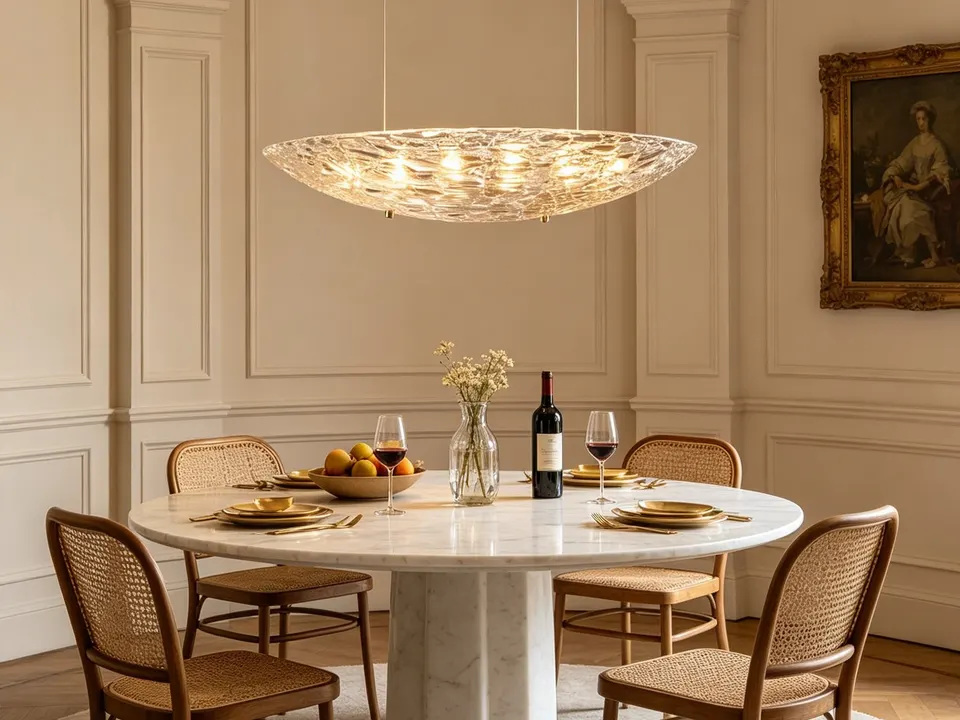
Over a dining table, the table decides. A chandelier roughly half to two-thirds the width of the table looks balanced, and it should leave a comfortable margin at each end so nobody bumps their head standing up. For a long table, consider a linear fitting or two smaller chandeliers rather than one huge round one.
- Room centre. Length plus width in metres, times about eight, gives a diameter in centimetres.
- Dining table. About half to two-thirds of the table width.
- Long table. A linear piece, or two matching fittings spaced along it.
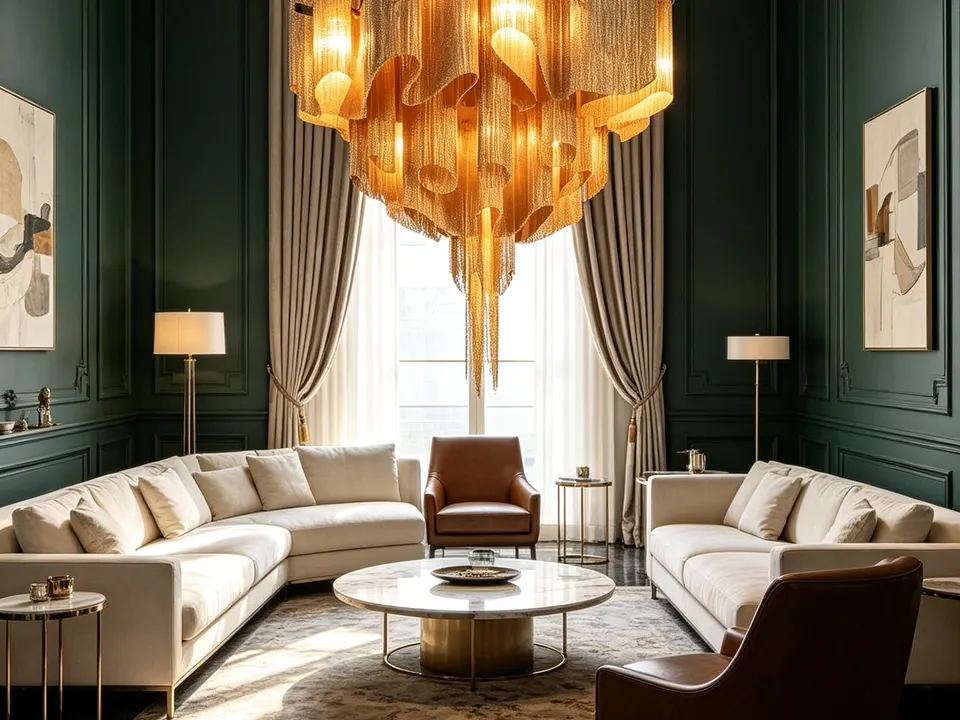
- Tall rooms and stairwells. Think in height as well as width: tiered and cascading pieces fill vertical space.
How high should a chandelier hang?
Over a dining table, the bottom of the chandelier usually sits around 75 to 90 cm above the tabletop. That is low enough to feel intimate and light the table, high enough not to block the view across it. In a higher room, go towards the upper end; with a very large or heavy-looking piece, a little higher still.
Where people walk underneath, in a living room, hall or bedroom, leave clear headroom: a common guide is at least 2.1 metres from the floor to the lowest point. In rooms with tall ceilings, which many older Istrian town houses have, the chandelier can drop well below the ceiling and should, so that its light reaches the people in the room rather than the plaster above them.
As for the height of the fitting itself, a rough guide for a statement piece is around 20 to 25 cm of chandelier for each metre of ceiling height. A three-metre ceiling can carry a piece of 60 to 75 cm comfortably.
If the table is not yet placed, place it first. The chandelier follows the table, not the ceiling.
Clear, frosted or coloured glass?
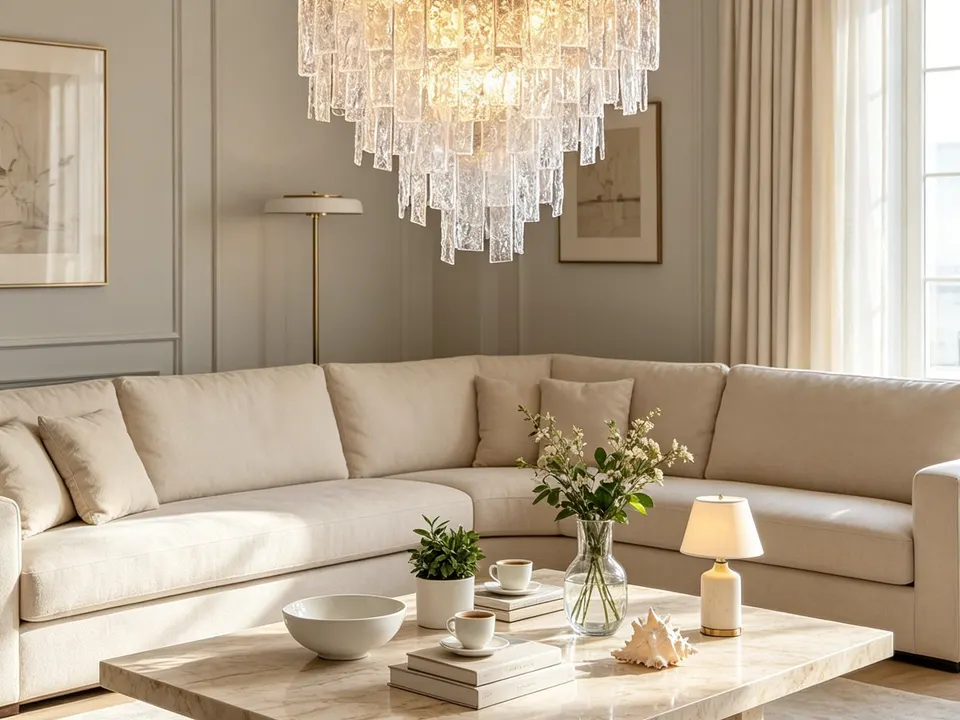
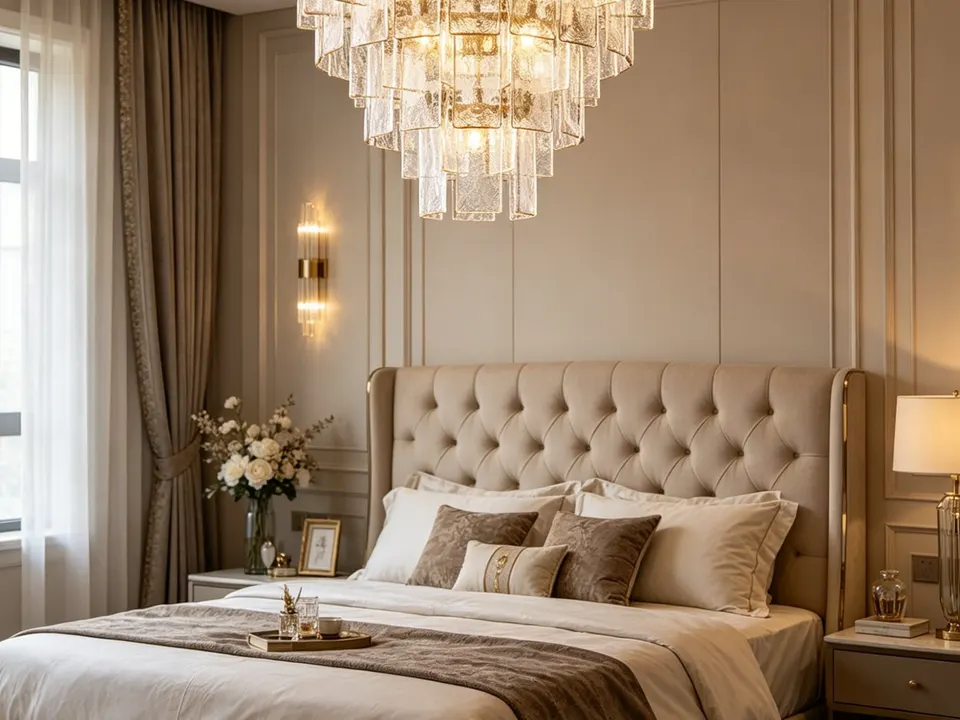
The glass changes the light as much as the shape does. Clear glass sparkles: it throws small points of light around the room and looks lively, especially with textured or faceted pieces. It also shows the bulbs, so their shape and colour matter. Frosted, opaline or milk glass diffuses light into a soft, even glow, kinder to faces and easier on the eyes in a bedroom or a low room. Coloured glass, amber, smoke, green, tints the whole room. It can be beautiful in the evening and is worth seeing lit before you commit.
Hand-made glass, Murano being the best-known example, has small irregularities, bubbles and variations in thickness that catch light in a way machine-pressed glass does not. Our guide to Murano glass lighting explains what to look for.
Bulbs, dimmers and light colour
- Warm white. Around 2700 K suits dining and living rooms; it flatters skin, timber and stone.
- Good colour rendering. Look for a high CRI so food and faces look natural.
- Always a dimmer. A chandelier at full power is for cleaning. At dinner it should glow.
- Match the bulbs. Mixed colour temperatures in one fitting look patchy, especially through clear glass.
- Check the fitting's rating. Use bulbs within the wattage and type the manufacturer specifies.
Installation: weight, ceilings and old houses
Glass chandeliers can be heavy. Before you buy, know what your ceiling is made of and how the fitting will be fixed. Concrete slabs, timber beams and lightweight plasterboard ceilings all need different fixings, and an old stone house may have surprises above the plaster. A qualified electrician should check the fixing point and the wiring, and fit a dimmer compatible with the bulbs. If you are renovating, plan the position and a reinforced fixing point before the ceiling is closed.
Think about cleaning too. A chandelier over a stairwell looks wonderful and is hard to reach. Ask whether the glass elements can be removed and washed, and whether the fitting can be lowered.
A chandelier as part of the room
A chandelier is the centrepiece, not the whole lighting plan. Combine it with lamps at seating height, wall lights and, where useful, discreet ceiling light for tasks. Our piece on lighting a villa room by room sets out how the layers work together.
Lampisa, the Istrian atelier we work with, offers lighting, including Murano glass chandeliers, in its online catalogue. Because it also builds furniture to measure, it can look at the table, the room and the light together, and show the chandelier in a 3D render of your room before you choose. If you are unsure about size or height, send the room dimensions and a photo and ask.