Solid wood sounds better, veneer sounds like a shortcut. In a house by the sea, the truth is closer to the opposite, as long as you know what sits under the veneer.
Ask most people which is better, veneer or solid wood, and the answer comes without hesitation: solid wood, of course. Veneer has a reputation as the cheap imitation, a thin skin of wood glued over something lesser. Sometimes that reputation is deserved. But it misses how fine furniture has been made for centuries, and how wood actually behaves in a house that faces the sea.
The honest answer is that the question is the wrong one. What matters is not only the surface you see but the core you do not, and how the two work together.
What is veneer, exactly?
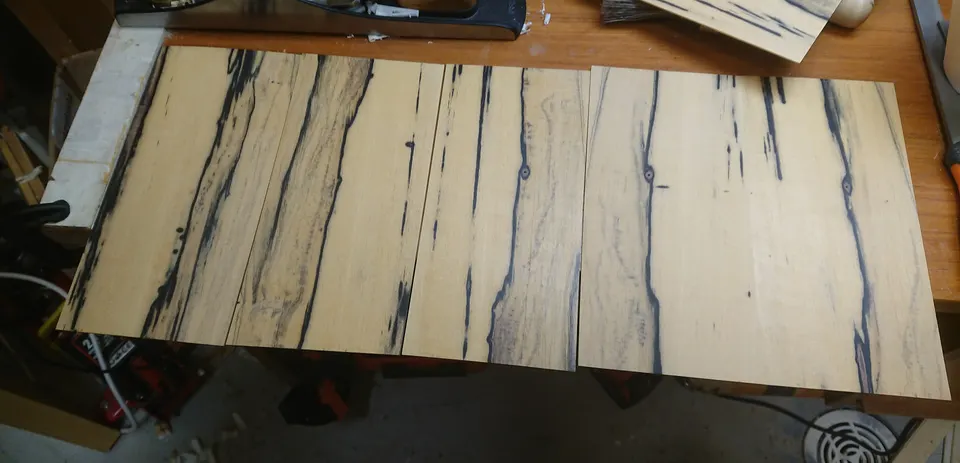
Veneer is real wood, sliced or peeled from a log into thin sheets. Those sheets are glued onto a stable base to make a panel: a tabletop, a wardrobe door, a drawer front. Because one log yields many sheets, the same figure can be repeated across a whole wall of cupboards, and leaves cut in sequence can be laid side by side so the grain mirrors or flows from one panel to the next. Cabinetmakers have used veneer this way for centuries, on some of the most valuable furniture ever made.
The quality of veneered furniture depends on three things: the veneer itself, the glue, and above all the board underneath. Fine veneer on particleboard is still particleboard furniture. The same veneer on plywood is something else entirely.
What is wrong with solid wood?
Nothing, as long as you respect how it moves. Wood takes up moisture from the air and gives it back, and it swells and shrinks as it does, mostly across the grain. A wide solid tabletop can change in width between a humid August and a dry, heated January. A good maker designs for this, with joints and fixings that let the wood move. A poor one does not, and the result is cracks, warped doors and drawers that stick in summer.
In an Istrian holiday home, that movement is exaggerated. The house may be closed for months, then opened and filled with people overnight. Sea air reaches well inland. Solid wood can live with this, but it needs the right design, the right finish and some care.
Why a plywood core changes the picture
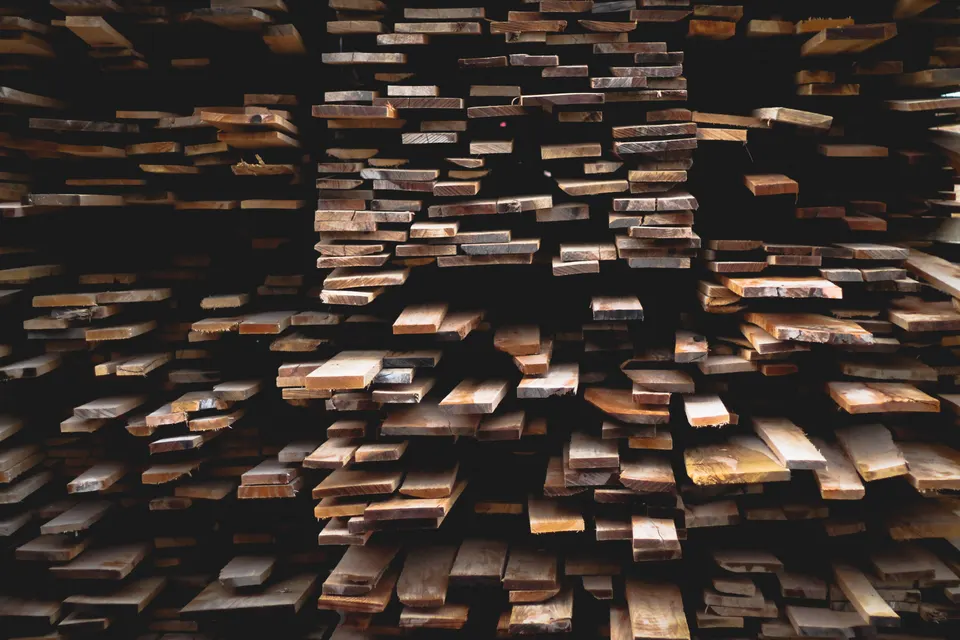
Plywood is itself made of veneers: thin layers of wood glued together with the grain of each layer turned at a right angle to the one below. Because the layers pull against each other, the board stays flat and moves far less than solid wood. Screws and fittings hold well, even after the piece has been taken apart and reassembled. And it is more resistant to moisture than particleboard, provided it is made with the right glue and its edges are sealed.
Put a fine face veneer on a plywood core, and you get the look of the chosen wood with the stability of an engineered board. That is why our partner atelier, Lampisa, builds with plywood as the structural material and treats the visible surface as a finish chosen room by room. Wood veneer is one of the finishes that can go on top. For the full comparison of the boards underneath, read plywood or particleboard.
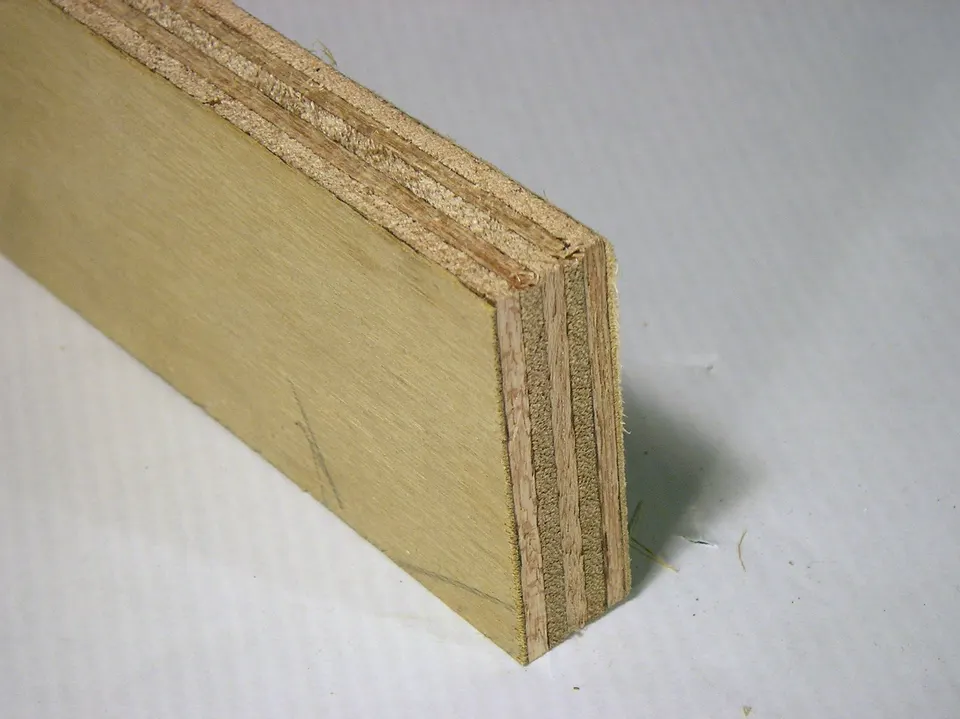
Fine veneer on particleboard is still particleboard furniture. The same veneer on plywood is something else entirely.
Veneer or solid wood: an honest comparison
- Stability. Veneer on plywood stays flatter through the seasons. Solid wood moves and needs a design that allows for it.
- Large surfaces. Wide doors, long sideboards and wall panelling are where a veneered panel shines; in solid wood they are prone to warping.
- Repairs. Solid wood can be sanded back many times. Veneer can be repaired and refinished too, but its thickness limits how deep you can go.
- Edges and knocks. Solid wood edges take knocks well. Veneered panels need well-made edges, ideally in solid wood or a thick edging.
- Grain and pattern. Veneer allows matched grain across a whole wall of doors, something solid boards cannot do.
- Weight. A plywood panel is lighter than solid wood of the same strength, which helps on stone staircases and with wall-hung units.
- Use of wood. One log covers far more surface as veneer than as solid boards.
Where solid wood still makes sense
There are places where solid wood is simply the right material. Chair frames and legs, which must take load and knocks. Handles and the edges of tables and worktops, which are touched every day and should feel like wood all the way through. Small pieces, where movement hardly matters. A good piece of furniture often combines both: a plywood carcass and panels for stability, with solid wood where the hand meets it. Lampisa can discuss solid wood details as part of the finish.
How to tell what you are buying
Look at an edge or the inside of a drawer. On a veneered panel you will see a thin layer of figured wood over a core: plywood shows parallel layers, particleboard shows a speckled mass of chips, MDF a smooth brown fibre. On solid wood, the grain on the face continues around the edge and over the end of the board. If the edge is covered with a strip, ask what is under it.
- What is the core? Plywood, particleboard or MDF.
- How thick is the face veneer? Thicker veneer allows more refinishing.
- How are the edges made? Solid lipping, thick edging or a thin strip.
- What is the finish? Oil, lacquer or varnish, and how is it maintained?
- Where is solid wood used, and how does the design allow it to move?
So which should you choose?
For fitted wardrobes, kitchens, sideboards and panelling in a coastal home, a good veneer on a plywood core is usually the more durable choice, not the cheaper compromise. For chairs, table edges and handles, solid wood earns its place. The worst choice is the one you cannot see: an attractive surface over a board that will not survive the first wet summer. Our guide to Istrian stone and oak shows how wood finishes sit within an Istrian interior.