What a genuine Murano chandelier costs, why arms, colour and gold leaf push the price up, how to recognise a copy and how to choose the right size.
A new, mouth-blown Murano chandelier with six to twelve lights cost roughly €7,000 to €11,000 in November 2026 from sellers who publish their prices. Grand pieces in the Ca’ Rezzonico style, with 36 to 50 lights, ranged from about €49,000 to €85,000. The price is driven mainly by the number of arms, the handwork, the colour, gold leaf and the origin. This guide shows how to read those factors, how to recognise a copy and why the size is chosen to suit the table and the ceiling before you pay.
What Murano glass is, where it comes from and how to care for it is explained in Murano glass lighting. Here the subject is buying.
What a Murano chandelier costs
Reliable prices are hard to find, because many workshops only quote on request. Some workshops from Murano and Venice, however, sell through curated online marketplaces for Italian craftsmanship, with published prices and lead times. The table shows examples we checked on 22 November 2026. In a selection of 68 Venetian chandeliers on one such marketplace, prices started at around €4,700 and went above €85,000.
| Chandelier | Lights | Size | Price | Lead time |
|---|---|---|---|---|
| Classic Venetian, 24-carat gold leaf | 6 | Ø 85 cm | about €7,100 | 16 to 17 weeks |
| Modern, made on Murano, with the origin mark | 12 | Ø 110 cm | about €7,400 | 13 to 14 weeks |
| Made on Murano, with the origin mark | 8 | Ø 70 cm | about €8,500 | 13 to 14 weeks |
| Oval, gold leaf, made on Murano, with the origin mark | 8 | 100 × 60 cm | about €8,500 | 13 to 14 weeks |
| Venetian, mouth-blown | 14 | Ø 100 cm | about €15,600 | 7 to 8 weeks |
| Grand piece in the Ca’ Rezzonico style | 36 to 50 | not stated | about €49,000 to €85,000 | not stated |
Shipping and installation come on top. For delivery to the kerb, the same listings quoted shipping from about €300 to €560, depending on the piece; delivery into the house costs extra. Most pieces are only made once ordered, with lead times of roughly two to four months. Second-hand and vintage pieces can be cheaper, but their price depends heavily on condition, completeness and wiring.
What drives the price
Number of arms and tiers
Each arm is a separate glass element shaped by hand, plus the candle cup, drip pan, leaves and flowers. More arms therefore mean more glass, more hours at the furnace and more assembly. Descriptions such as “6+3” or “12+6” indicate two tiers: six arms below, three above. The link is not linear, though. In our table a plain, modern chandelier with twelve lights costs less than one with eight lights and gold leaf. Style counts as much as number.
Mouth-blown and shaped at the furnace
Genuine Murano glass is shaped by hand while hot. That takes time and skill and is the core of the price. Pressed or moulded glass is far cheaper to make, but it also looks the same piece after piece. The origin mark also distinguishes two kinds of work: a red label for glass shaped at the furnace (prima lavorazione) and a blue one for the second stage of working (seconda lavorazione).
Colour
Clear glass, called cristallo on Murano, is the base. Coloured glass gets its colour from minerals and metal oxides in the melt, and some colours are more demanding than others, such as ruby red, which is traditionally coloured with gold. Multicoloured chandeliers, with arms, flowers and leaves in different shades, usually cost more because more individual parts in different colours have to be matched.
Gold leaf
Many classic models carry gold leaf, often 24-carat, worked into the glass or applied as leaves. It raises the price and is also a test: real gold leaf in glass shows a fine, irregular pattern of cracks and patches, because the foil is stretched apart as the glass is shaped. Gold paint or a metallic coating sits evenly on the surface and can be scratched.
Origin and workshop
The biggest difference is where the glass is made. Only a few dozen firms on Murano use the protected origin mark; in November 2026 the list of licensees had about 35 companies. A piece from one of these workshops usually costs more than a “Venetian” chandelier from the mainland or an import that only looks the part. In between lies a grey area: lights assembled in Italy that may contain glass from the island. So always ask which part was made where.
How to recognise a copy
The basic signs of handwork, such as small bubbles, colour in the glass rather than on it, and weight, are covered in our guide to Murano glass. When buying, what counts most is the wording, the paperwork and the price.
Read the description carefully. “Murano style”, “Venetian style”, “Murano look” or simply “Made in Italy” do not mean the glass was made on the island. Serious sellers name the workshop, the model and the place of manufacture explicitly.
Check for the Vetro Artistico Murano origin mark. It is a collective mark created by the Veneto Region by law in 1994 and managed by a consortium of glassmakers, and it may only be applied to glass made on Murano. The label is red or blue, carries the maker’s code at the top and, since 2016, a serial number and a Data Matrix code that identify each piece. Both codes can be checked on the consortium’s verification page, original.muranoglass.com, or with its app, and muranoglass.com lists the licensed firms. Not every genuine Murano maker uses the mark, but where it is missing, the other evidence should be all the clearer.
Ask for an invoice that names the workshop, model, number of lights and place of manufacture, and for a certificate of authenticity that refers to that exact piece. A certificate issued by the seller alone, naming neither maker nor label, proves little. Look for mould seams as well: fine lines along a glass part and elements that are exactly identical point to pressed glass.
And compare the price with the work. A chandelier with twelve arms and flowers offered as genuine Murano for a few hundred euros deserves close questioning when workshops on the island charge many times that for simpler models.
Where the glass was made is written on the label and the invoice, not in the product name.
The right size: table and ceiling first, then the chandelier
With Murano, size is a question of money as well as looks. A larger diameter usually means more arms and more glass, and because most pieces are only made once ordered, a chandelier that is too big can rarely just be exchanged. Ask before ordering whether a return is possible and on what terms.
So choose in this order: first the table and the room, then the chandelier. It belongs to the table, not to the centre of the room, and its height follows from the ceiling. The rules of thumb for diameter and hanging height are in How to choose a chandelier. When buying, a few further points are often overlooked.
Ask for the overall height, including canopy and chain, not just the height of the glass body. Check whether a model comes in several sizes or with a different number of lights; many workshops adapt colour, dimensions and lights on request, which can lengthen the lead time. And test it at home: a cardboard circle the diameter of the chandelier, hung where it will go above the table, shows in five minutes whether the size is right. Find out early, too, whether the ceiling can carry the weight and where the connection is.
Delivery and installation
A Murano chandelier usually arrives dismantled, in several boxes, with the frame and wiring separate and each glass element packed on its own. The maker usually includes assembly instructions. Check the boxes on delivery before you sign, and report breakage straight away with photos; a replacement for a single glass part is often made specially and takes time.
Connecting and fixing the frame is a job for an electrician. Hanging the glass parts takes patience, several hours for large pieces. Photograph every step, because the same pictures help later with cleaning. For a villa you do not live in all year, plan the installation with the person who holds the key and with enough time before the first guests.
Murano, light and the partner atelier
A chandelier is the centrepiece of a room, not all of its light. Whether it works depends on the table below it, the chairs, the wall lights and the colour of the walls. That is why it pays to plan it together with the rest of the room rather than buy it as a single piece.
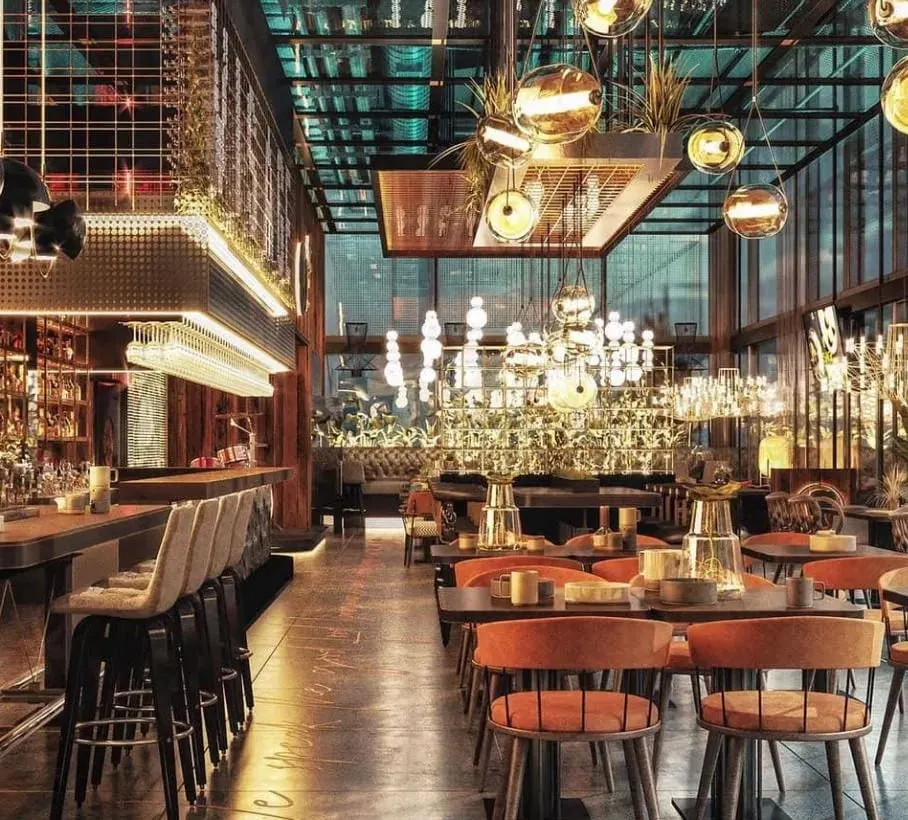
Atrij helps you with this as an intermediary: with our partner atelier Lampisa we look at which lights from the lighting collection suit your table and ceiling, arrange the offer and follow the order. Whether a particular piece is made on Murano we clarify for each piece individually before the offer. The atelier can show the chandelier together with the table and the room in a 3D view before you decide. How glass lights work above tables can be seen in the atelier’s projects such as Visage Gastrobar in Zürich and Why Montreux Restaurant.