Stone towers on low capes and lonely islets have guided ships along the Istrian coast for two centuries. Here is where to find them, how to see them and what makes each one special.
Few things capture the Istrian coast as well as a lighthouse at dusk: a pale stone tower, a keeper's house with green shutters, the sea turning silver behind it. Istria has a long, indented coastline and lies on one of the oldest shipping routes in the Adriatic, the approach to Trieste, Rijeka and Venice. So it is no surprise that its capes and islets carry some of the most beautiful historic lighthouses in Croatia. Most were built in the nineteenth century, when the coast belonged to the Austrian Empire and Trieste was its main port.
Savudrija: the oldest light on the coast
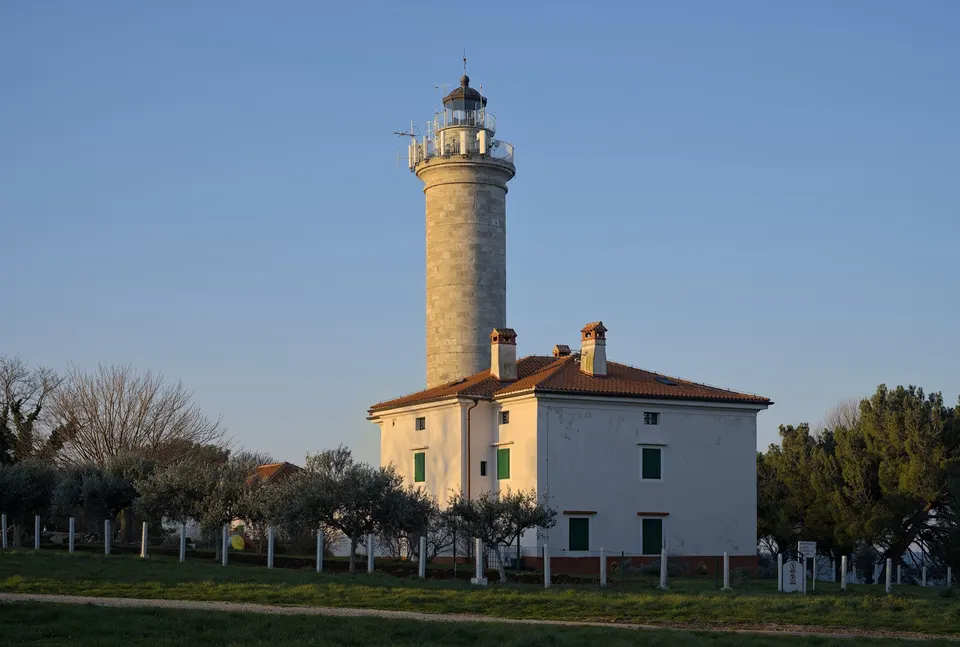
At the north-western tip of Istria, close to the westernmost point of Croatia, the lighthouse of Savudrija stands on a low, open shore just outside the village. It was built in the early nineteenth century and is generally described as the oldest working lighthouse in the Adriatic. The slender stone tower rises from a two-storey house, surrounded by lawn, olive trees and flat rocks that slope gently into the sea.
Savudrija is also the easiest lighthouse in Istria to visit. You can walk right up to it, swim from the rocks nearby and, above all, watch the sunset. On clear evenings the view reaches across the Gulf of Trieste towards the Slovenian and Italian coasts. A romantic local legend says the lighthouse was built by a nobleman for a girl he loved, who died before she could see it. Nobody can prove it, but it is told to every visitor. For more on this corner of Istria, see our guide to Umag and Savudrija.
Porer: the lighthouse at the end of Istria
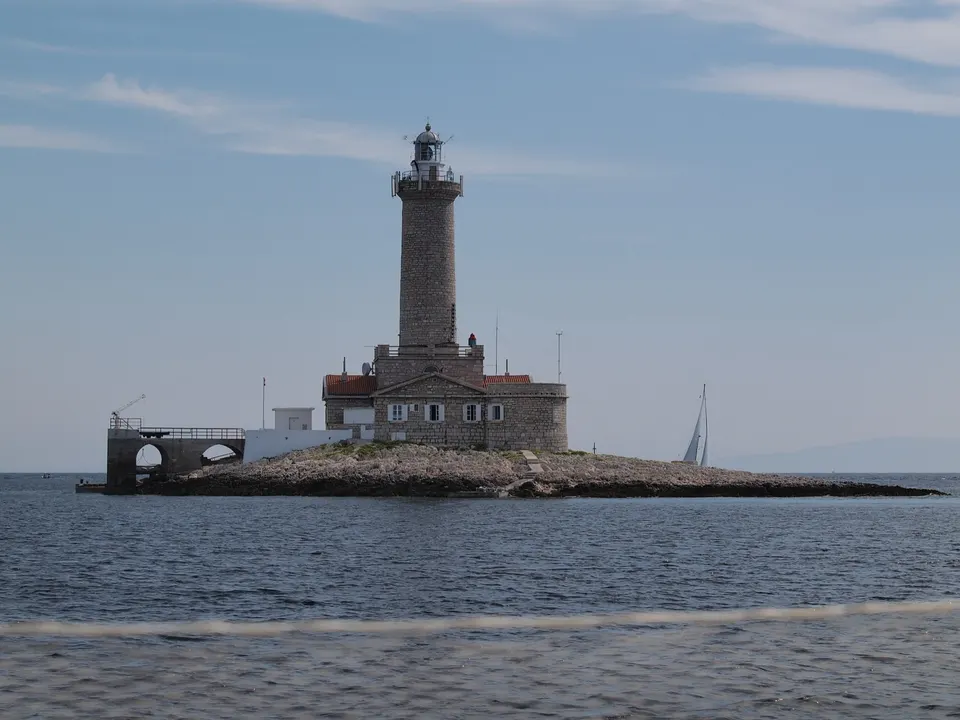
Off the southern tip of the peninsula, beyond the protected cape of Kamenjak, a single lighthouse rises from a tiny, almost bare islet. This is Porer, built in the 1830s to mark the dangerous rocks and shallows at the entrance to the Kvarner. Its tall stone tower rises from a low stone building that covers much of the islet, so from a distance it looks as if the lighthouse is floating on the sea.
You cannot walk to Porer, but you do not need to. The western side of Kamenjak gives a perfect view of it, especially at sunset, when the tower stands black against the sky. In summer, boat trips from Premantura and Pula often pass close by, and sailors use it as a landmark for rounding the cape.
From a distance, Porer seems to float on the sea: one tower, one islet, and nothing else until the horizon.
Sveti Ivan na pučini: the lighthouse off Rovinj
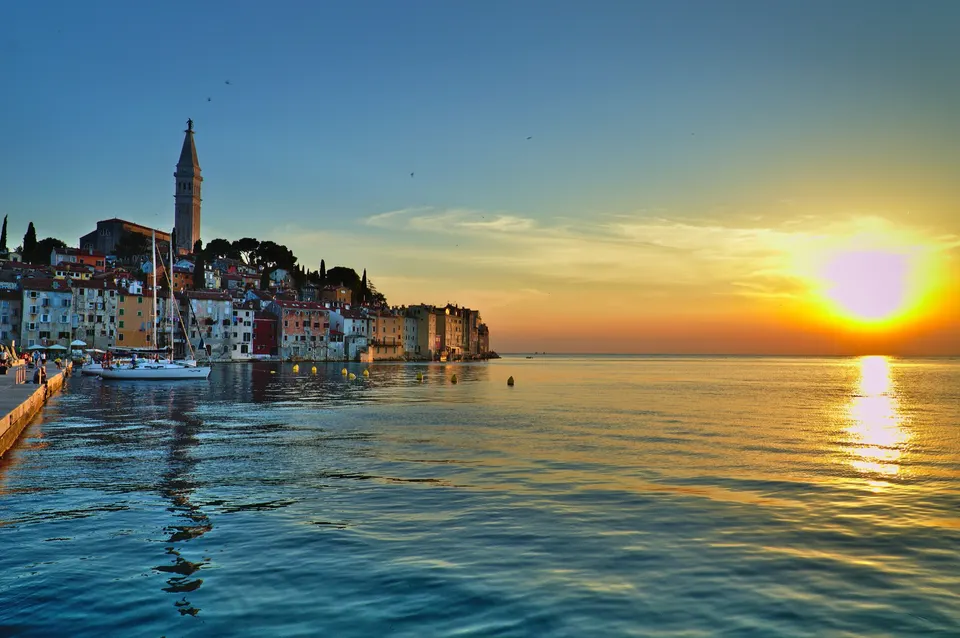
In the archipelago of small islands off Rovinj, the furthest and loneliest is Sveti Ivan na pučini, St John on the open sea. Its lighthouse, built in the mid-nineteenth century, has a sturdy stone tower rising from a solid keeper's house, set on a low rocky islet with nothing around it but water. On a clear day you can see it from the waterfront of Rovinj, a small white mark on the horizon.
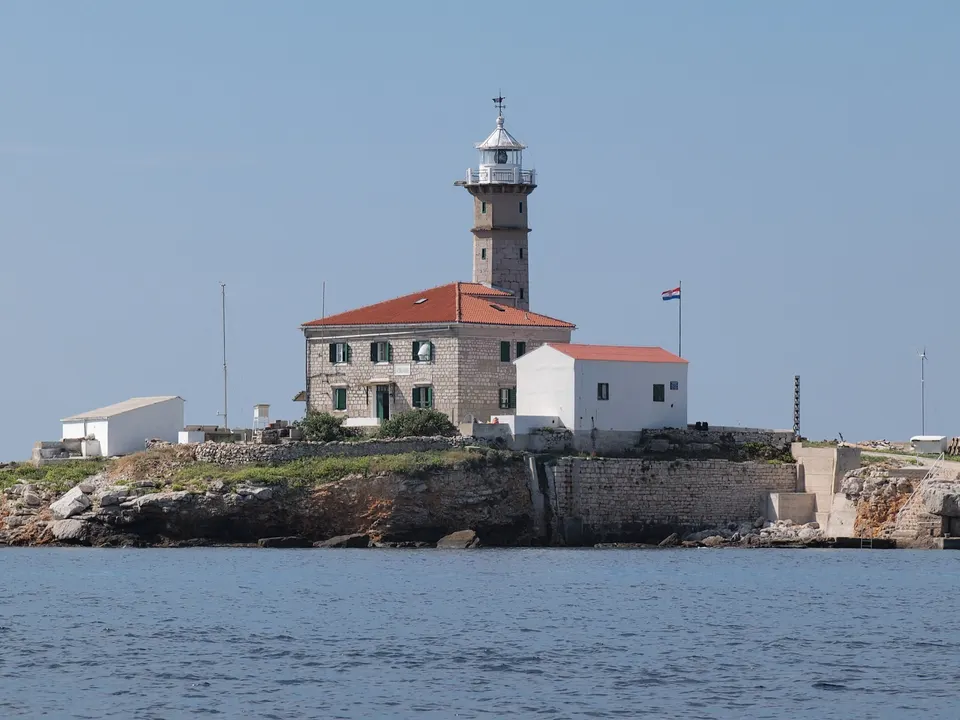
The only way to see it up close is by boat. Excursion boats and boat-hire companies in Rovinj sail around the archipelago in summer, and the lighthouse makes a natural turning point. If you are sailing yourself, it is a useful landmark on the way along the west coast; our guide to sailing in Istria has more on the route.
Other lighthouses along the coast
These three are the most famous, but they are not alone. Smaller lights mark the capes and harbour entrances all along the coast: on the west coast between Novigrad and Poreč, at the entrances to Rovinj and Pula, on the Brijuni islands and on the capes of the south-east, around Medulin and Ližnjan. Many are simple modern beacons, but some still keep their old stone towers and houses. A good nautical map, or simply a walk along the coastal paths, will reveal them one by one.
Can you stay in a lighthouse in Istria?
Most Croatian lighthouses are now automated, and the keepers have left. Some of the old keepers' houses along the Croatian coast, including several in Istria, have been converted into holiday apartments. Availability, rules and access change from year to year, and the most remote islets can be reached only by boat, with no shops and limited fresh water. If the idea appeals, search for official lighthouse accommodation and check carefully what is included before you book.
Good to know
- By land. Savudrija is a short walk from the village. Porer is best seen from the western shore of Kamenjak.
- By sea. Sveti Ivan na pučini and Porer can be seen up close only from a boat; excursions run mostly in the summer season.
- Respect the sites. Lighthouses are working navigation aids. Do not climb fences or enter areas marked as private.
- Sunsets. Savudrija and Porer both face west and are among the best sunset spots in Istria.
- Wind and weather. Boat trips to the islets depend on the sea; the bura and the jugo can cancel them at short notice.
- Photography. A longer lens helps for the offshore lighthouses; for Savudrija, come in the golden hour before sunset.
A different way to see the coast
Lighthouses change the way you look at the sea. They remind you that this beautiful coast was, for most of its history, a place of work and danger, where a light on a rock could decide whether a ship came home. Visiting them is a quiet, unhurried way to explore Istria, and a perfect excuse to stay out until the first lights come on.