Cement, tile adhesive, insulation, grout: how to look up what building materials cost at the large Croatian retailers, how to read a price, and how to use it against a builder's quote.
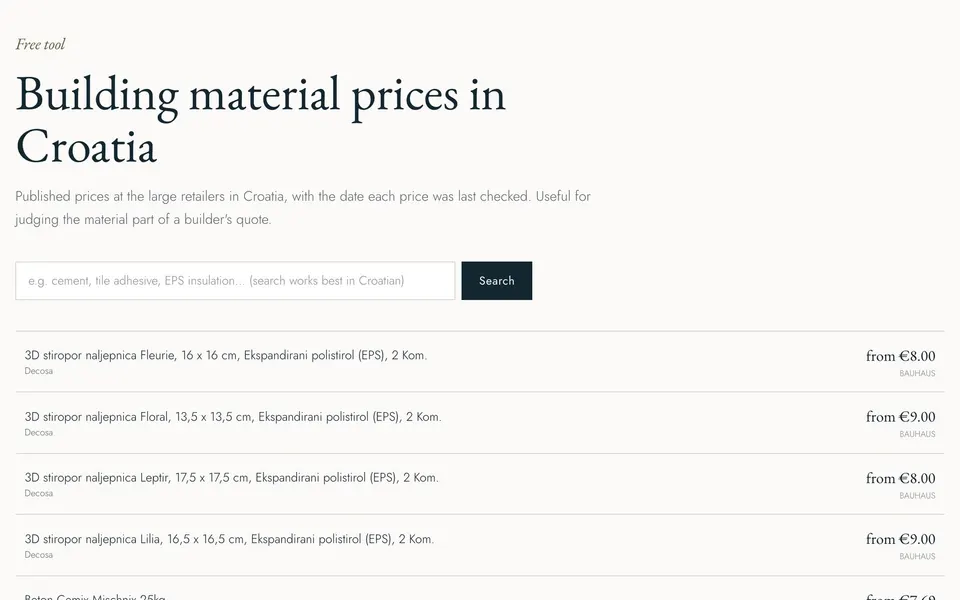
When a builder's quote says dobava i ugradnja, supply and fix, the price on each line covers both the material and the labour. You cannot see where one ends and the other begins, but you can find out what the material costs on the shelf. Atrij's building material prices collects the published prices of building materials at large retailers in Croatia, with the date each price was last checked, so you can look them up in a minute without visiting a store.
This guide explains how the catalogue works, how to search it when product names are in Croatian, how to read a price properly and how to use what you find. It is free and needs no account. The page is available in Croatian, English and German.
What is in the catalogue
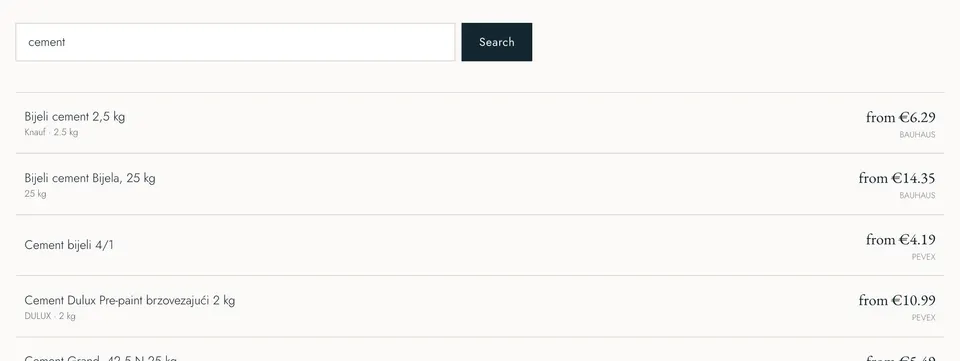
The catalogue lists building materials you meet in renovation quotes: cement and concrete mixes, screeds, tile adhesives and grouts, facade adhesives, insulation and similar products. Each product appears under the name the retailer uses, in Croatian, with the brand and pack size where known, a ‘from’ price and the retailer. At the time of writing the prices come from two large DIY and building retailers, Bauhaus and Pevex. The catalogue is being added to over time, so if something is missing today, it may be there later.
How to search: use Croatian words
Because product names are in Croatian, the search works best in Croatian, and the search box says so. You do not need much vocabulary. These words cover most of what appears in a quote:
- cement: cement; bijeli cement is white cement.
- beton: ready-mixed dry concrete in bags.
- estrih: screed.
- ljepilo: adhesive; ljepilo za pločice is tile adhesive, ljepilo za fasadu facade adhesive.
- fugir masa: tile grout.
- stiropor: expanded polystyrene (EPS) insulation.
- žbuka: plaster or render.
If a search returns nothing, try a shorter or more general word. The results list shows each product on a line, so you can scan the brands and pack sizes quickly. The full catalogue is also browsable page by page without searching.
How to read a price
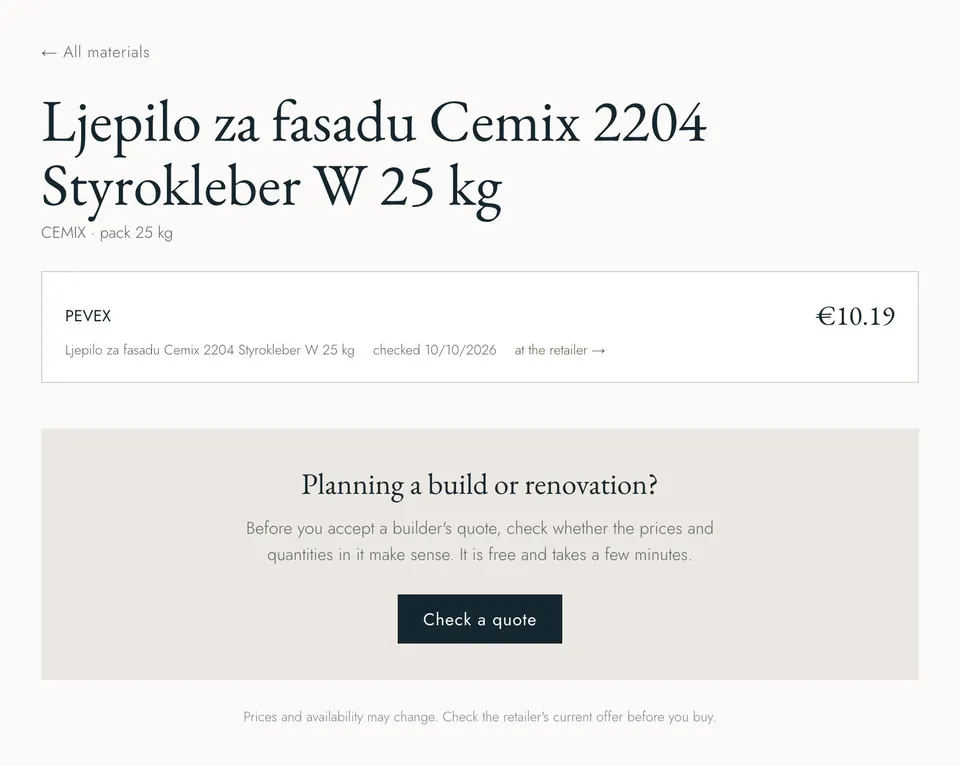
Open a product and you will see who sells it, the price, and the date the price was checked, with a link through to the product at the retailer. A price that has not been refreshed recently is marked as older. Prices and availability change, so the catalogue reminds you to check the retailer's current offer before you buy.
Three habits make the numbers more useful. First, compare the price per unit, per kilogram or per square metre, rather than the price per pack; the catalogue itself points out that offers with different pack sizes are alternatives, not the same thing. Second, compare like with like: a basic tile adhesive and a flexible one for large-format tiles or underfloor heating are different products at different prices. Third, remember that these are retail prices. A builder may buy at trade prices, and also pays for transport, storage, waste and the time spent fetching it.
A shelf price does not tell you what a builder should charge. It tells you where the conversation starts.
Using material prices against a quote
The catalogue is most useful in two situations. The first is a supply-and-fix line that looks high. Work out roughly how much material the line needs from the quantity in the quote, look up what it costs, and you will see how much of the unit price is left for labour and the builder's costs. That is not a verdict, but it gives you something concrete to ask about. Our guide on how to read a builder's quote explains supply and fix and the other columns.
The second is a labour-only quote, where you buy the materials. Here the catalogue helps you budget, and the bill of quantities tells you how much to buy; see the bill of quantities (troškovnik) for how quantities are set out. Agree with the builder in writing exactly which products, and how much of each, they expect you to supply, and who orders the surplus or the shortfall.
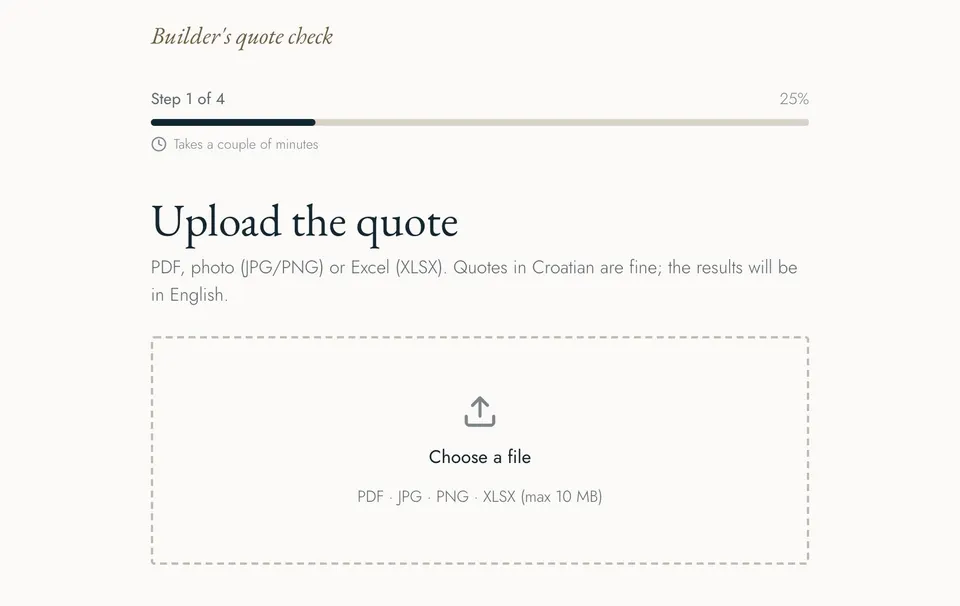
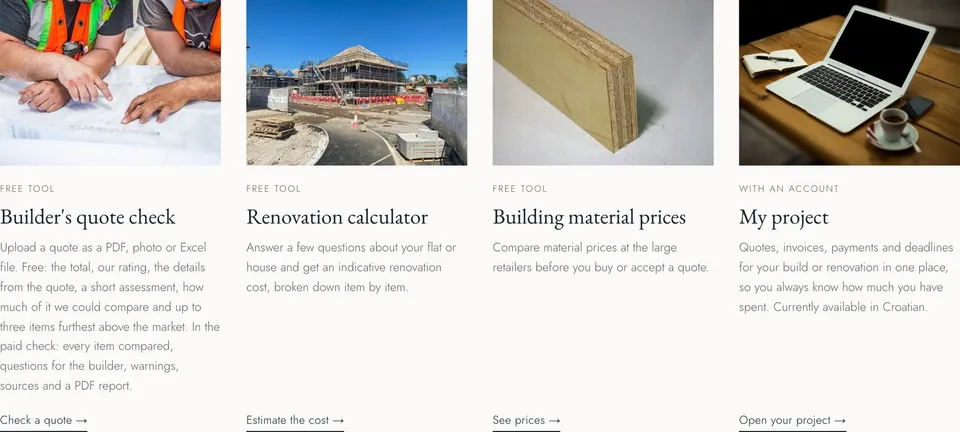
For the whole quote rather than single lines, the builder's quote check reads the whole document and tells you, for free, how many items are worth checking and how much of the quote's value it could compare with market ranges. Material prices are the quick, do-it-yourself counterpart: one product, one question, one minute.
Before you buy
- Check the date. Look at when the price was last checked, and confirm with the retailer.
- Check the pack size. Compare per kilogram or per square metre.
- Check the product. Ask the builder for the exact product or class they plan to use.
- Check the delivery. Heavy bags of cement and adhesive often cost more to bring to site than you expect, especially to a village house.
- Check what is left over. Ask how surplus material is handled before the work starts, not after.
Material is usually only part of what you pay for, and often not the largest part. Knowing what it costs simply makes the rest of the quote easier to discuss. When you next see a line you do not understand, look the material up before you pick up the phone.