Kitchen showrooms sell doors and worktops. The part that decides how long a kitchen lasts is the box behind them, and in a kitchen it meets water every day.
When people choose a kitchen, they choose the doors. The colour, the handles, the worktop, perhaps the tiles behind the hob. That is understandable, because the doors are what you see. But a kitchen door is a panel hung on two hinges. Everything it depends on, the box it closes, the shelf that carries the plates, the base that stands next to the dishwasher, is the carcass. And the carcass is the part most kitchen offers say least about.
In most kitchens sold today the carcass is particleboard with a melamine surface. In a kitchen built from plywood, it is layers of real wood. The difference does not show on the day of installation. It shows years later, under the sink.
What the carcass actually does
A kitchen carcass carries more than any other piece of furniture in the house. It holds the worktop, which in stone can be very heavy. It carries the sink, full of water and pans. It holds the hinges of doors opened dozens of times a day and the runners of drawers loaded with cast iron and crockery. It sits on the floor, where water ends up when anything spills, and next to appliances that give off heat and steam.
So the carcass has three jobs: stay square under load, keep its screws and fittings tight, and survive the moisture a kitchen produces. Doors can be replaced in an afternoon. A carcass that has swollen or sagged means taking the kitchen apart.
Water: where particleboard fails first
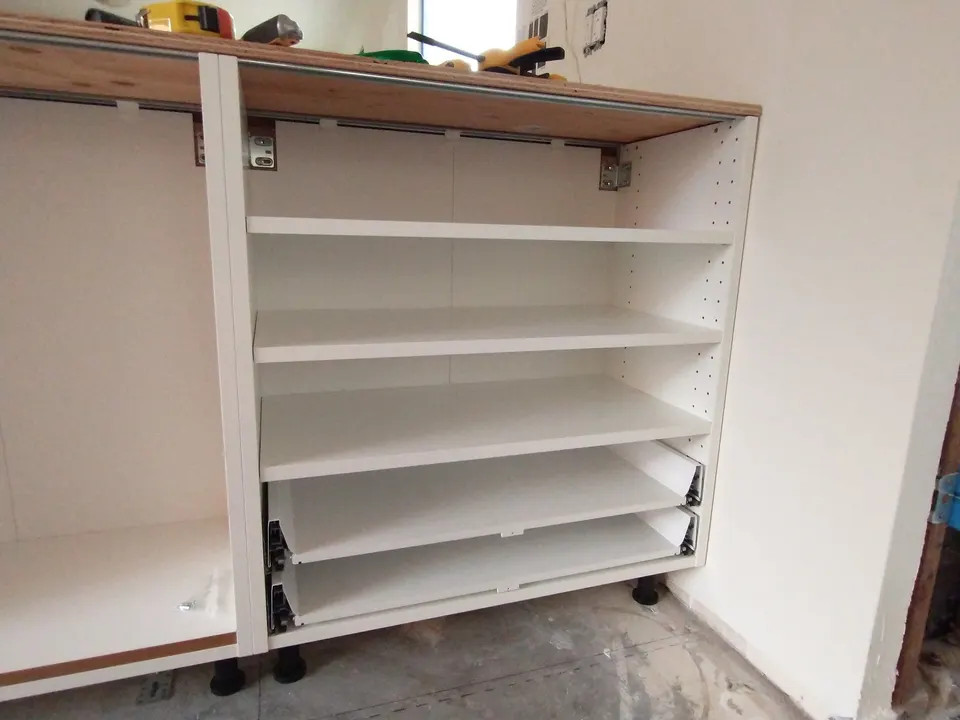
Particleboard is made from wood chips pressed together with resin. Its surface coating protects it well, as long as the coating is intact. The trouble is that a kitchen is full of places where it is not: the cut-out for the sink, the holes drilled for the tap and the waste pipe, the edges behind the dishwasher, the bottom of the plinth that stands on a mopped floor.
When water gets into particleboard, it swells, and it does not shrink back. The base of the sink unit is usually first: it bulges, the edging lifts, and the hinges start to lose their hold. A slow leak from a dishwasher hose can ruin a whole run of units before anyone notices.
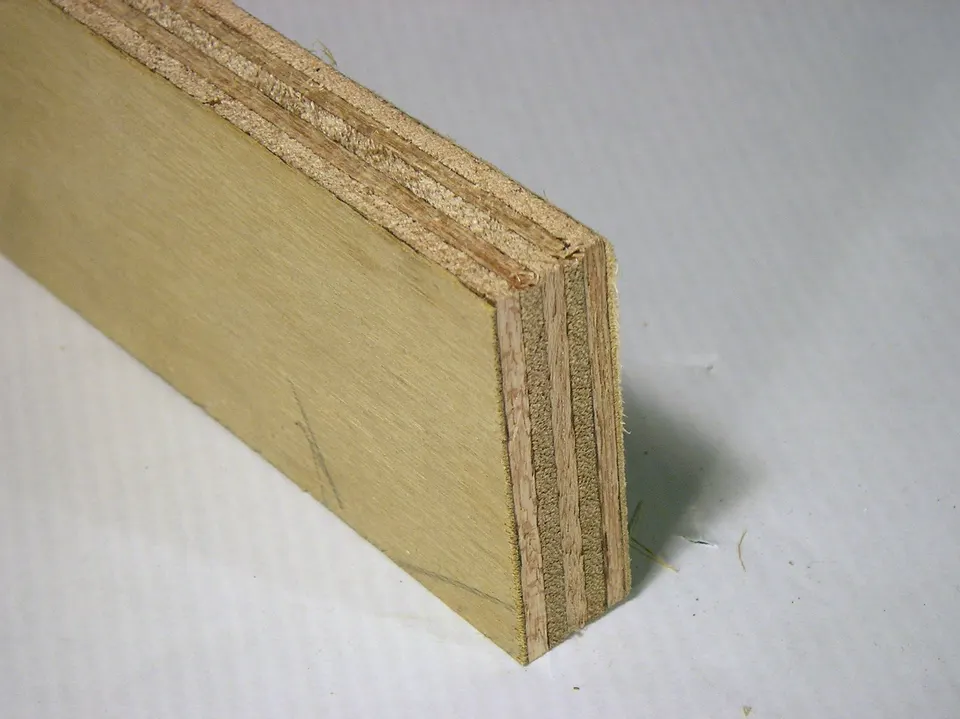
Plywood is more resistant to moisture, provided the right glue is used and the edges are sealed. It is not waterproof, and no honest maker will tell you it is. But a spill wiped up the next morning will usually leave it as it was, and a damaged section can be cut out, repaired or replaced rather than condemning the whole cabinet.
Doors can be changed in an afternoon. A carcass that has swollen means taking the kitchen apart.
Screws, hinges and heavy drawers
Modern kitchens use deep drawers instead of cupboards with shelves, and a full pan drawer is heavy. Its runners are held by a handful of screws in the side of the carcass. In particleboard, those screws grip compressed chips; overload the drawer, slam it a few hundred times, or adjust the runner once too often, and the screw starts to pull out. Plywood holds screws in layers of real wood and keeps holding after adjustments, and after the kitchen has been taken down and refitted during a renovation.
The same applies to hinges. Kitchen doors are adjusted more often than any others in the house, because a door that rubs or hangs crooked is noticed at once. Each adjustment loosens the fixing a little. Over the years, the board decides whether that adds up to anything.
Plywood you can see, plywood you cannot
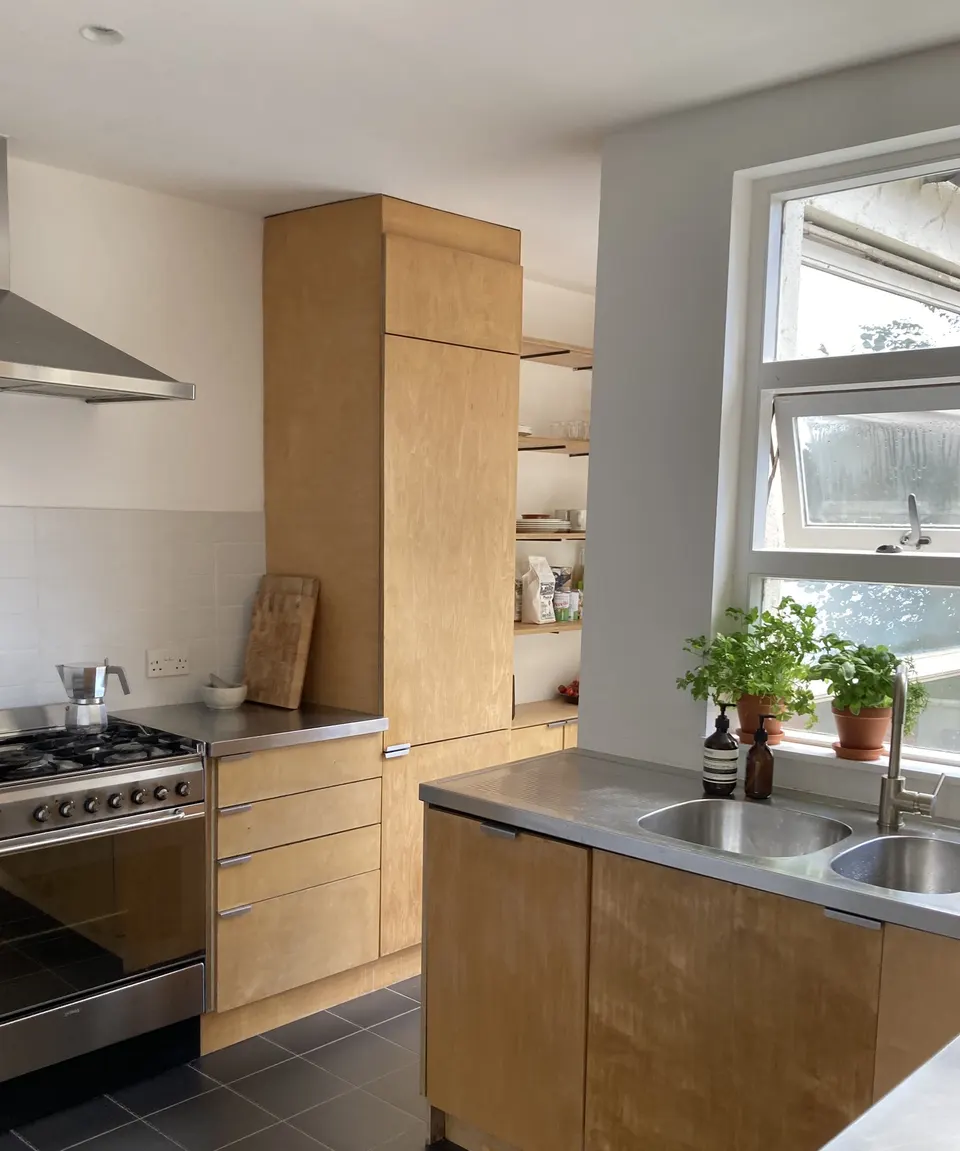
Plywood has become a style of its own. Some kitchens, like the one in the photograph at the top of this page, show it openly: birch faces and visible layered edges, which age to a warm honey colour. Others hide a plywood carcass behind painted, lacquered or veneered doors, so the kitchen looks like any other but behaves better inside.
Both are valid. Exposed plywood suits a relaxed, modern house and pairs well with steel, terrazzo or stone. Hidden plywood suits a classic kitchen where the doors carry the style. What matters is that the structure is right; the finish is a question of taste.
Questions to ask before you order
- What are the carcasses made of? Not the doors: the boxes, including the backs and the bottoms.
- What is the sink unit made of? Some kitchens use a better board only here; ask what the rest is.
- How are cut edges and drilled holes sealed? Especially around the sink, tap, dishwasher and plinth.
- What are the drawer boxes made of? Cheaper boards often hide in drawer sides and bottoms.
- Can a single damaged panel be replaced? Or does a leak mean a new cabinet?
- Who measures and installs? A kitchen fitted to the room by the people who built it fits better than one assembled from standard boxes.
The honest part: cost
A plywood kitchen costs more than a particleboard one. The board itself is more expensive, and it takes more care to cut, edge and finish. What narrows the gap is how the kitchen is bought. Ordering directly from an atelier that builds and installs it, without a showroom and several layers of distribution in between, puts more of the budget into the material and the work.
Lampisa, our partner atelier in Istria, builds its furniture in plywood rather than particleboard, and can make kitchen units to measure. With its from moodboard to render service you bring photos of kitchens and materials you like, the atelier prepares a 3D render of your own kitchen, and nothing is built until you have approved it. For more on planning the room itself, from islands to where people gather, see villa kitchens built for gathering, and for the full material comparison, plywood or particleboard.