Steam, splashes and a house shut up all winter. Why bathroom furniture fails first in Istrian villas, and what lasts instead.
Guests judge a villa in two rooms. The bedroom tells them whether they will sleep well. The bathroom tells them, within a minute of arriving, whether the owner has cut corners. It is the room where people look closely, at short distance, in good light, with nothing else to distract them. A chipped edge on a vanity or a drawer that no longer closes is noticed in a way that a slightly tired sofa never is.
It is also the hardest room in the house for furniture. Istria has an estimated seven thousand villas, and many of them were built carefully, with good stone, good glazing and good tiling. Yet the bathroom furniture is often the first thing to look worn, sometimes after only a season or two. The reason is rarely the design. It is what the furniture is made of.
A difficult room, twice over
In summer a busy villa bathroom works harder than most domestic bathrooms ever will. Several showers a day, wet swimwear, towels drying on every hook, windows closed against the heat while the air conditioning runs. Steam settles on every surface and water runs along the top of the vanity to its edges, where it sits.
Then the season ends and the house is closed. For months there is little heating, little ventilation and nobody opening a window. Damp air from the walls and the sea settles inside, temperatures swing between mild days and cold nights, and materials that took in moisture during the summer are given no chance to dry out properly. By spring, whatever was weak has had half a year to show it.
Why particleboard vanities fail
Much of the bathroom furniture sold in large volumes is made from particleboard, also called chipboard: wood chips pressed together with glue and covered with a decorative layer. While that layer is intact, it behaves well enough. The trouble begins where it is cut, drilled or chipped, and in a vanity those places are exactly where water goes: the cut-out for the basin, the holes for the tap and waste, the lower edges near the floor.
Once water reaches the core, particleboard swells, and it does not shrink back. The edge around the basin lifts and crumbles. The surface bubbles. Hinges screwed into the side panels begin to pull out, because the chips that held the screw have softened. Doors sag, drawers rub, and a repair usually means replacing the whole unit, often in the middle of the season.
A bathroom vanity rarely fails in the middle. It fails at the edges, exactly where the water goes.
Why plywood does better
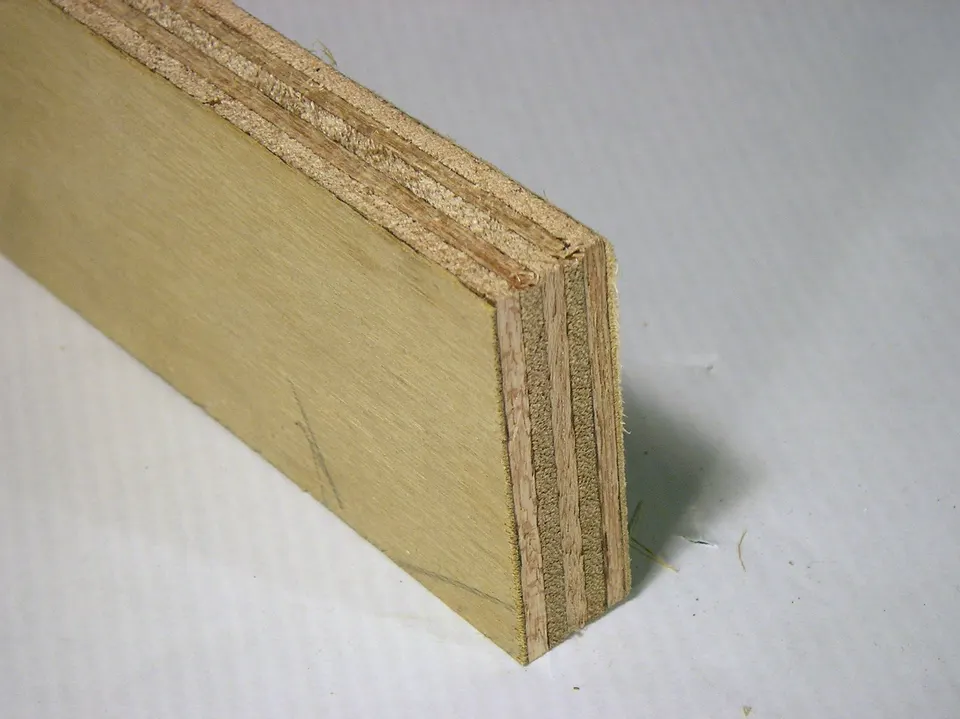
Plywood, sometimes called multiplex, is built differently. Thin layers of wood veneer are glued together with the grain of each layer running across the one below. That cross-laminated structure makes it strong and stable in shape, and it is far more tolerant of moisture than particleboard, provided the right glue is used and the edges are properly sealed. Screws and hinges hold firmly in it, even after a cabinet has been taken apart and put back together, and a damaged surface can be repaired and refinished rather than thrown away.
This is the key difference with our partner atelier, Lampisa: it does not build with particleboard at all. Its furniture is made from plywood. Whether the atelier makes bathroom vanities and storage, and which moisture-resistant boards, glues and edge treatments it uses for wet rooms, should be confirmed for each project. For the wider comparison, see plywood or particleboard: what is actually inside your furniture.
Ventilation is half the answer
No material does well in a room that never dries. Before choosing furniture, it is worth checking that the bathroom has a fan that actually runs long enough after a shower, and that the house is ventilated during the closed months, even if only by someone opening windows on dry days. Leave a small gap behind and beneath freestanding pieces so air can move. Avoid boxing a cabinet tightly against an outside wall where condensation forms. These are small decisions that cost little and add years to everything in the room.
Finishes and hardware
The finish is the furniture's first line of defence. In a wet room it should be sealed on every face, including the back and the inside of cut-outs, not only the surfaces you see. Matt finishes hide water marks better than gloss; very dark colours show limescale more than mid tones. Ask what finish is used and how it can be refreshed after a few seasons, because a finish that can be renewed is worth more than one that only looks good on delivery.
Hardware matters as much. Hinges and drawer runners in a bathroom should be rated for damp conditions, and handles should not rust where wet hands touch them every day. Soft-close mechanisms are not a luxury in a rental: they stop doors being slammed, which is what loosens fixings over time.
Storage for guests, not for owners
A villa bathroom is used by people who arrive with a suitcase and leave a week later. They need somewhere to put a wash bag that is not the edge of the basin, a shelf for each person sharing the room, hooks for wet towels and robes, and a drawer for a hairdryer that does not leave its cable across the worktop. Owners, on the other hand, need a locked or high cupboard for spare toilet paper, cleaning products and reserve towels, so that housekeeping does not have to carry everything in on changeover day.
Light and mirrors
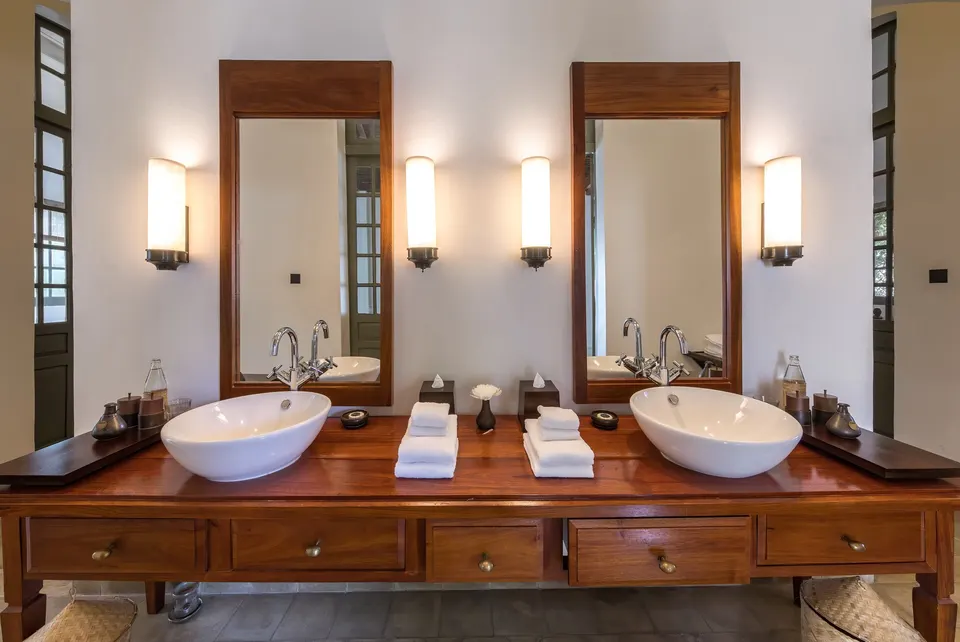
The light in front of the mirror is what guests actually experience. A single bright spot in the ceiling casts shadows on the face and makes everyone look tired. Light from either side of the mirror, or from a soft strip around it, is kinder and more practical. A warm, dimmable light for the evening and a clean, neutral one for the morning cover most needs. Plan the sockets and switches together with the furniture, so that the shaver socket is not hidden behind a cabinet door and the mirror light is centred on the basin rather than on the wall.
What guests notice
Guests no longer want to stay somewhere worse than their own home, and the bathroom is where that comparison happens first. They notice edges that are clean and tight, drawers that close quietly, enough space to unpack, good light and a towel that is dry when they reach for it. They also notice the opposite, and they mention it in reviews. The same thinking applies to the room next door, as we explored in why guests expect to sleep better than at home.
A well-made bathroom is not about expensive gestures. It is about choosing materials that will still look right in the fifth summer, planning the room around the people who use it, and making sure that when something does wear, it can be repaired rather than ripped out.