A buyer’s guide to quiet pods: what decibels mean and how they are measured, what to check on air, power, weight and materials, and which size suits which use.
Choosing an acoustic pod is easiest if you check six things in turn: how much it really reduces sound and how that was measured, how the air is exchanged, what it needs in terms of power and network, how much it weighs, what it is made of and which size fits the purpose. Looks and price matter, but a pod that is stuffy or lets conversation through will not be used, however good it looks. At the end is a list of questions for the supplier.
The guide applies to hotels, resorts, conference venues, cafés and offices looking for an office pod. Specific figures refer to the quiet pods Atrij offers with its partner supplier, according to the manufacturer’s specifications.
What does sound reduction in decibels mean?
The decibel is a logarithmic unit. The ear perceives a difference of 10 dB roughly as a sound half or twice as loud, so a reduction of 30 dB is a big change. Normal conversation is about 65 dB. If a pod reduces it by 30 to 35 dB, what remains outside is roughly the level of a quiet room. That is why no pod is completely soundproof: loud music or shouting can still be heard, only much more quietly.
For the quiet pods we offer, the manufacturer states a sound reduction of 30 to 35 dB. The supplier tested size S by playing music at 90 dB inside and measuring the level outside. It is a clear and useful test, and we send a video of it with the presentation. Still, it is not the same as a measurement to an international standard, and that difference matters when you compare offers.
How is a pod’s sound insulation measured, and what is ISO 23351-1?
For pods and similar furniture ensembles there is an international standard, ISO 23351-1:2020, titled “Acoustics: Measurement of speech level reduction of furniture ensembles and enclosures, Part 1: Laboratory method”. It specifies a laboratory method intended to make different pods comparable. The sound power of a source is measured twice, once without the pod and once with the same source inside it. The difference is calculated in octave bands from 125 to 8,000 Hz and reduced to a single number: the speech level reduction in decibels, A-weighted, that is, adjusted to human hearing. The standard applies to complete pods and ensembles, not to individual components such as a screen, a chair or a light.
A decibel figure only makes sense together with how it was measured. A reduction measured with music and a microphone outside the door, the sound insulation of a single panel in a laboratory and the speech level reduction to ISO 23351-1 are not the same quantity and cannot be compared directly. So ask every supplier three things: what the value is, which method or standard it was measured by, and who did the measuring. If a supplier cites a measurement to ISO 23351-1, ask for the test report.
If a value to the standard matters for your comparison, tell us in the presentation and we will request it from the supplier.
Ventilation and air: what should you look for?
An enclosed pod without good air exchange soon becomes warm and stuffy, and people do not go back into a pod like that. So ask how many fans it has, where the air comes in and goes out, and how loud the fans are when running. Every air opening can also be a path for sound, so it is worth asking whether the sound reduction was measured with the fans switched on.
The pods we offer have two fans for fresh air in every size. The other question is what you are breathing: new materials, adhesives and fabrics can release chemical substances into the air. The supplier states that the pod holds UL GREENGUARD Gold certification, which confirms low chemical emissions into indoor air.
Power, network and weight: what does a pod need from the space?
A pod needs no construction work, but it does need two things: a socket and a floor that can carry it. Our pods need only a 220 V socket nearby. Inside there are 220 V sockets, USB and USB-C ports, a network (UTP) cable connection, a recessed LED light and a wall desk or shelf. For video calls, a cable connection is usually more stable than Wi-Fi.
Weight is easy to overlook. The one-person pod weighs 320 kg, the small meeting room 750 kg. On a solid ground floor this is usually not a problem, but on a mezzanine, an upper floor or a raised floor the load capacity should be checked before ordering.
Materials, door and glass: what should you check?
A pod stands in a public space, so material safety is not a side issue. Ask whether the interior walls are fire-resistant and whether there is a document to show it, what kind of glass is used and how the door closes. Tempered laminated glass holds together on breaking thanks to its interlayer instead of shattering into sharp pieces, and a soft-close door shuts quietly without slamming.
On the outside, the pods we offer have metal panels with a double sound-insulating layer, tempered laminated glass with a sound-damping film and a soft-close door. Inside, the walls are fire-resistant and lined with sound-absorbing felt, and the edges have soft finishes. Colour and finishes can be matched to the interior, and a warranty is included.
Which acoustic pod size for which use?
A common mistake is to choose a pod by the free space rather than by its purpose. A phone booth where you stand is excellent for a ten-minute call, but nobody will work on a laptop in it for an hour. Start with three questions: who will use it, for how long, and how many people at once.
| Size | Outside (W × D × H) | Weight | Use |
|---|---|---|---|
| S, one-person pod | 100 × 100 × 228 cm | 320 kg | Phone calls standing or on a bar stool, wall shelf |
| W, one-person work pod | 140 × 125 × 228 cm | 430 kg | Longer laptop work seated, seat and height-adjustable wall desk |
| D, pod for two | 220 × 125 × 228 cm | 650 kg | Conversation or meeting for two, interview, video call with two people |
| C, small meeting room | 240 × 240 × 228 cm, about 5.8 m² | 750 kg | Short meeting of a small group, sofa or seating and table |
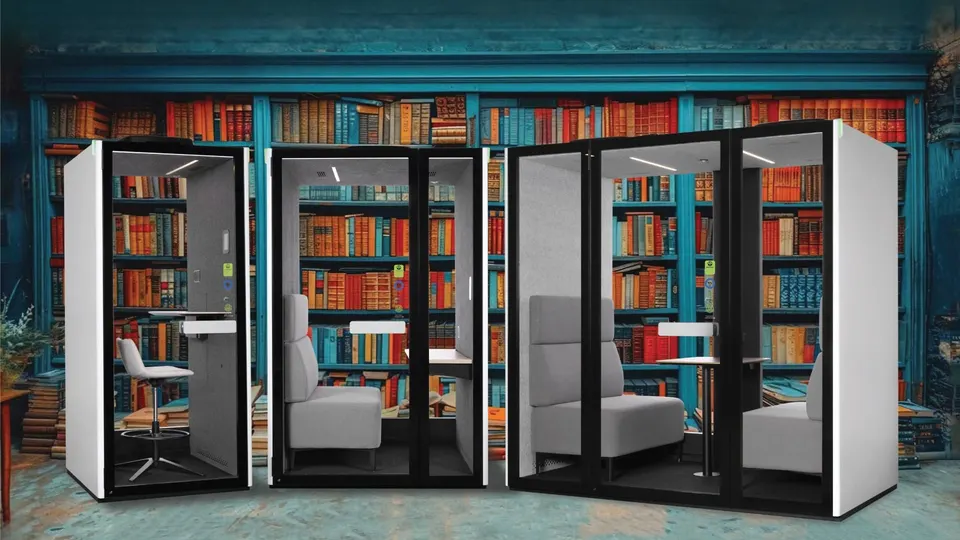
Larger versions of up to about 9 m² also exist for bigger group meetings. For a hotel lobby the natural choice is S, which we cover in a phone booth in the hotel lobby, for a café or coworking space W, and as meeting pods for conferences D and C, as described in a meeting room without construction work.
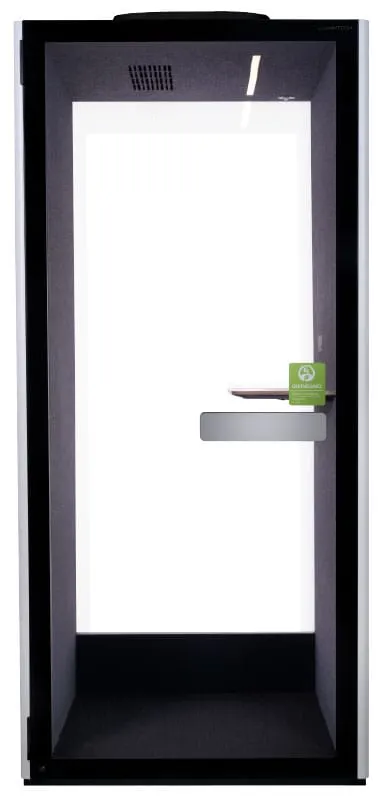 Size S: one-person pod with a wall shelf
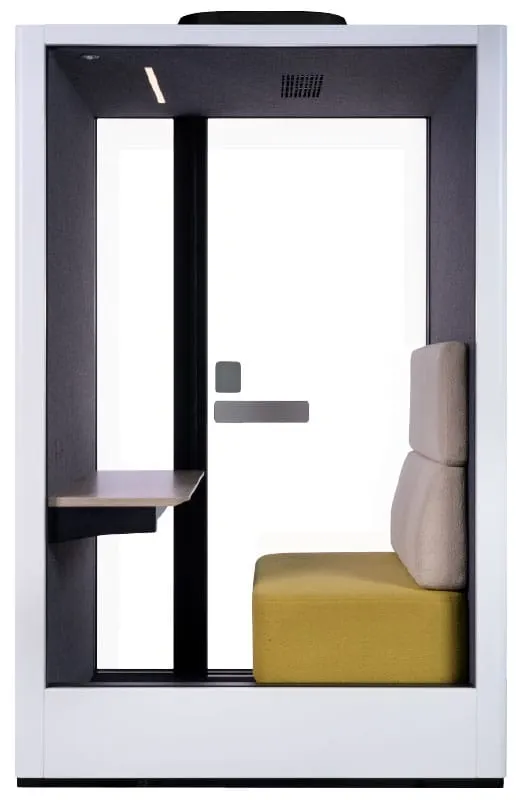 Size W: one-person work pod with a seat and wall desk
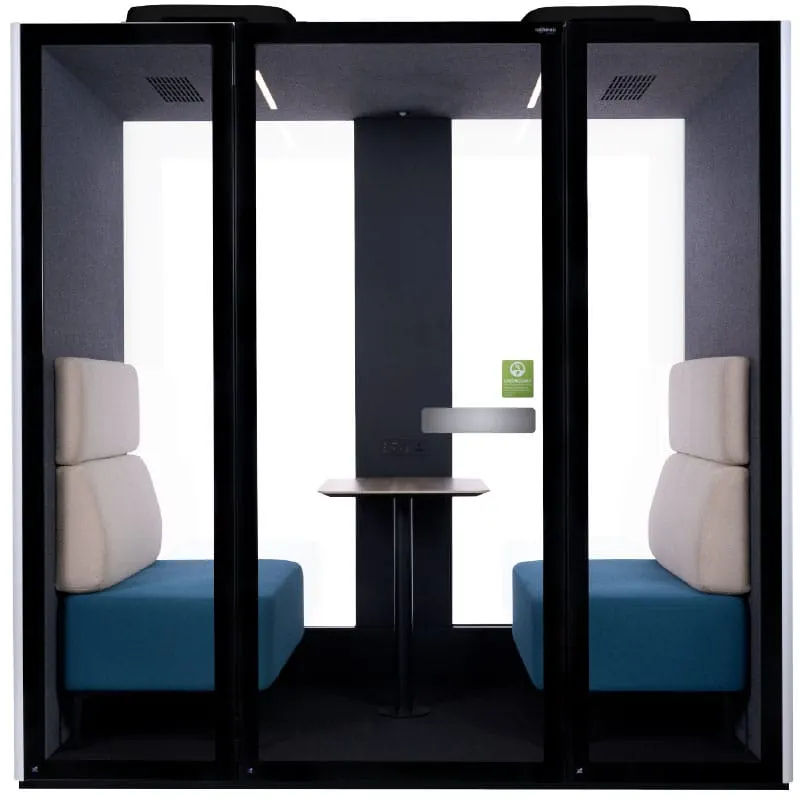 Size D: pod for two with facing seats and a small table
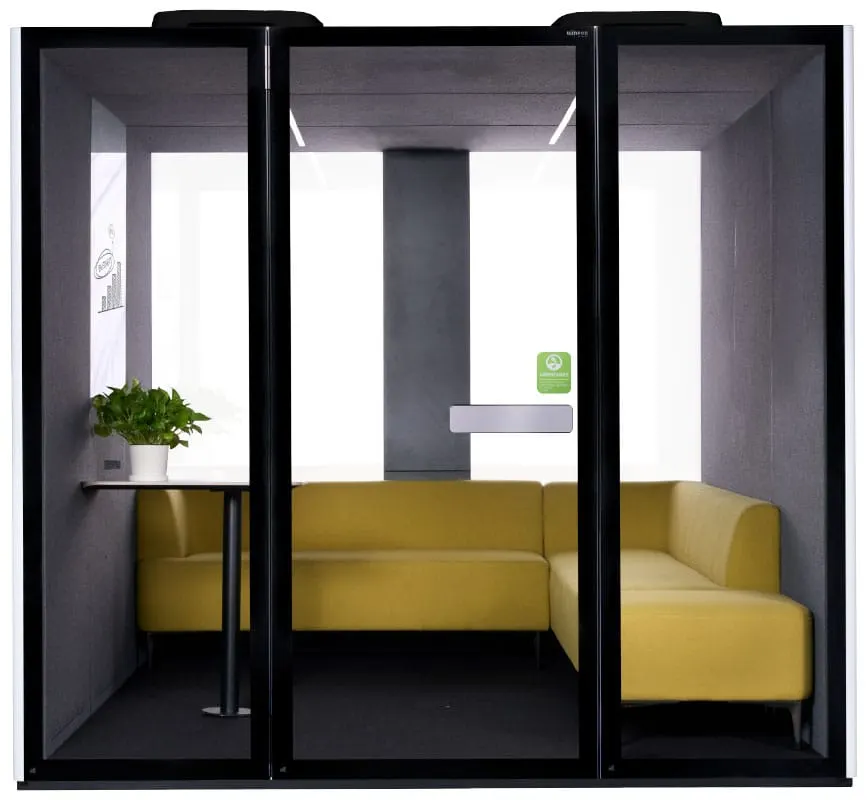 Size C: small meeting room with a corner sofa and table
Our pods are delivered and installed by our partner, and according to the manufacturer two people assemble one in about 60 minutes with basic tools. A pod can be taken apart and moved, which matters to hotels that use their spaces differently through the year: in the lobby in summer, in the conference hall in autumn. If you are torn between a pod and a built room, we compare the two in acoustic pod or built room.
Which questions should you ask a supplier before buying?
Before ordering, go through this list with the supplier. If you do not get a clear answer to a question, ask for it in writing.
- Sound reduction. What is the value in decibels, which method or standard was it measured by, for example ISO 23351-1, and is there a test report?
- Ventilation. How many fans does the pod have, how loud are they, and was the sound reduction measured with the fans on?
- Air and materials. Is there a certificate for low chemical emissions, such as GREENGUARD Gold, and a document on fire resistance?
- Weight and access. How much does the pod weigh, and do its parts fit through your doors and lift?
- Installation and moving. Who delivers and installs the pod, how long does assembly take, and can it be moved later?
- Warranty and service. How long is the warranty, and who handles a fault with a fan, the light or the door?
- Purchase or rental. Can the pod be rented, and on what terms?
For the pods we offer, you get the answers to these questions in a free presentation, done remotely. You send us a floor plan or photos of the space, and we suggest the size and position of the pod and send you models, dimensions, photos and a video of the sound test. If useful, we also arrange a short video call. Atrij advises, prepares the offer and follows the order, and coordinates delivery and installation with the partner. Besides purchase, rental can also be discussed. For the wider picture of why hotels add quiet pods, read quiet pods for hotels and resorts.