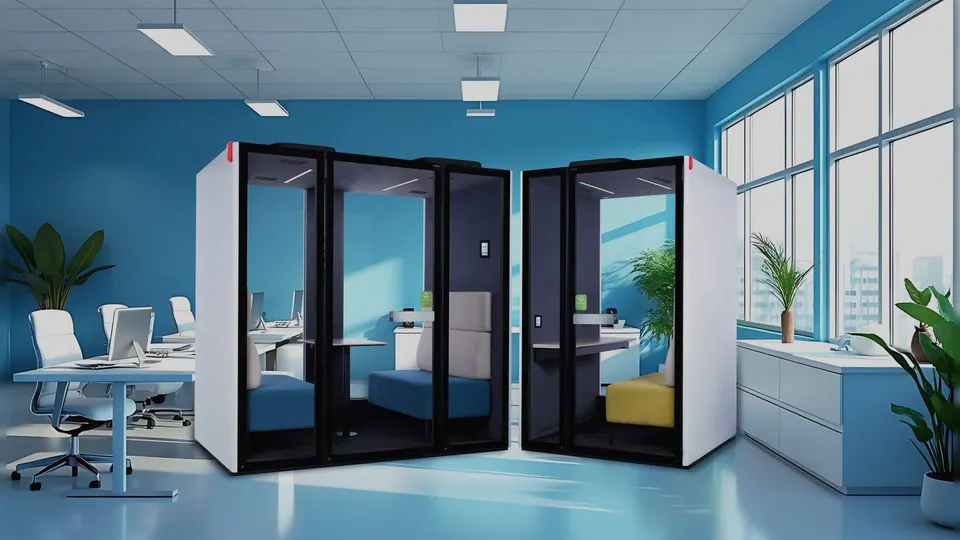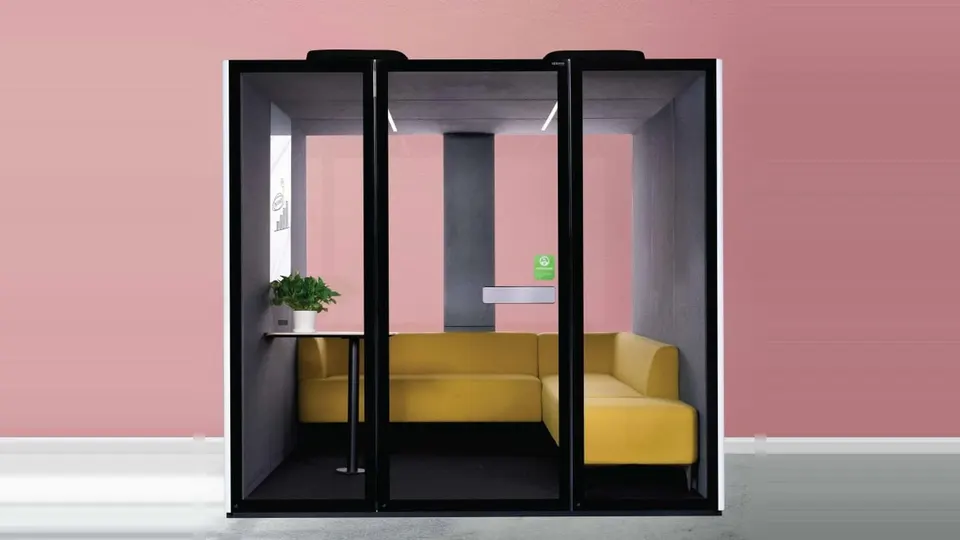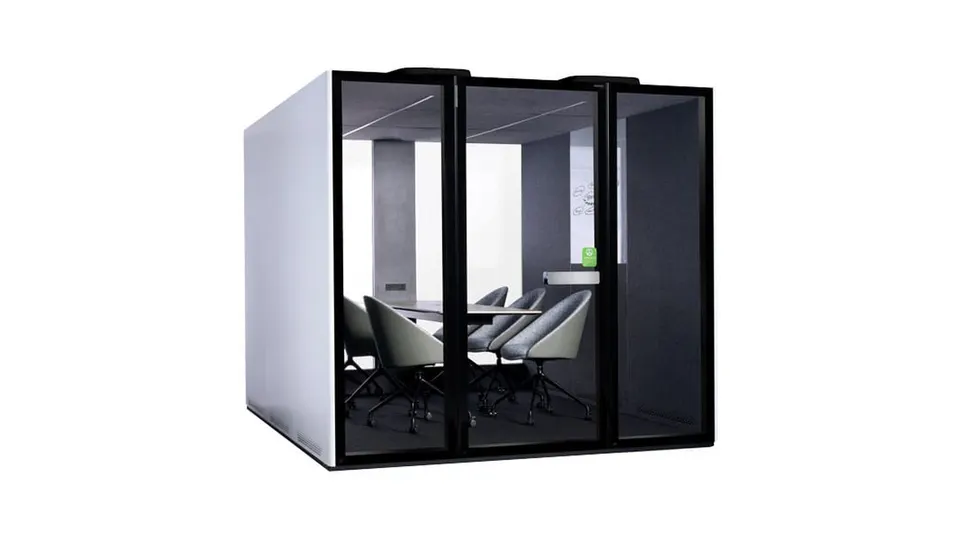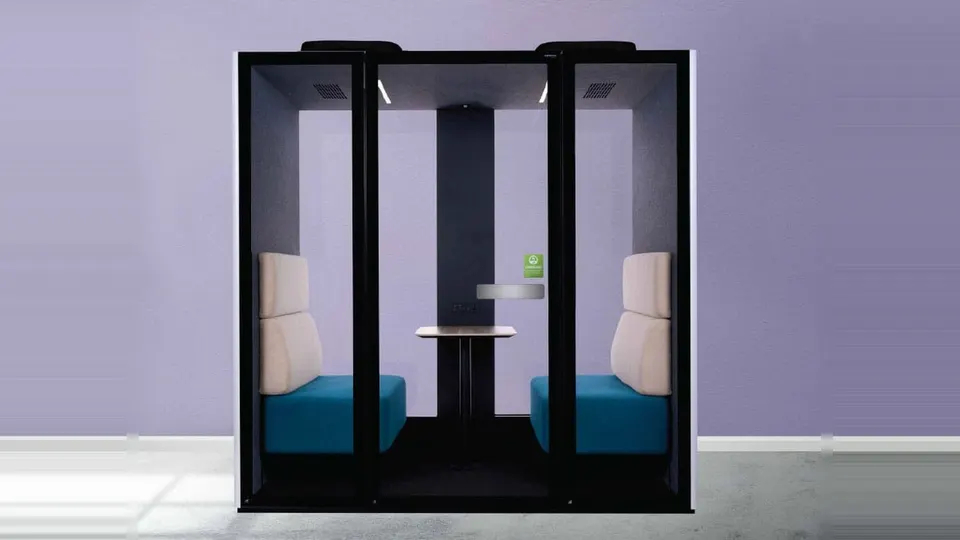
Comparing a quiet pod with a drywall room in a hotel that stays open: build time, dust, sound, air and light, and what happens when needs change.
If your hotel needs a quiet place for calls, video meetings or a conversation for two, and needs it quickly without closing off part of the lobby, an acoustic pod is usually a simpler answer than a drywall room. The pod arrives finished, with ventilation, lighting and sockets, and according to the manufacturer two people assemble it in about 60 minutes, with no construction work. A drywall room is the better choice when you need a permanent, larger room for more people, with a window and daylight, or when you are renovating that part of the hotel anyway.
Below we compare the two the way a hotelier experiences them in practice. We deliberately leave prices out: a drywall room depends on the space, the building services and the contractor, so it needs a separate quote from a builder, while the price of a pod comes with the presentation and the offer for your space.
How long does the work take, and what does it mean for a hotel that stays open?
On paper a drywall room looks simple: studs, boards, insulation and a door. In practice it is a line of trades, one after another: drylining fitters, an electrician, someone for ventilation or air conditioning, then filling, sanding and painting, and finally the door and the clean-up. Each stage waits for the one before, so the job is measured in days and often longer.
In a hotel that is open, time is not the only problem. Drilling makes noise, and sanding the filler creates fine dust that travels beyond the work area. Part of the lobby has to be closed off, working hours have to fit around guests who are sleeping or having breakfast, and everything has to be cleaned thoroughly at the end of each day. A guest who has paid for a quiet holiday does not want to hear a drill behind reception.
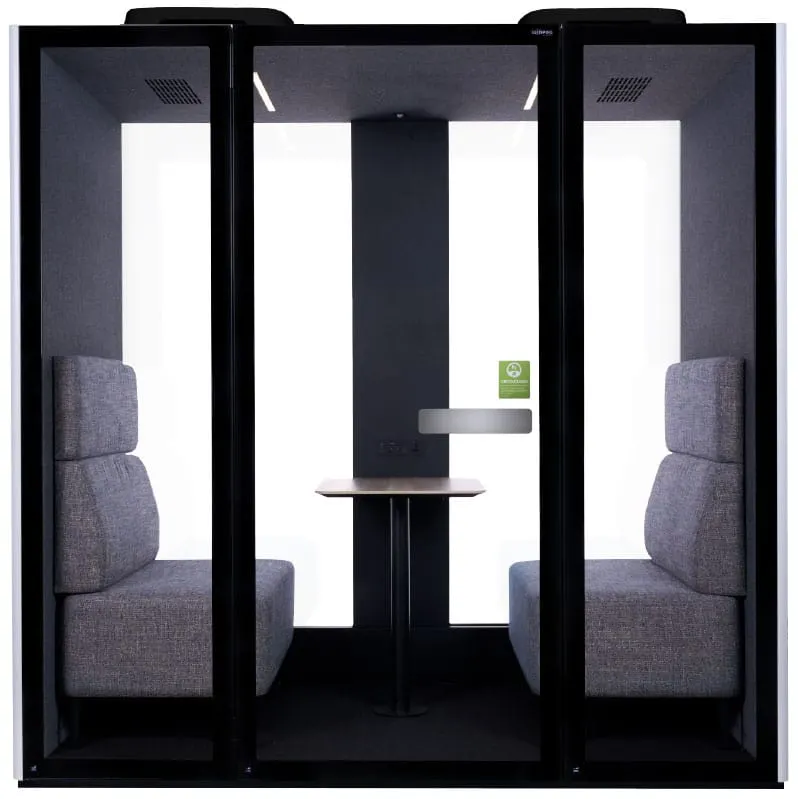
A pod arrives in parts and is assembled on site. According to the manufacturer this takes two people, about 60 minutes and basic tools. There is no wet work, sanding or painting, and the only connection it needs is a 220 V socket nearby. The pod is delivered and installed by the partner, and Atrij agrees the timing with them, so installation can be slotted into a quiet part of the day.
Which option blocks sound better?
A well-designed drywall partition, with double boards and mineral wool, can separate two rooms well, but the result does not depend on the wall alone. Sound escapes through the weak points: the door and the gaps around it, a suspended ceiling when the wall stops short of the slab, sockets placed back to back and ventilation ducts. That is why such a room has to be designed and built carefully, ideally with advice from an acoustician.
With a pod, sound insulation is part of the factory construction. Outside there are metal panels with a double sound-insulating layer and tempered laminated glass with a sound-damping film, and the door closes slowly and quietly. The manufacturer states that the pod reduces sound by 30 to 35 dB. It measured this by playing a song at 90 dB inside an S-size pod and measuring the sound outside.
What does that mean in practice? Normal speech is around 65 dB, so a conversation inside the pod is heard outside at roughly the level of a quiet room. The pod is not completely soundproof: loud laughter will still be heard, only muffled. For calls, video meetings and conversations for two, it is enough for the people inside and the guests outside not to disturb each other.
The acoustics inside are often overlooked. The pod is lined with sound-absorbing felt, so voices do not echo and the person at the other end of a video call hears clear speech. A small drywall room with smooth walls, glass and a hard floor tends to echo, so it later needs acoustic panels or textiles.
Ventilation, lighting and power: what needs planning?
A small closed room quickly becomes stuffy, especially in summer. A drywall room therefore needs its own fresh-air solution, and often cooling, plus lighting, sockets, a network cable and, depending on the space, alignment with the fire safety system. Each of these is designed, installed and paid for separately.
A pod has all of this built in. Every size has a wall desk or shelf, USB, USB-C and 220 V sockets, a UTP network connection, two fans for fresh air and a recessed LED light. The inner walls are fire-resistant. The manufacturer also states a UL GREENGUARD Gold certificate, which confirms low chemical emissions into indoor air. What else to look for in air, materials and power is covered in our guide how to choose an acoustic pod.
What happens when the hotel's needs change?
A drywall room becomes part of the building. If after two seasons it turns out to be in the wrong place or too small, the only way to change it is demolition, with fresh dust, waste and repairs.
A pod is equipment, not construction. It can be taken apart and reassembled somewhere else, which suits seasonal hotels: in summer it stands in the lobby for guests who work on holiday, and in autumn it moves to the congress hall for organisers and speakers. If the hotel operates in a leased building or relocates, you can take the pod with you, whereas a drywall room stays with the building.
The same goes for the number of pods: you can start with a single phone booth by reception and later add a pod for two or a small meeting room. How a small meeting room helps a hotel that is short of meeting space is covered in a meeting room without construction work.
When to do it: in winter, before the season or in the middle of it?
Hotels in Istria and along the coast usually leave building work for the winter, when they are closed or nearly empty. That window is short, and contractors are at their busiest. If the drywall room is not finished by opening day, the work spills into the pre-season, when it is hard to schedule around the first guests.
A pod does not depend on that window. It goes up in about an hour and does not require closing off any space, so it can be installed even in mid-season, when you realise guests are asking for somewhere to take calls or when you need extra space for an autumn congress.
| What we compare | Acoustic pod | Drywall room |
|---|---|---|
| Work on site | About 60 minutes of assembly according to the manufacturer, no dust | Several trades, days or longer, with sanding and painting |
| Sound | 30 to 35 dB reduction according to the manufacturer | Depends on design, door, ceiling and workmanship |
| Acoustics inside | Felt absorbs sound, voices do not echo | Often needs acoustic panels or textiles |
| Air, light, power | Fans, LED light, sockets and UTP built in | Designed and installed separately |
| Moving | Taken apart and moved | Stays with the building, changed by demolition |
When is a drywall room the better choice?
It is only fair to say when a pod is not the right answer.
- You need a room for more people. The small meeting room is about 5.8 m² and suits a short meeting of a small group, and there are larger versions of up to about 9 m². Ten people or a workshop with a projector need a proper meeting room.
- You want daylight and a window. A pod stands inside an existing room and looks into it. A room along the façade can have a window onto the sea or the garden.
- The space has to be part of the architecture. If the walls must continue the same cladding, built-in joinery and lighting as the rest of the hotel, that is easier to achieve with construction.
- You are renovating anyway. When part of the hotel is closed for a larger renovation, an extra room is just one more item in the same works.
- The requirements are specialised. Sound recording or simultaneous interpreting need purpose-built spaces. Interpreting booths have their own standard (ISO 4043), and a quiet pod is not a replacement for them.
Before you decide, check the space where the pod would stand. It is 228 cm high, so the ceiling must be higher, and depending on size it weighs between 320 and 750 kg, which is worth checking on the upper floors of older buildings.
How do you get a proposal for your hotel?
Atrij is the intermediary between the hotel and our partner supplier of pods. We advise which size suits which spot, prepare the presentation and the offer, coordinate delivery and installation with the partner and follow the order through to the end. The free presentation is done remotely: you send a floor plan or a few photos of the lobby, corridor or hall, and we suggest which pod and where, with models, dimensions, photos and a video of the sound test. If it helps, we also arrange a short video call.
Besides buying, rental can also be discussed. If you are also considering a drywall room, ask a contractor for a quote and compare both options item by item, as explained in how to compare builder quotes. An overview of why hotels add quiet pods is in quiet pods for hotels.