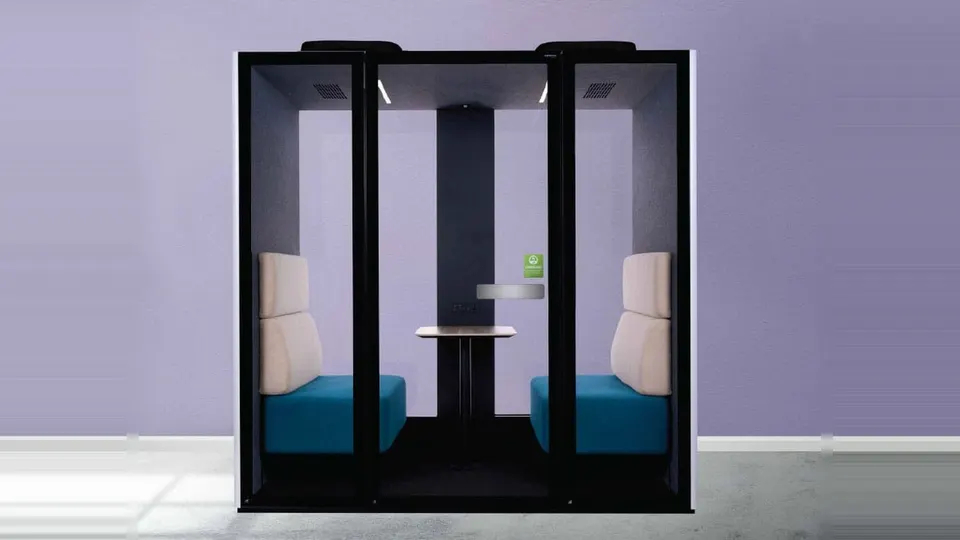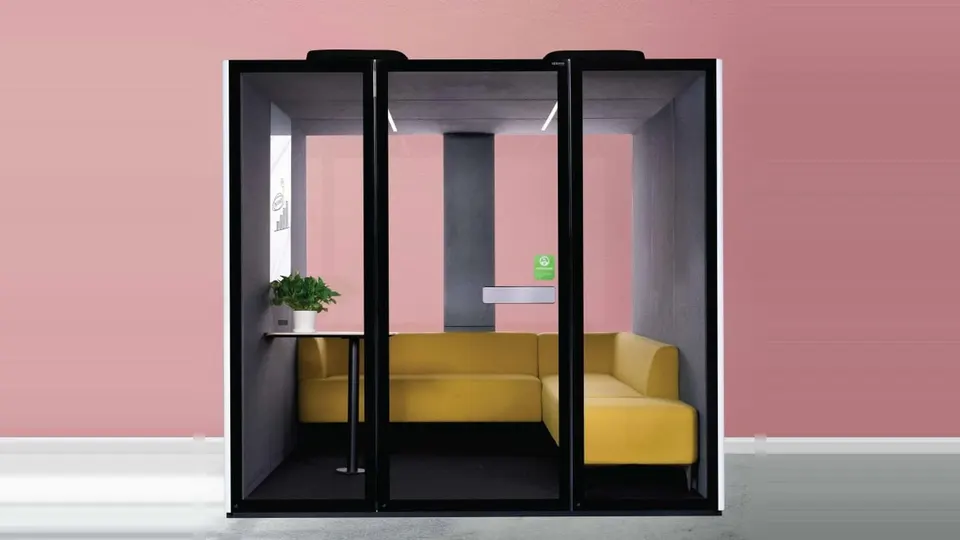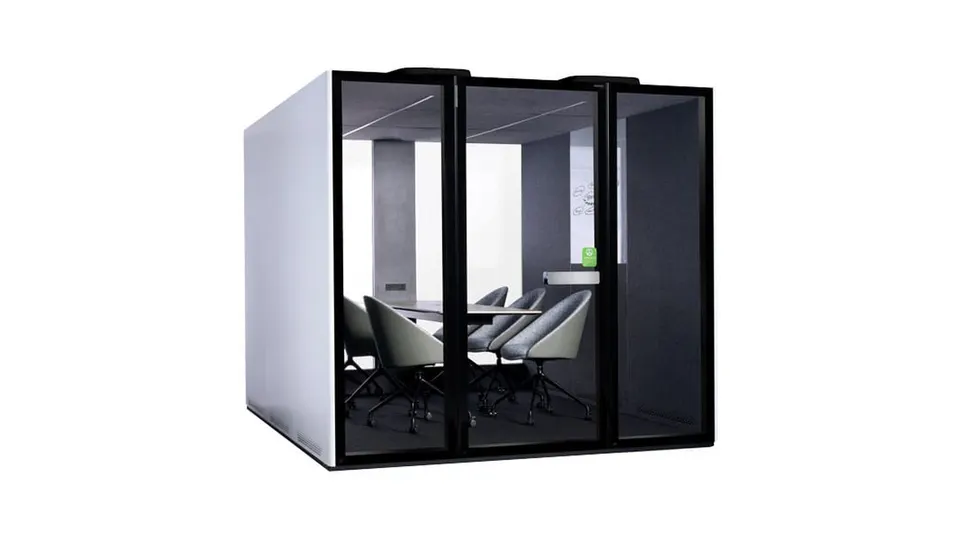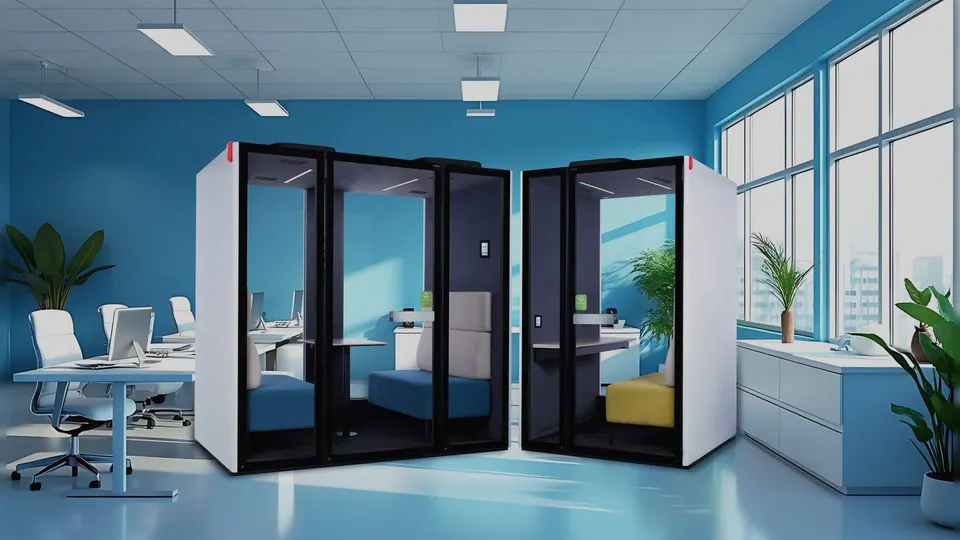
Where speakers prepare, organisers take calls and sponsors meet clients: two-person pods and small meeting rooms on a hotel's conference floor.
An acoustic pod on a hotel's conference floor gives organisers, speakers and sponsors a quiet place to prepare, hold a short meeting or take a call, without hunting for a free room. For conferences, the usual choice is a two-person pod and a small meeting room for about four people, with one or two phone booths for calls during breaks. The pods go in without construction work, need only a 220 V socket nearby and, according to the manufacturer, reduce sound by 30 to 35 dB.
A conference day in a hotel has its own rhythm. The halls are booked from the morning, and in the coffee break the foyer fills with people all talking at once, while everyone needs to call the office, arrange a meeting or check a presentation. Below we look at who gains most from a pod at a conference, which size does what and what a pod is not.
Why does a conference hotel need quiet space outside the halls?
A hotel hosting a conference knows how little space there is on those days. Every hall and meeting room is booked in advance, and delegates who need ten minutes of quiet end up in a corridor, on the stairs or outside the entrance. Reception hears the same question again and again: is there a free room somewhere, just for a moment. There rarely is, and opening a whole hall for one call makes no sense.
An acoustic pod fills exactly that gap: a small, always available room next to the halls, where you step in, close the door and get on with it. When the conference ends, the same pod serves business guests, which we cover in more detail in our guide to quiet pods for hotels and resorts.
Where can the organiser and the speaker prepare?
For a conference organiser, work arrives by phone all day: the technician says the presentation has not come through, catering needs the lunch numbers confirmed, a speaker's flight is late. A one-person or two-person pod next to the hall gives them a place to open the laptop, plug into a network cable and sort things out without the buzz around them. Every pod has a wall desk or shelf, USB, USB-C and 220 V sockets and a UTP connection, so a presentation can be sent or changed even when the wireless network is overloaded.
A speaker needs something different. Before going on stage they want to run through their notes once more, try the opening line out loud or have a quick word with the moderator. Without a pod they search the hotel for a free room or retreat to their own room, floors away from the hall. A pod placed near the hall entrance means the speaker is close at hand when called, yet still has a few minutes alone.
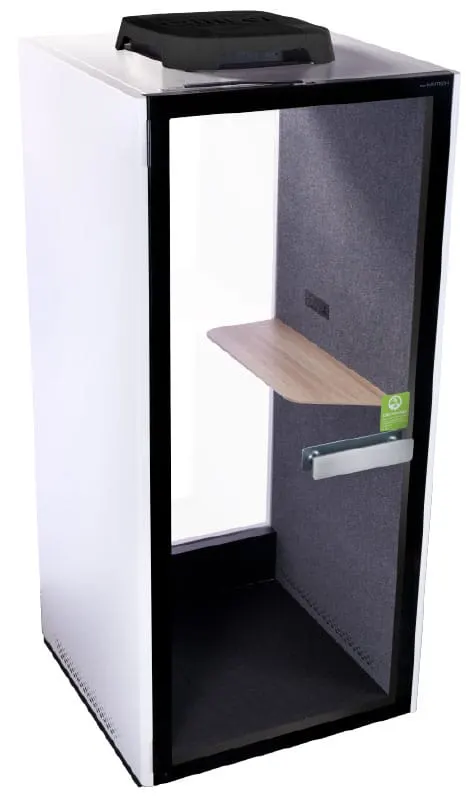
Interviews, VIP meetings and calls during breaks
At larger conferences, journalists want a statement from a speaker between two sessions. In the foyer that conversation happens amid noise and passers-by; in a two-person pod the journalist and the speaker sit facing each other at a small table, in peace. For a short radio or podcast statement the conditions are better than in a corridor, but a pod is not a professional studio.
Sponsors and VIP guests also come to a conference for the meetings. A sponsor who has paid to be there wants somewhere to sit down with a prospective client, and a distinguished guest does not want to discuss business with someone standing behind them. For the duration of the event, a small meeting room on the conference floor can become the sponsors' meeting point, with time slots booked at reception or through the organiser.
The third group is everyone else: delegates who need to call the office, family or a client during the break. For them one or two phone booths by the hall foyer are enough, and we write more about them in a phone booth in the hotel lobby.
Two-person pod or small meeting room: which size for a conference?
The pods come in four sizes, and for a conference hotel the two larger ones matter most. The two-person pod has two seats facing each other with a small table between them, which suits an interview, a one-to-one conversation or a video call with two people. The small meeting room has a floor area of about 5.8 m², a sofa or seating and a table, and is meant for a short meeting of a small group, shown in the manufacturer's photos with seating for about four. There are also larger versions, up to about 9 m².
| Size | Outside (W × D × H) | Weight | At a conference |
|---|---|---|---|
| S, phone booth | 100 × 100 × 228 cm | 320 kg | calls during breaks, speaker preparation |
| W, one-person work pod | 140 × 125 × 228 cm | 430 kg | longer laptop work for the organiser |
| D, two-person pod | 220 × 125 × 228 cm | 650 kg | interviews, meetings for two, video calls |
| C, small meeting room | 240 × 240 × 228 cm | 750 kg | sponsor meetings, team briefings, about 4 people |
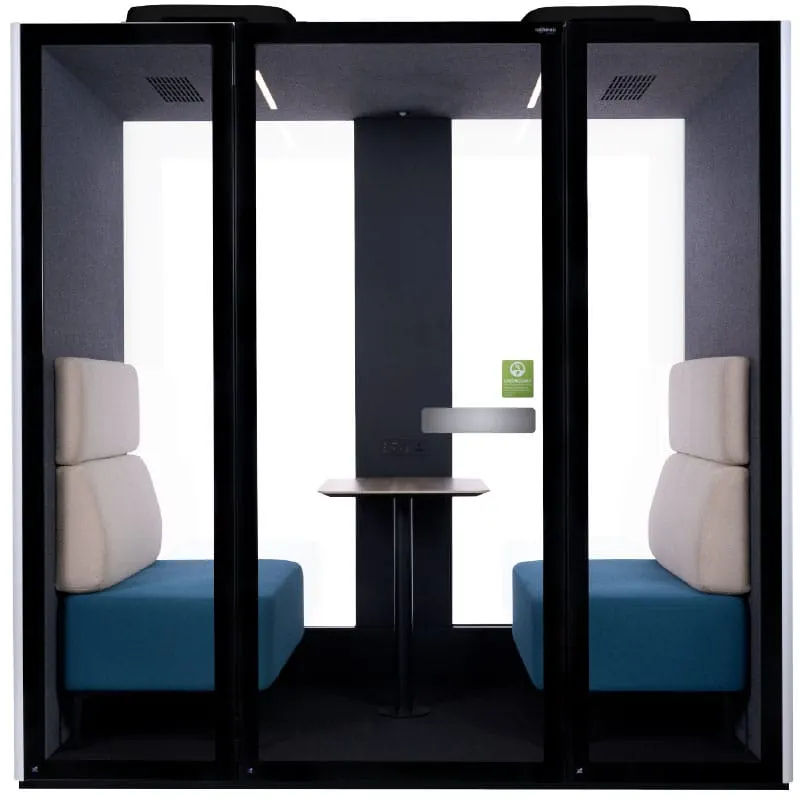
All sizes share the same basic equipment: besides the desk, sockets and network connection, there is a recessed LED light and two ventilators for fresh air. Ventilation matters more at a conference than it might seem: in a small room with four people the air soon turns stale if nothing replaces it. The manufacturer also states a UL GREENGUARD Gold certificate for the pods, which confirms low chemical emissions from the materials into indoor air.
Can a pod be moved from one hall to another?
It can, and that is one of its main advantages over a plasterboard room. According to the manufacturer, two people assemble a pod in about 60 minutes with basic tools, and it can be taken apart and set up somewhere else. In summer it can stand in the lobby for guests who work, and in autumn, when the conference season starts, move in front of the conference hall.
A move still needs planning. The two-person pod weighs 650 kg and the small meeting room 750 kg, so they are not pushed down a corridor but taken apart, carried and reassembled. Before the first order it is worth checking the width of the doors and lifts on the way between the halls and the floor capacity where the pod will stand. In the new spot all it needs is a 220 V socket nearby and, if you want a wired network, a network socket.
Is an acoustic pod the same as an interpreting booth?
No, and the organiser should hear that before counting on it. Booths for simultaneous interpreting have their own standard, ISO 4043 for mobile booths, with specific requirements for the view of the speaker and the screen, sound insulation, ventilation and equipment for interpreters. An acoustic pod for calls and meetings is not a replacement for them. If a conference needs simultaneous interpreting, the booths come from a conference technology or interpreting company.
It is also worth being honest about sound. The manufacturer states a reduction of 30 to 35 dB, and tested the S size by playing a song at 90 dB inside and measuring the level outside. Normal speech is about 65 dB, so a conversation in the pod comes down outside to roughly the level of a quiet room. That is enough for a calm conversation, but the pod is not completely soundproof: loud applause or music right next to it will still be heard, only much more quietly.
Why does a pod remain an asset for the hotel after the conference?
Conference organisers choose a hotel for its halls, rooms and technology, but also for the small things that make their day easier. A line in the hotel's proposal saying that the conference floor has a quiet small meeting room and two phone booths is a concrete advantage an organiser understands immediately. Between events the pods serve business guests, teams holding working meetings and guests who work on holiday. Colour and finish can be adapted to the hotel's interior. How a whole meeting room goes in without building walls is described in a meeting room without construction work.
Atrij works as an intermediary. We advise which pod suits which spot, prepare the presentation and the offer, coordinate delivery and installation with our partner supplier and follow the order through to the end. The pod is delivered and installed by the partner. The free presentation is done remotely: you send a floor plan of the conference floor or photos of the foyer and halls, and we suggest which pod and where, and send models, dimensions, photos and a video of the sound test. If useful, we also arrange a short video call. The pods can be bought, and rental can also be discussed. What to look for when comparing offers is covered in our guide how to choose an acoustic pod.